Academic Grammar & Tone: Polish Drafts Before Submission
Learn how to fix verb tense shifts, calibrate academic hedging, and cut conversational phrasing so your research draft reads like a publishable paper.

Key Takeaways: Reviewers judge clarity before they judge novelty. Locking down verb tense consistency across paper sections, replacing overconfident claims with calibrated hedging, and stripping conversational filler can lift a solid B-grade draft to publication-ready prose in a single focused revision pass.
1. Why Strong Ideas Still Lose Marks on Tone and Grammar
Every semester at the university writing center, I see the same frustrating pattern: a student spends six weeks designing an experiment or synthesizing twenty peer-reviewed studies, only to lose half a letter grade—or receive a "revise for language" decision—because the prose reads like an unedited lab notebook or a casual blog post. When a reader has to decode shifting verb tenses or mentally translate conversational idioms into formal claims, your argument loses authority before the evidence even gets a fair hearing.
Standard spellcheckers rarely rescue academic register. A green squiggle won't warn you that switching from past tense to present tense inside your Methods paragraph makes your procedure sound hypothetical, or that calling a correlation "proof" signals inexperience to a thesis committee. Pre-submission polish is not about making sentences sound pompous or artificially complex; it is about precision, predictability, and epistemic honesty.
2. Verb Tense Discipline Across IMRaD Sections
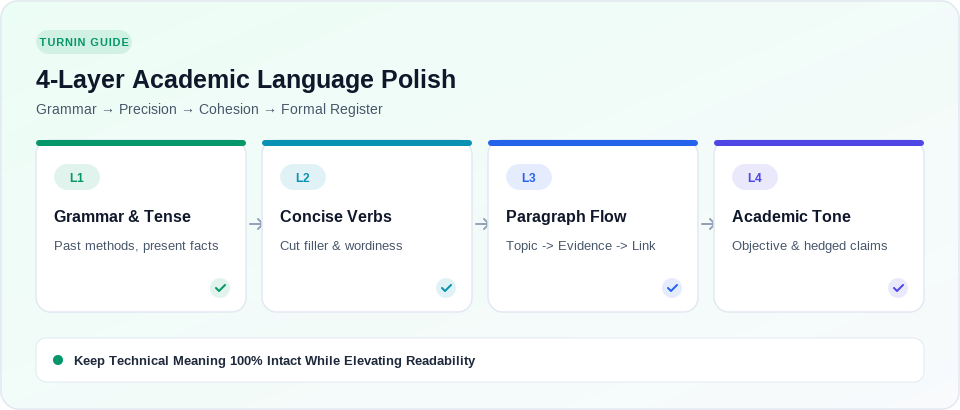
In empirical and analytical papers, verb tense is not a stylistic whim—it is a roadmap telling the reader whether an action happened in your specific study, reflects an ongoing scholarly consensus, or states an enduring principle. One of the fastest ways to make a manuscript feel disjointed is mixing past and present tense within the same paragraph when describing your own data.
Follow the standard IMRaD tense convention (Introduction, Methods, Results, and Discussion) as your default baseline, adjusting only when your discipline's style guide explicitly requires otherwise:
| Paper Section | Primary Verb Tense | What It Signals to the Reader | Example Sentence |
|---|---|---|---|
| Literature Review (Trends) | Present Perfect | Ongoing research momentum up to now | "Recent studies have linked sleep fragmentation to slower memory consolidation." |
| Literature Review (Single Study) | Simple Past | A specific completed experiment | "Patel et al. (2023) measured cortisol levels across 120 undergraduates." |
| Methods | Simple Past | Actions you performed in this study | "We stratified participants by baseline proficiency and recorded response latency." |
| Results (Data & Observations) | Simple Past | What your specific dataset showed | "The intervention group scored 11.4% higher on the delayed post-test." |
| Figures, Tables & Established Theory | Simple Present | Permanent visuals and accepted truths | "Table 2 summarizes the regression coefficients; higher variance reduces precision." |
Notice the crisp distinction in the bottom two rows. Your participants *scored* 11.4% higher (simple past, because that event occurred during data collection), while Table 2 *summarizes* those scores (simple present, because the table sits right in front of the reader every time the paper is opened). Aim for zero unmotivated tense shifts per paragraph: if a sentence moves from past to present, make sure you are intentionally pivoting from your local observation to a general principle.
3. Calibrating Hedging Language and Cutting Informal Clutter
Academic prose walks a narrow ridge between timid vagueness and reckless overstatement. International and domestic students alike often fall into the overstatement trap when trying to sound persuasive, reaching for verbs like *proves*, *guarantees*, or *totally eliminates*. In scholarship, single studies rarely *prove* a universal law; they *indicate*, *suggest*, *support*, or *demonstrate under specific conditions*.
Before-vs-After: Hedging Without Sounding Weak
Over-hedging ("It might possibly seem to perhaps suggest...") drains your argument, whereas calibrated hedging matches claim strength to your sample size and design:
- Before (Overclaimed): "These survey results prove that remote lectures destroy student engagement across all STEM majors."
- After (Calibrated): "These survey results suggest that unmoderated remote lectures are associated with lower self-reported engagement among first-year engineering students."
- Before (Informal & Vague): "A lot of researchers have talked about this huge gap, so we wanted to figure out what is going on."
- After (Formal & Precise): "Although prior studies have noted this empirical gap, the underlying mechanism remains underexplored; this study therefore examines how feedback timing shapes revision quality."
- Before (Conversational Filler): "Basically, the model didn't work out as well as we hoped because the dataset wasn't big enough."
- After (Publication Register): "Model accuracy remained limited (), likely reflecting the modest sample size () and class imbalance."
Practical Tone Thresholds to Audit Before Submitting
- Zero contractions and slang: Replace *don't*, *can't*, *a lot of*, *kind of*, and *pretty much* with full forms and concrete quantifiers (*substantially*, *frequently*, or exact figures).
- Maximum one hedge per clause: Stack *may* + *suggest* (not *might possibly tend to indicate*). Double or triple hedging reads as uncertainty rather than rigor.
- Purposeful passive voice: Keeping active voice at roughly 65%–75% in Introduction and Discussion paragraphs keeps agency clear ("We tested..."), while selective passive voice works well in Methods when the apparatus matters more than the operator ("Samples were centrifuged at 3,000 rpm").

4. A 5-Step Pre-Submission Polish Checklist
Run this sequence at least 24 hours before your deadline—fresh eyes catch rhythm and register slips that tired eyes skim right past:
- Run a section-by-section tense sweep. Highlight every main verb in your Methods and Results paragraphs. Confirm completed procedures stay in simple past while references to tables, figures, and established theory stay in simple present.
- Audit absolute claims and informal phrasing. Search your draft for *prove*, *always*, *never*, *obviously*, *a lot*, and contractions, replacing each with measured hedging and specific evidence.
- Eliminate mechanical grammar noise first. Paste your draft into Turnin's academic grammar checker to catch subject-verb agreement slips, dangling modifiers, and article errors (*a/an/the*) that distract human reviewers.
- Upgrade sentence flow and academic register. Use Turnin's AI-guided tutor polish workspace to compare stiff or conversational drafts against natural academic phrasing, checking each suggested edit to make sure your original meaning stays intact.
- Run a final holistic readiness and integrity check. Review argument coherence, citation alignment, and structural rubric fit with Turnin's academic paper evaluation tool, and if you also review similarity or AI-writing indicators via the Turnin pre-submission check, treat every metric strictly as a guide for responsible, honest revision. Always remember that Turnin is an independent study and editing platform—your university's official submission and integrity system always has the final word.
5. Frequently Asked Questions
Should I avoid first-person pronouns like "I" and "we" in academic writing?
Not anymore, unless your professor or target journal explicitly prohibits them. Most modern APA, IEEE, and life-science style guides prefer active first-person ("We excluded three outliers") over awkward third-person circumlocutions ("The present authors excluded..."). Just keep the focus on the research choices rather than personal feelings.
How much hedging is too much hedging in a research paper?
Use one clear qualifier per claim—such as *suggests*, *appears to*, *is consistent with*, or *under these conditions*—and let your numerical evidence carry the rest. Stacking multiple hedges in a single sentence ("It could possibly be argued that this might suggest...") makes your conclusions sound unsupported even when your data are strong.
Can I rely on Turnin's grammar and evaluation scores to guarantee an A or clear my school's check?
No automated tool can guarantee a grade or replace human judgment. Turnin's grammar, tutoring, and evaluation tools help you spot register slips, structural gaps, and passages that need clearer attribution before submission, but your instructor's rubric and your university's official plagiarism or integrity system always prevail.