AI Math & STEM Solvers: Verify Steps Without Blind Copying
Use step-by-step AI solvers for math, physics, and statistics responsibly by auditing units, boundary conditions, sign errors, and LaTeX before submission.
Key Takeaways: Step-by-step AI solvers are powerful study companions for calculus, physics, and statistics, but they still make silent algebra sign flips, drop physical units, and break LaTeX syntax. Auditing dimensional consistency, boundary conditions, sign rules, and final formatting turns raw solver output into verified understanding you can defend on exams.
1. Why Blindly Copying AI Math Steps Costs You Points
Every STEM teaching assistant recognizes the telltale signature of an unverified AI solution: tidy typography, confident transition phrases like *"clearly, it follows that"*, and a subtle algebra mistake on line four that silently propagates into an impossible physical answer—such as a negative probability, a bridge carrying imaginary tension, or a car accelerating faster than light.
In university mathematics, physics, engineering, and statistics courses, partial credit lives inside the intermediate reasoning. Copying steps without auditing them hurts you twice: you lose points on homework when a grader spots a flawed substitution, and you walk into closed-book midterms unable to reconstruct the derivation yourself. The smarter approach is treating an AI solver the way you would treat a sharp study partner—helpful for unsticking a tough integral or checking a hypothesis-test setup, yet always subject to your own line-by-line verification.
2. The Four-Point Technical Audit: Units, Signs, Limits, and LaTeX
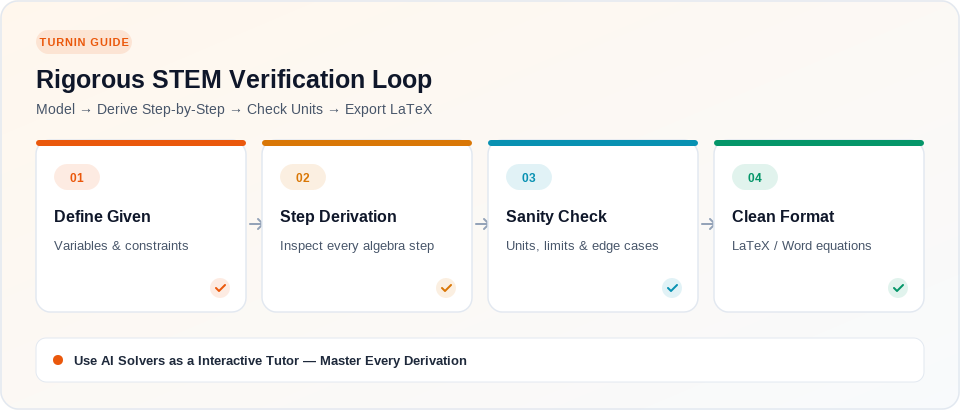
Before you accept any step-by-step derivation, run a four-point technical audit. Experienced physicists and engineers do these sanity checks automatically because they catch over 90% of mechanical errors in seconds—without forcing you to re-derive the whole problem from scratch.
| Verification Check | Common AI Solver Failure | Quick Self-Test | Concrete Example |
|---|---|---|---|
| Dimensional Analysis | Dropping constants like or mixing with | Track units on both sides of the final expression | Checking gives , not |
| Boundary Conditions | Invalid simplifications at endpoints or asymptotes | Plug in , , or | Drag force must vanish when ; -value must stay inside |
| Algebra & Sign Flips | Distributing negatives wrong or forgetting inequality reversals | Test with a simple non-zero number like | Expanding must yield , not |
| Domain & Mode Checks | Using degrees instead of radians or dividing by | Verify angle units and check denominator roots | holds only when is in radians |
| LaTeX Formatting | Missing braces, unescaped %, or ambiguous fraction grouping | Render to PDF and inspect nested exponents/fractions | \frac{1}{2}x vs \frac{1}{2x} changes whether sits in the numerator |
Notice how little time each check takes. Testing in the original expression and the simplified expression catches almost every sign flip or dropped coefficient immediately. Likewise, plugging or into a closed-form formula exposes broken boundary behavior long before a grader circles it in red.
3. Before-and-After Walkthrough: Catching Subtle Errors in Practice
Suppose you are solving a first-order RC circuit problem or a kinematics problem, and an AI solver hands you a neat derivation for the time needed for a quantity to reach half its peak value, or asks you to simplify an inequality for a statistics confidence interval. Consider this realistic before-vs-after audit on an algebra-plus-units step:
- Before (Unverified Solver Output):
To solve for a control threshold, the draft writes:
.
*What went wrong?* Two classic bugs hid inside two lines: first, equals , not ; second, dividing an inequality by must flip > to <. Both mistakes look visually plausible at a glance.
- After (Audited & Corrected Submission):
Distributing the negative carefully gives , so . Dividing both sides by reverses the inequality sign, yielding . *Quick sanity check:* Pick (which satisfies ) and plug it into the original inequality: . Validated in five seconds.
Apply the same discipline to statistics and LaTeX write-ups. When checking a -score or standard error formula such as , confirm two practical thresholds:
- Test at least two independent values (one typical interior point and one edge/limiting case) whenever a solver gives a symbolic simplification.
- Verify unit and scale consistency at every stage—if a sample size quadruples, your standard error must halve, and your confidence interval width must shrink accordingly. If your final formula grows wider as increases, a square root ended up in the numerator by mistake.

4. Your 5-Step Responsible Solver Workflow
Use this five-step routine whenever you work through problem sets, lab reports, or quantitative methods sections:
- Attempt the setup on paper first. Write down knowns, unknowns, coordinate axes, and target units before opening any solver; this builds the exam muscle memory no tool can replace.
- Inspect intermediate steps with a structured solver. When you hit a wall, run the problem through Turnin's step-by-step math and STEM solver and read each line actively—ask *why* each substitution or theorem applies rather than skipping straight to the boxed answer.
- Execute the four-point audit. Check dimensional units, test boundary/edge cases (, , ), plug in a test number to catch sign flips, and verify radian vs. degree assumptions.
- Clean up your notation and LaTeX. Organize derivations, variable definitions, and formatted equations inside Turnin's academic paper and formatting tools, rendering the final formulas so braces, subscripts, and fraction bars read unambiguously.
- Confirm integrity and course compliance before turning it in. Rework the clean solution in your own logical flow and manage your final pre-submission review inside the Turnin student workspace. Always check your syllabus rules on AI study aids, and remember that Turnin is a learning and self-verification tool—your university's official grading and academic integrity system always prevails.
5. Frequently Asked Questions
Does using a step-by-step solver violate my university's academic integrity policy?
Policies vary by course and instructor. Many departments allow AI or symbolic solvers for practice and self-checking while prohibiting verbatim copying on graded problem sets or take-home exams. Check your syllabus first, treat Turnin as a tutor to verify your own reasoning, and submit only work you genuinely understand and can reproduce independently.
How can I catch a subtle algebra sign error without redoing the entire problem from scratch?
Use numerical spot-checking. Pick an easy test value that avoids and (such as or ) and evaluate both the original equation and the final simplified line. If the numbers disagree, binary-search the middle line of your derivation to isolate the exact step where the sign or factor broke.
What should I check in LaTeX output before exporting a lab report or problem set to PDF?
Compile the document and visually inspect three common failure points: mismatched curly braces inside \frac{...}{...}, exponents accidentally attached only to the first digit (e^-2t instead of e^{-2t}), and upright units versus italicized variables (write \text{m/s} rather than m/s inside math mode).