
Source attribution is often lost during a handoff: a quotation is pasted into notes, a note becomes a draft sentence, or a paragraph moves away from its citation. Preventing accidental plagiarism means protecting those transitions rather than waiting for a report to expose missing information. Intent does not replace accurate acknowledgment; any academic consequences depend on the applicable institutional process and rules.
Set up the task and source trail
Read the assignment, rubric, source requirements and citation style. Confirm what collaboration, language assistance and AI use are permitted. Plan a working answer and the evidence needed to support it. Keep enough time to review the complete argument and actual upload file, not merely run a checker before the deadline.
For every source you consult, save its publication identity and retrieval information. Record the relevant real location beside the evidence. The University of Toronto’s guidance on avoiding plagiarism recommends clear recordkeeping and marking exact words in notes. These habits make it possible to distinguish your thinking from material encountered during research.
Protect the handoff from source to notes
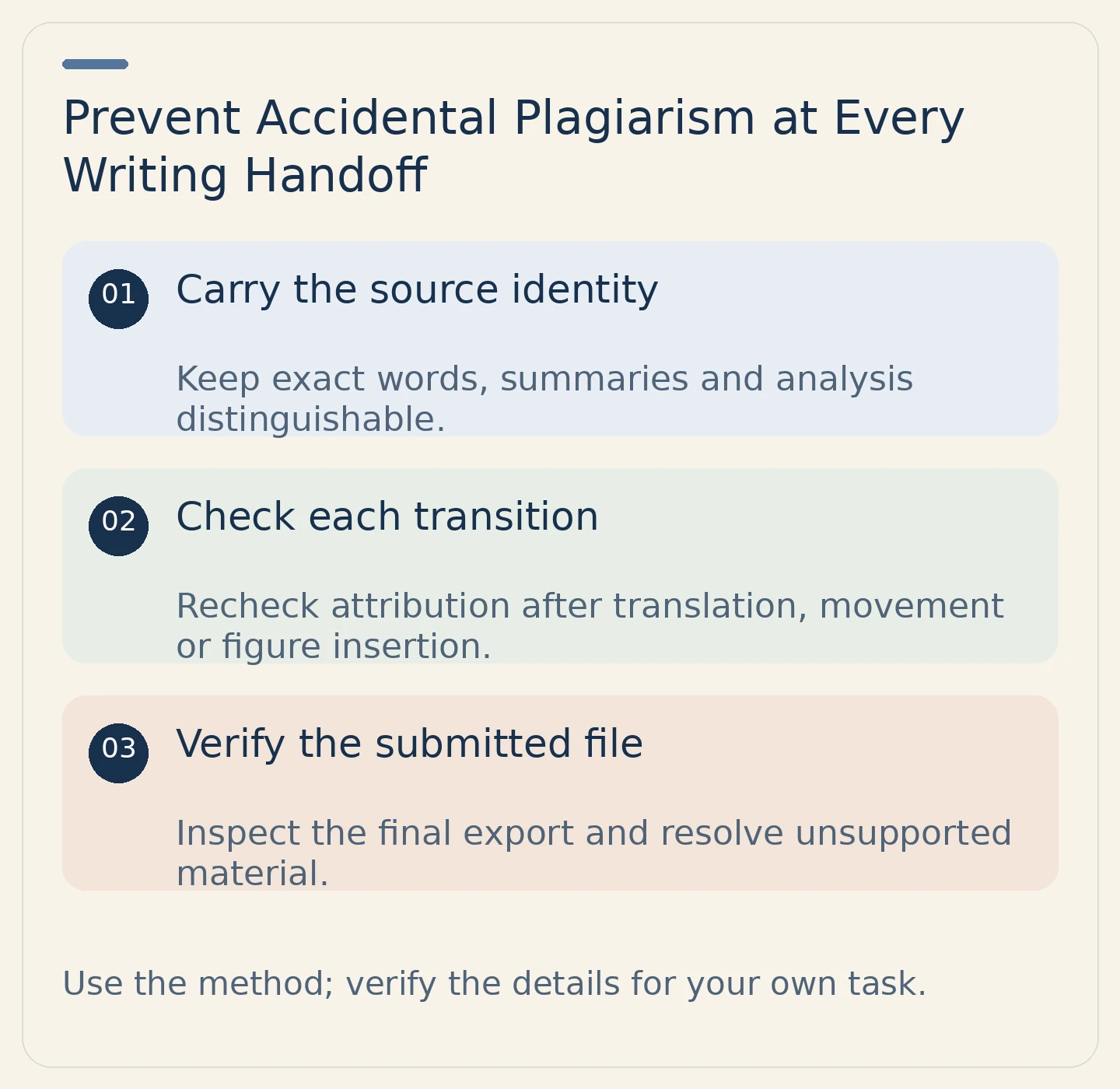
Put copied words in quotation marks immediately and label them as exact wording. Store your summary separately, with the same source identity. Use a third space for your analysis, questions and possible applications. A colored highlight alone may not survive copying to another document, so keep a textual label too.
Do the same for data, images, tables and course materials. A chart saved without its source and definitions can become as difficult to document as an unattributed paragraph. Do not assume that material found online is free of acknowledgment or permission requirements.
Protect the handoff from notes to draft
Draft around the claim you need to develop. Explain the source idea from understanding, compare with the original and cite it. If you retain distinctive wording, use quotation formatting as required. Mechanical word replacement is not an adequate substitute for independent expression.
| Handoff | Common failure | Preventive action |
|---|---|---|
| Copying into notes | Source words lose quotation marks | Mark exact text and location immediately |
| Notes into draft | A summary appears to be your discovery | Carry source identity into the sentence |
| Across languages | Translation is treated as original authorship | Cite the underlying source and check meaning |
| Moving paragraphs | A citation stays behind or changes scope | Re-map each borrowed claim after the move |
| Adding figures | Data origin or adaptation is unclear | Record data, source and applicable permission checks |
| Exporting | Notes or citations disappear from the upload file | Inspect the actual export before submission |
Recheck when structure or language changes
A citation at the end of one paragraph may become ambiguous after you combine it with another. Read the new paragraph as a stranger: can you tell which author supports each point and where your analysis begins? Restore source boundaries with appropriate citations and reporting phrases, not a guessed reference at the end.
Illustrative example: a sentence beginning “The author suggests…” is moved below a different source’s quotation. The pronoun now appears to refer to the wrong person. Naming the actual author and checking the citation scope repairs a problem that punctuation alone would not reveal. This is an invented editing example, not a report of a real incident.
Language edits need the same attention. Preserve the source’s object, scope, negation and uncertainty. Translating someone else’s argument does not make it yours, and a fluent rewrite may still distort what the source established.
Stop when you cannot recover the source
Put unverifiable material aside while you search your records and the actual publications. If support cannot be found, remove the claim or replace it with evidence you can verify. Do not invent a page number, cite a plausible title or pretend you read an original work through a secondary account. Follow the assigned rules for secondary citation when that is the honest route.
Keep AI-use records and disclosures according to the task’s policy. A statement does not authorize prohibited assistance, and a report score cannot decide whether a particular use was allowed.
Use checks to confirm, not conceal
If your course permits report access, inspect meaningful Turnitin matches against their context and actual sources. Its student guide explains that similarity is not a plagiarism judgment. Legitimate borrowing can match; unattributed ideas may require attention even without a highlight. Do not delete necessary references or manipulate text to change the number.
Finish by checking the argument, factual support, quotation accuracy, citation-reference requirements and readability. Inspect captions, footnotes and references in the final export. Upload the correct file through the designated route and retain the confirmation and genuine records. Turnin offers supplementary guidance, not official Turnitin access or institutional approval.
Related practical guides
For a separate evidence check, use the citation readiness guide; for the final handoff, use the pre-submission checklist. These are supplementary resources, not your institution’s submission system or policy.
Sources and scope
Further reading: University of Toronto: How Not to Plagiarize; University of Toronto: Using Quotations; Turnitin: Understanding the similarity score for students. Institutional examples apply to their own settings; follow the requirements governing your work.