
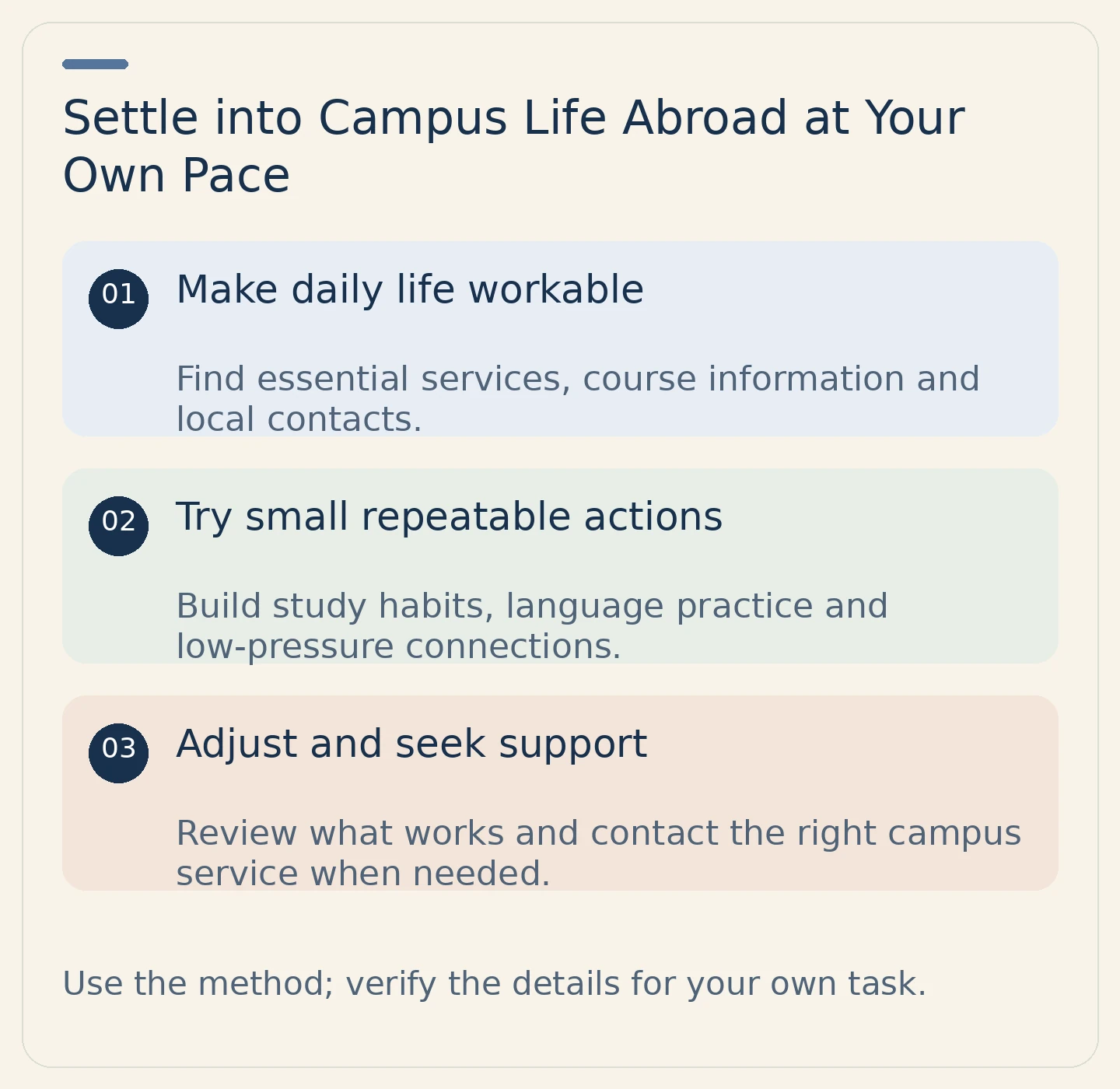
Arriving at a new campus can be exciting, tiring, confusing or several of these at once. You do not need to feel settled by a particular date or follow the same emotional path as other students. Aim first to make daily life workable, understand your courses and identify people who can help. Relationships and confidence can develop through small, repeatable actions.
In the first week, make a usable campus map
Attend the orientation sessions relevant to your situation, including any alternatives offered when schedules conflict. Locate the teaching spaces, library, student services and official course platform. Check how your institution communicates important notices so you do not rely only on informal group chats.
Build a contact list from official university pages. Save office names, current contact routes, opening arrangements and what each office handles. Do not copy emergency numbers or service promises from a guide for another country or campus.
| Need | Likely starting point to verify locally |
|---|---|
| Course expectations or assessment questions | Instructor, teaching assistant or academic adviser |
| Reading, research or referencing support | Library or academic learning service |
| Housing problems | Accommodation or residence office |
| Budget questions or financial difficulty | Student finance or student support team |
| Disability-related study arrangements | Accessibility or disability support service |
| Emotional or wellbeing support | Student wellbeing, counseling or the institution’s referral service |
| Immediate safety concerns | The locally appropriate emergency route and campus security information |
Names and responsibilities vary. If you reach the wrong office, ask who owns the issue and how to contact them. This is a navigation tool, not a substitute for professional or emergency advice.
Over the next few weeks, learn how your courses work
Read the syllabi and rubrics. Check participation expectations, deadlines, office hours, group-work rules and citation conventions. A familiar subject may be taught or assessed differently from your previous experience; ask about the specific requirement rather than assuming a national education system has one uniform style.
Take one focused question to office hours. For example: “The rubric asks for evaluation; what distinguishes that from description in this assignment?” Prepare by reading the instructions first and bring the relevant passage. Record the answer and use it in your study plan.
Set up a weekly routine that includes reading, class preparation, independent work and practical responsibilities. Study groups can help you discuss concepts, but check where permitted discussion ends and individually assessed work begins.
Make language practice specific and manageable
Identify situations that are difficult: following a fast discussion, asking for clarification, reading specialist vocabulary or understanding everyday conversation. Practice the situation rather than treating “improve my language” as one enormous task. Prepare a question before class, keep a terminology list or join an approved language exchange.
You do not need perfect wording to ask someone to repeat or explain a point. For assessed writing, use authorized language support and keep responsibility for meaning and citations. Rules for translation, proofreading and AI assistance must be checked in the actual course.
Build connections without making sociability a test
Choose an activity you genuinely want to try, such as a small club meeting, shared-interest workshop or volunteering session. Repeated contact can make conversation less demanding than attending a different large event every evening. Starting with a practical question or offering to join a small task is a legitimate way to participate.
Illustrative option, not a student testimonial: attend one society session, introduce yourself to the organizer and ask when the next meeting takes place. You can leave after the planned activity without measuring success by how many friends you made. Keep connections with people from home while allowing room for relationships across backgrounds; neither requires rejecting the other.
Make independent living more predictable
Learn the routes you actually use and check current transport information. Make a workable budget using your own housing, food, travel and study costs. Establish a few reliable meals and routines rather than attempting to master everything at once. Use official campus information for healthcare access, insurance requirements and safety procedures relevant to your location; this guide does not supply medical, legal or insurance advice.
Seek support when you need it, not after a fixed waiting period
The University of Saskatchewan’s culture-shock guidance discusses patience, maintaining connections and seeking help. Its services are specific to that institution, but the general reminder is useful: adjustment is not something you must manage alone. Homesickness or difficult days do not establish that you made the wrong decision.
If distress is interfering with daily life, contact the appropriate wellbeing or student support service for guidance. Do not diagnose yourself from a checklist or wait for an internet timetable to say you should have recovered. As life becomes more stable, revisit what is working, adjust your commitments and keep the support map current.
Related practical guides
For unfamiliar academic expectations, browse English academic writing guides. Before your first coursework upload, use the pre-submission checklist alongside the instructions for your own course.
Sources and scope
Further reading: University of Saskatchewan: Dealing with culture shock. Institutional examples apply to their own settings; follow the requirements governing your work.