
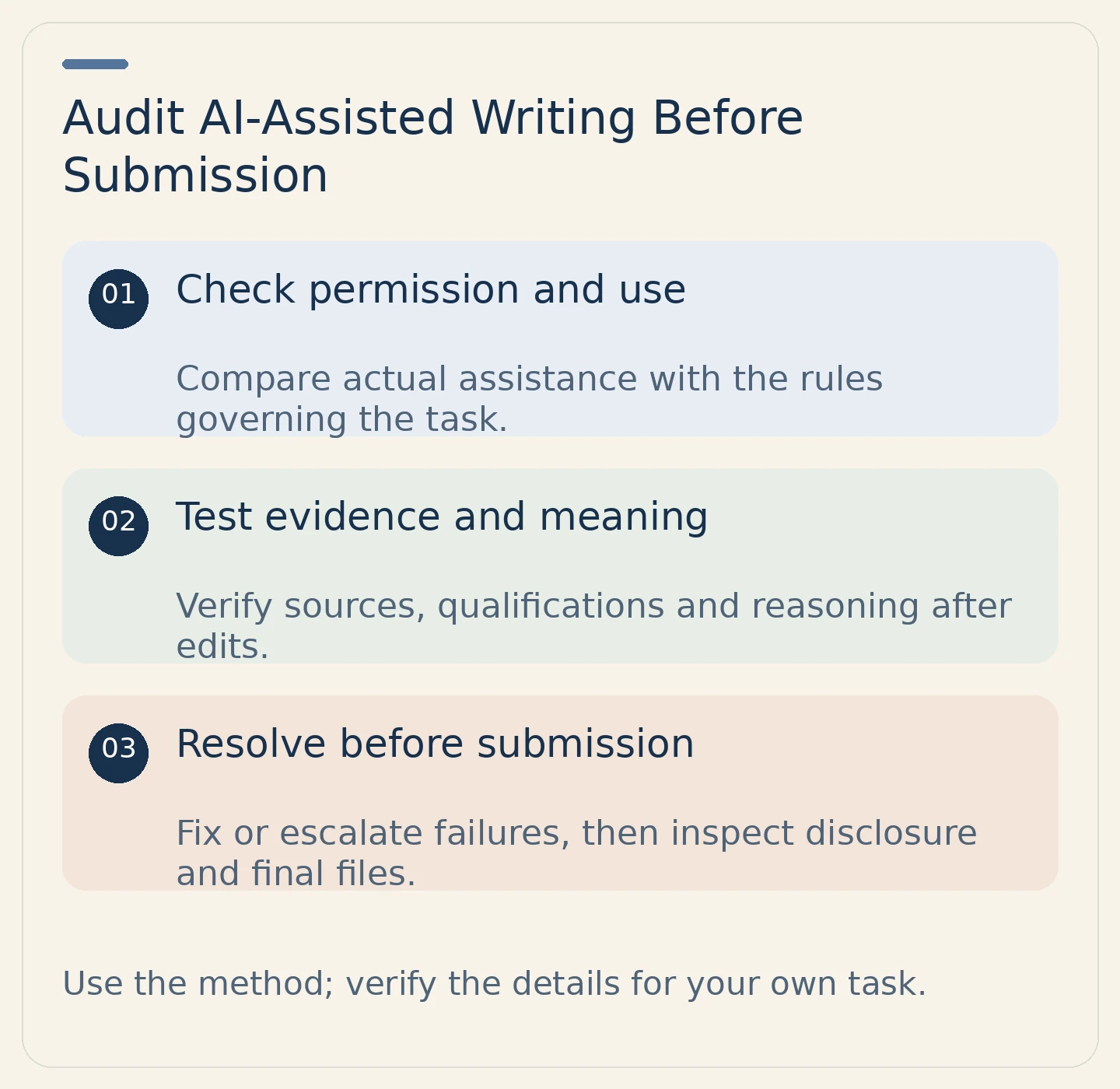
A useful integrity audit does not ask only whether the writing is fluent or a report looks reassuring. It asks whether the assistance was permitted, whether the claims are supported and whether the submitted work accurately represents your contribution. Review these dimensions separately so that success on one does not hide failure on another.
Establish the applicable permission
Read the current task, syllabus and relevant institutional or publisher guidance. Identify permitted uses and disclosure requirements. Do not assume that proofreading, translation, outlining and substantive content generation fall under one permission. If the rules are unclear, ask the responsible instructor or supervisor about the actual activity.
Make a factual account of use from genuine records: tool, date or period, task, sections affected, suggestions retained and checks performed. This is not a declaration template; it is the information needed to decide whether the paper and its disclosure are accurate. Do not claim that assistance was language-only if it affected reasoning or evidence selection.
Use a check–evidence–action audit
| Check | Evidence to inspect | Action if unresolved |
|---|---|---|
| Permission | Assignment instructions and relevant clarification | Ask before treating the use as compliant |
| Actual involvement | Genuine prompts, outputs, notes and drafts | Describe uncertainty honestly; do not invent records |
| Source identity | Real publication or data record | Hold unsupported references until verified |
| Claim support | The actual passage, data or material | Narrow, replace or remove an unsupported claim |
| Meaning after edits | Original source and changed sentence | Restore qualifications and correct distortion |
| Your reasoning | The argument you can explain | Rebuild missing analysis from actual reading |
| Disclosure | Required form, wording and location | Correct the statement to match actual use |
| Final version | The submitted file and attachments | Regenerate or replace only under the allowed process |
An unresolved central evidence problem is not repaired by ticking the disclosure box. Likewise, a carefully cited paper may still involve assistance outside the task’s rules. Keep each issue visible until it is resolved or referred through the appropriate process.
Verify the evidence rather than the appearance of references
Locate and read every source used for an important claim. Check its identity, version and actual support for the sentence. A DOI that resolves or a search result containing the title is not enough. When a reference cannot be verified, set it aside while investigating; do not cite a plausible work simply because it appears related.
Compare direct quotations with the original, supply real locators as required and distinguish paraphrases from your own analysis. University of Toronto guidance on avoiding plagiarism explains why borrowed ideas need acknowledgment even when expressed differently. A generated summary does not replace reading the underlying evidence.
Inspect what accepted suggestions changed
Read edited passages against the evidence and your intended argument. Look for a narrower population becoming “all students,” a possibility becoming a certainty, an association becoming a cause or an author’s position becoming your own unmarked conclusion. Check captions and reference details as well as body paragraphs.
Illustrative example: a language suggestion changes “the evidence is consistent with” to “the evidence proves.” Even if the new wording sounds stronger, it may be inaccurate. Restore the appropriate limit and inspect nearby claims for the same change. This is a teaching example, not an account of a particular tool’s tested behavior.
Confirm your contribution and the disclosure
Explain each section’s purpose and why its evidence matters. If you cannot explain an adopted argument, return to the materials and rebuild your reasoning rather than submitting unfamiliar text. Verify any code, calculations or classification with methods suitable for the project and describe only checks actually performed.
The MLA’s guidance distinguishes acknowledging substantive AI involvement from merely citing an output. Use the applicable course or publication instructions to decide the required form and location. If use exceeded permission, consult the responsible authority honestly. A declaration or a cosmetic rewrite does not automatically make the prior use acceptable.
Keep reports in their proper role
If Turnitin report access is permitted, inspect similarity matches in context. Its official guidance distinguishes matching from a plagiarism judgment. The AI Writing Report is separate; Turnitin warns that its model can be wrong and should not be the sole basis for adverse action. Neither output establishes factual accuracy, permitted use or complete disclosure.
Do not assume every paper receives an AI indicator or that your institution enables the feature. Avoid uploading confidential or restricted material to unapproved services while seeking reassurance.
Close the audit with a real file check
Check the whole argument, readable language, required citations and disclosures, and the actual exported document. Inspect footnotes, figures, references and attachments before uploading through the authorized route. Retain genuine process materials and confirmation. If an important problem remains unresolved near the deadline, use the designated support procedure rather than manufacturing evidence or claiming the audit is complete. Turnin does not provide institutional approval or guaranteed detection outcomes.
Related practical guides
For a separate evidence check, use the citation readiness guide; for the final handoff, use the pre-submission checklist. These are supplementary resources, not your institution’s submission system or policy.
Sources and scope
Further reading: University of Toronto: How Not to Plagiarize; MLA: Beyond Citation: Describing AI Use in Your Work; Turnitin: Understanding the similarity score for students; Turnitin: Using the AI Writing Report. Institutional examples apply to their own settings; follow the requirements governing your work.