
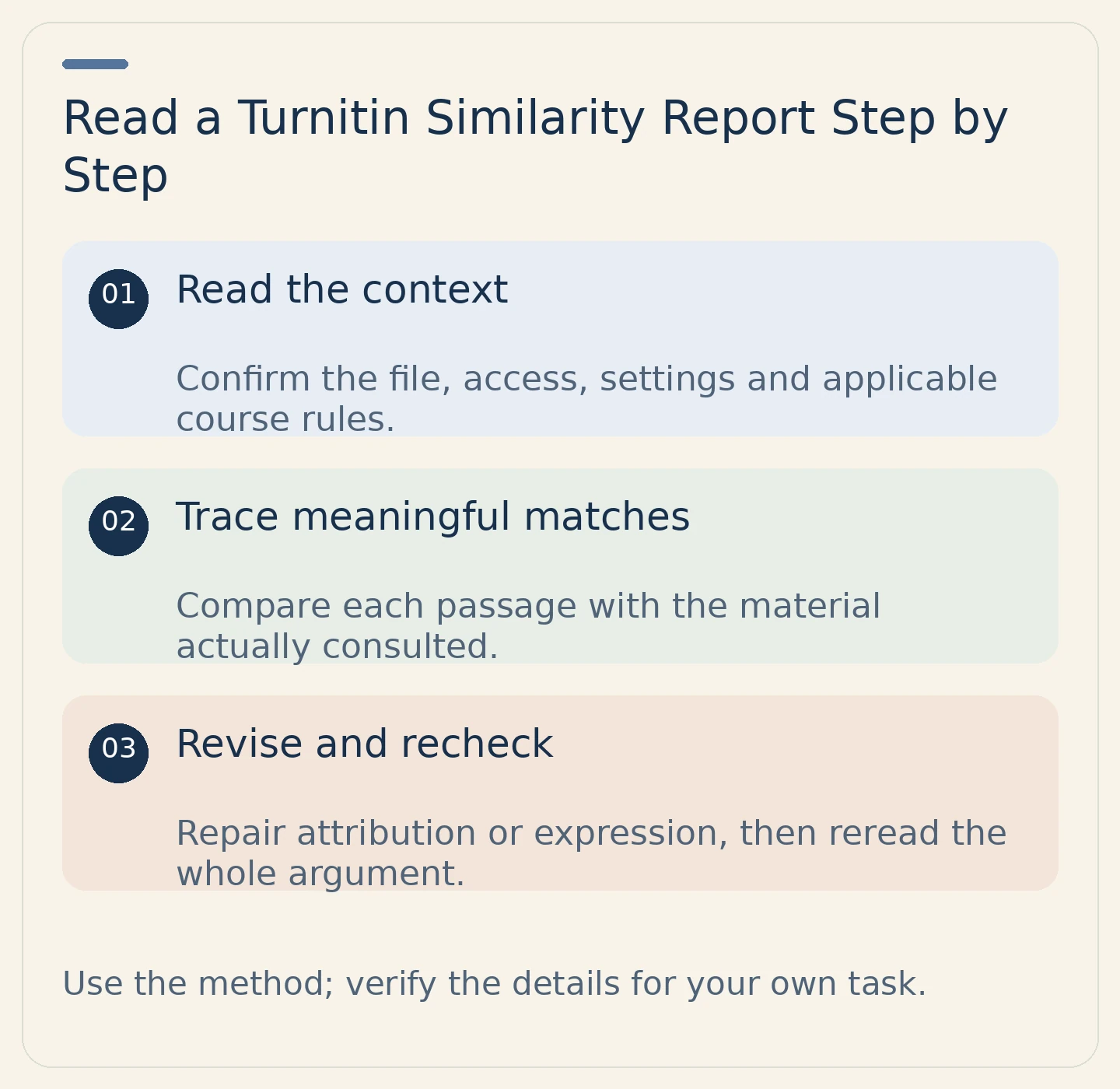
The first useful question when opening a Similarity Report is not “Is this number safe?” It is “What matched, why, and how did I use that material?” Read the report as a route into the paper and its sources. A careful review connects highlighted wording to quotation, paraphrase, citation and your own reasoning, then returns to the complete draft.
Check the report context first
Confirm that the report belongs to the intended file and assignment. Read the course instructions about student access, draft checks and resubmissions. Note any visible exclusions or settings that affect interpretation; do not assume you control them. If something is unavailable or processing, consult the actual interface guidance or instructor rather than assuming a fixed waiting time.
Turnitin’s official student guide explains that similarity is not a plagiarism judgment. Correct quotations and references can match. There is no universal acceptable percentage independent of the assignment and local expectations. A lower result also cannot establish that ideas are properly attributed or evidence is accurate.
Move from the overview to passages
Use the overall result to orient yourself, then inspect the meaningful matches and source information available in your report. Pay attention to concentrated borrowing, but do not label a passage unacceptable solely because of its size or color. A necessary quotation and an unmarked copied passage require different decisions.
Read the surrounding paragraph before changing anything. Determine what the passage is doing: defining a term, presenting evidence, summarizing a source or making your own analysis. You need that function to choose an appropriate correction.
| Match type | What to inspect | Possible action |
|---|---|---|
| Quotation | Exact wording, visible quotation formatting, citation and purpose | Correct formatting or retain a justified quotation |
| Paraphrase | Meaning, sentence structure and attribution | Redraft from understanding and verify against the original |
| Reference entry | Bibliographic identity and required format | Correct errors; do not remove a necessary source |
| Required wording | Course instructions and the role of the template | Retain what is required and ask about report interpretation |
| Unattributed borrowing | Where the words or idea came from | Recover the source, attribute it and correct expression |
| Earlier work | Whether the match is a draft or a separate submission | Ask about repository context and applicable reuse rules |
Distinguish the matched source from the consulted source
The source displayed by a matching system is not automatically the original author or the material you actually read. Several websites or publications may contain overlapping language. Do not rewrite the reference list merely to match the report’s displayed source.
Trace the idea through your notes to the material consulted. Read the relevant passage and check its publication identity, version and location. If you only encountered an original author through a secondary source, obtain the original if possible or use the required secondary-citation convention. Do not pretend a matching link establishes firsthand reading.
When several sources overlap with one passage, investigate the wording and attribution rather than treating each display as an independent wrongdoing. What matters is whether your own use of the material is accurate, appropriately expressed and transparent.
Repair a mixed-source paragraph
Illustrative example, not actual research: a teaching paragraph combines one source’s definition with another source’s criticism, then ends with a single citation. Even if the wording is independently written, the reader may not know which source supports which point. Introduce the definition’s source and the critic separately, then identify your own comparison as interpretation.
When revising a close paraphrase, reread for meaning, set the source aside and explain the point in a structure suited to your argument. Compare the result with the source for accuracy and retained distinctive wording. Add the citation. University of Toronto guidance supports acknowledging both paraphrases and quotations rather than relying on a bibliography alone.
Recheck the argument after correcting matches
A revised sentence can change citation scope, the paragraph’s logic and the strength of the conclusion. Reopen adjacent sentences and verify that claims still follow from evidence. Do not introduce extra examples, stronger causal language or unsupported claims just to create distance from the source wording.
An AI Writing Report, if enabled and available, is separate from similarity. It is not another matching-source list or proof of misconduct. This first report-reading routine does not require guessing how an AI detector works.
Finish beyond the highlights
Review unhighlighted claims, borrowed data and figures too. Confirm required citation-reference correspondence, actual locators and quotation accuracy. Read the paper for task alignment, transitions and understandable terminology. Check permitted assistance and disclosures, inspect the final file, submit through the designated route and retain the confirmation. Turnin is supplementary writing support, not official Turnitin or a replacement for your institution’s process.
Related practical guides
For a separate evidence check, use the citation readiness guide; for the final handoff, use the pre-submission checklist. These are supplementary resources, not your institution’s submission system or policy.
Sources and scope
Further reading: Turnitin: Understanding the similarity score for students; University of Toronto: How Not to Plagiarize; Turnitin: Using the AI Writing Report. Institutional examples apply to their own settings; follow the requirements governing your work.