
Using several references does not automatically produce synthesis. A paragraph can cite many authors and still be a list of summaries. Synthesis begins when you compare what sources contribute to the same question and explain their relationship in your own argument. You can do this in an ordinary essay without turning the entire assignment into a literature review.
Plan the full paper before combining sources
Read the question, rubric, source requirements, citation style and submission instructions. Confirm the permitted scope of assistance and report access. Write a working answer and outline the reasons supporting it. Identify where one well-chosen source is enough and where comparing several perspectives would genuinely advance the answer.
Research selectively. For each source, save its identity, version and real locations. Keep exact quotations, summaries and your analysis separate. Read enough context to understand definitions, evidence and qualifications before extracting a convenient conclusion.
Compare sources on a common question
Choose the paragraph’s question first. Then extract the information needed to answer it from each source. Do not assume that sources using the same keyword mean the same thing or that different results are direct contradictions.
| Comparison field | What to ask | Writing consequence |
|---|---|---|
| Definition | Do the sources define the central concept similarly? | Explain a difference before comparing conclusions |
| Object and setting | Are they discussing comparable material or populations? | Limit any shared claim to the relevant scope |
| Evidence or method | How does each source support its position? | Compare the basis for the conclusions |
| Claim and qualification | What does each establish, and what does it leave open? | Preserve uncertainty and avoid false consensus |
| Relationship | Do they agree, differ or address complementary questions? | Choose the actual relationship as the paragraph’s focus |
This matrix is a thinking aid, not evidence by itself. Keep a route back to the passages behind every entry. If a cell is unclear, return to the source rather than filling it with an assumption.
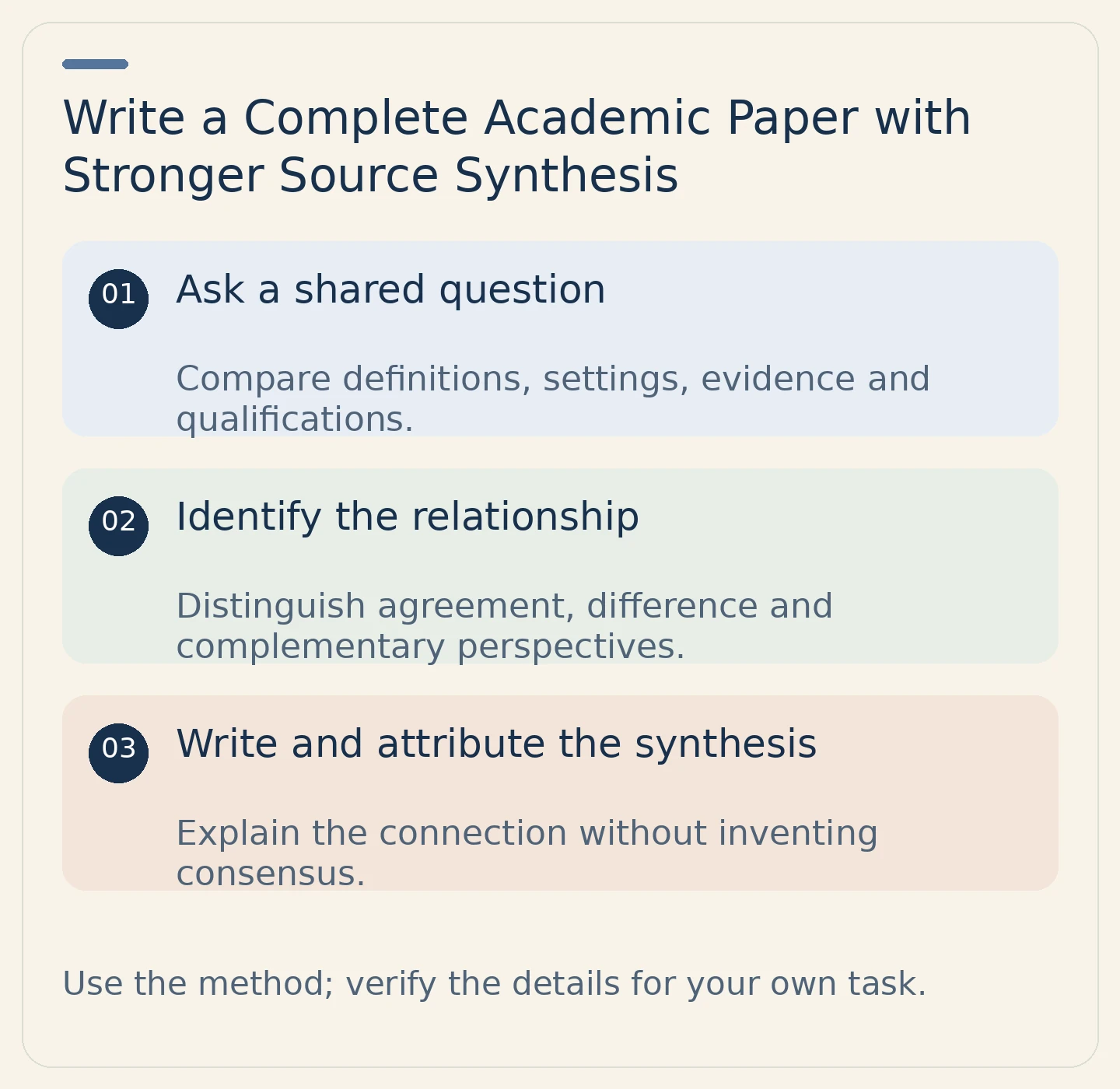
Move from comparison to an analytical paragraph
Begin with the point that matters to your essay. Introduce the relevant source contributions, explain their relationship and state what that comparison means for your argument. Your own reasoning provides the connection; it should not be presented as another source’s reported finding.
Illustrative example, not a real research summary: teaching source A discusses the speed of feedback, while teaching source B discusses its specificity. A weak synthesis says “all research shows feedback is effective.” A more accurate account says the teaching sources address different dimensions of feedback, so evaluating a proposed practice requires considering what kind of improvement is being claimed. The example does not establish that either dimension improves outcomes.
In actual writing, use real sources and citations for the contributions you describe. If you need an outcome claim, find evidence that addresses it. Do not treat a useful conceptual comparison as a substitute for empirical support.
Keep attribution visible when several sources meet
A grouped citation is appropriate only when readers can understand what each source supports. If one author supplies a definition and another disputes an application, introduce those roles separately. Avoid putting a cluster of references after a sentence containing several claims and assuming every reference supports all of them.
Paraphrase from understanding and check the result against the source. Keep important qualifications and established terms. Quote exact wording when necessary, with the required formatting and real locators. University of Toronto guidance on source acknowledgment makes clear that independent wording still needs attribution when the idea is borrowed.
Review the entire argument, not just the synthesis paragraph
Once the paragraph is drafted, reconnect it to the paper’s thesis. Has the comparison changed your position or revealed a limit? Update the introduction and conclusion if necessary. Remove repetitive summaries elsewhere so the new paragraph adds reasoning rather than more length.
Audit citations and references using the assigned style. Verify that every important claim is supported by the actual material consulted; source existence and correct formatting are separate from evidential fit. If an original work was only encountered through a secondary source, represent the route honestly.
Use report feedback and finish the file
If allowed, inspect Turnitin matches in context. Its student guide explains that similarity is not a plagiarism judgment. Correct overly close wording or missing attribution, but do not remove relevant references or replace accurate terms merely to alter the percentage. A low score cannot prove successful synthesis.
Read for clear transitions and proportionate conclusions, check permitted assistance disclosures, and inspect the actual export, including figures and references. Upload the intended version through the authorized route and retain confirmation and genuine records. The goal is a complete paper whose sources illuminate your reasoning rather than obscure it.
Related practical guides
For a separate evidence check, use the citation readiness guide; for the final handoff, use the pre-submission checklist. These are supplementary resources, not your institution’s submission system or policy.
Sources and scope
Further reading: University of Toronto: How Not to Plagiarize; University of Toronto: Using Quotations; Turnitin: Understanding the similarity score for students. Institutional examples apply to their own settings; follow the requirements governing your work.