Write Stronger Abstracts, Intros & Lit Reviews Using CARS
Master the 5-sentence structured abstract, Swales' CARS funnel for introductions, and thematic literature reviews with ready-to-use templates and before-and-after edits.

Key Takeaways: Strong opening chapters work as one continuous logical funnel rather than three disconnected summaries. Pair a 5-sentence informative abstract with Swales' three-move CARS (Create a Research Space) introduction and a theme-driven literature review so examiners immediately grasp why your study matters—and why your method fits.
Why Opening Sections Fail (and How the Funnel Fixes Them)
In university writing-center consultations, the hardest problem in a thesis or manuscript is rarely weak data. Far more often, the opening three sections read like separate essays taped together. The abstract hides the key result, the introduction opens with a sweeping cliché ("Since the dawn of technology..."), and the literature review marches through sources one author at a time like an annotated shopping list.
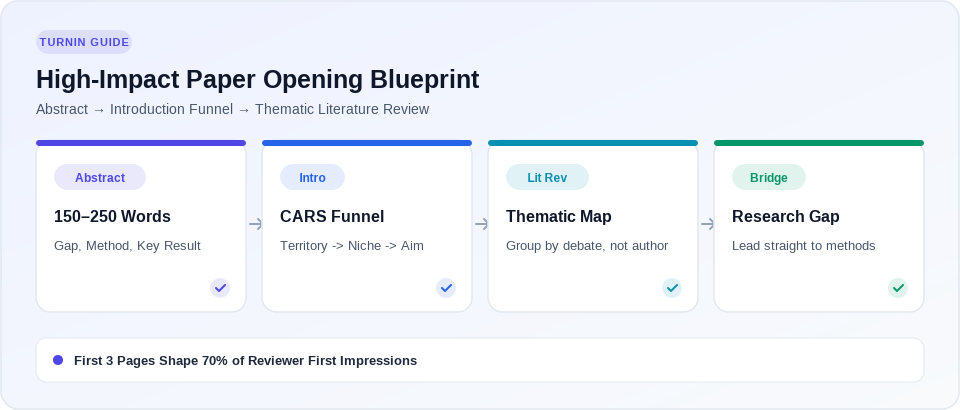
Treat these sections as a single hourglass funnel instead. Your abstract compresses the whole study into five disciplined sentences. Your introduction moves from shared scholarly territory to one unanswered question. Your literature review then steps into that gap and groups prior findings by *debate* and *evidence*, proving your design is the logical next move.
The 5-Sentence Abstract & Swales' CARS Introduction
The 5-Sentence Structured Abstract Formula
Most journals and graduate rubrics cap abstracts at 150 to 250 words. Descriptive abstracts ("This paper explores...", "Implications are discussed") waste that budget by acting like a table of contents. An informative abstract delivers the answer upfront using five functional moves:
- Context (1 sentence): State the real-world or scholarly stakes.
- Gap (1 sentence): Pinpoint what current models or methods fail to explain.
- Purpose & Method (1–2 sentences): Specify your sample, dataset, or design.
- Key Finding (1 sentence): Report the primary outcome with concrete direction or numbers.
- Implication (1 sentence): Explain what changes for theory, policy, or practice.
Before (vague and descriptive):
*This dissertation examines hybrid learning in undergraduate engineering courses. Using survey data and interviews, we analyze student engagement. The findings highlight key challenges and offer recommendations for instructors.*
After (informative 5-sentence formula):
*Hybrid engineering labs increasingly replace bench work, yet first-year attrition remains high (Context). Existing evaluations track exam scores while overlooking real-time troubleshooting support (Gap). This study followed 312 undergraduates across two semesters using LMS logs and semi-structured interviews (Method). Students receiving structured peer-code checkpoints completed 24% more lab modules on time than self-paced peers, p < .01 (Finding). Adding brief synchronous checkpoints gives departments a low-cost way to stabilize early retention (Implication).*
Swales' CARS Model: Move 1, Move 2, and Move 3
Linguist John Swales showed that effective introductions across disciplines follow a three-move choreography called CARS (Create a Research Space):
- Move 1 — Establishing a Territory: Claim centrality and synthesize consensus ("Over the past decade, urban heat-island mitigation has centered on canopy expansion...").
- Move 2 — Establishing a Niche: Pivot with contrast signals (*However*, *Yet*, *Despite*, *Few longitudinal studies...*) to expose a contradiction, methodological blind spot, or under-studied group.
- Move 3 — Occupying the Niche: State your research questions, dataset, or argument, and briefly roadmap the paper.
Fill-in-the-Blank CARS Template:
*[Move 1] Recent scholarship in [field] shows that [established consensus] (Author, Year). [Move 2] However, prior work relies on [limitation], leaving unclear whether [variable] holds under [new context]. [Move 3] Drawing on [method/corpus], this paper tests [hypothesis] to clarify [contribution].*
| Section / Move | Primary Rhetorical Job | Typical Length | Key Signal | Common Pitfall |
|---|---|---|---|---|
| 5-Sentence Abstract | Preview problem, method, result, takeaway | 150–250 words | Action verbs + data | Teasing results without stating them |
| CARS Move 1 (Territory) | Show why the topic matters now | 1–2 paragraphs | *Increasingly, consensus* | Starting with dictionary definitions |
| CARS Move 2 (Niche) | Justify why your study is needed | 1 paragraph | *However, yet, unclear* | Claiming a gap without citations |
| CARS Move 3 (Occupy) | State aim, scope, and roadmap | 1–2 paragraphs | *This study tests* | Overclaiming from small samples |
| Thematic Lit Review | Group debates to frame your design | 15%–25% of paper | *Whereas X, Y shows* | Author-by-author summaries |
Writing a Thematic Literature Review (Not a Book Report)
The fastest way to lose marks in a literature review is the "Smith said / Jones said" parade—an annotated bibliography disguised as prose where every paragraph starts with a researcher's surname. Examiners want to see *relationships* across studies: where findings converge, where methods diverge, and why those tensions motivate your design.
Structure subsections around themes or methodological debates, target 2 to 3 cited studies per analytical paragraph, and keep direct quotations under 10% of the chapter.
Before (annotated list):
*Garcia (2020) studied remote feedback in biology and found delayed grading lowered motivation. Chen (2021) surveyed 180 students and argued internet speed mattered most. Okafor (2023) interviewed online learners and concluded weekly rubrics improved persistence.*
After (thematic synthesis):
*Early pandemic cohorts linked online attrition mainly to hardware and bandwidth barriers (Chen, 2021). Yet controlled follow-ups show that instructional cadence—specifically turnaround time on formative feedback—predicts persistence more strongly than connectivity alone (Garcia, 2020; Okafor, 2023). Pairing rubrics with 48-hour feedback loops narrowed completion gaps across income groups (Okafor, 2023), indicating course design mediates technical inequities.*
Putting authors inside parentheses keeps ideas in the driver's seat and sharply reduces accidental patchwriting.

5-Step Pre-Submission Workflow for Opening Chapters
Before exporting your final PDF, run this structured revision pass. Remember that writing diagnostics exist to sharpen your scholarly reasoning and eliminate unintended close paraphrasing—always cite sources faithfully, and remember that your university's official rubric and submission portal always prevail.
- Audit your abstract against all five moves: Read each sentence aloud and check whether a reviewer can spot your sample size, main finding, and contribution in ten seconds using the Turnin abstract analyzer.
- Trace the Move 1 → Move 2 → Move 3 pivot: Highlight the exact sentence where your introduction shifts from consensus to gap; if it appears too late, trim background bloat with Turnin's introduction writing guide.
- Color-code literature review topic sentences: Confirm every paragraph opens with a *claim or debate*, not an author's name, and tighten weak transitions through Turnin's literature review diagnostic.
- Verify paraphrase integrity and citation hygiene: Place verbatim phrases in quotation marks with page numbers, rewrite synthesized claims in fresh syntax, and check that every in-text citation matches your reference list.
- Run a final cross-section consistency pass: Read your abstract, introduction, and literature review back-to-back to verify matching terminology and scope via Turnin academic writing tools before uploading to your official institutional portal.
Frequently Asked Questions
Should I write my abstract before or after finishing the introduction and literature review?
Draft a working abstract early to stay focused, then rewrite the final version last. Until your analysis and discussion are locked, you cannot report concrete findings or exact sample details accurately. Polishing the 5-sentence abstract at the end ensures complete alignment across chapters.
How long should a CARS introduction be relative to the literature review?
In a 3,000-word journal paper, a CARS introduction typically runs 400 to 600 words (around 15% of the essay) and integrates brief citations. In a thesis with a standalone literature review chapter, keep the introduction tighter—roughly 8% to 12% of total word count—so you do not repeat the full thematic synthesis twice.
Can using writing feedback tools on my literature review trigger similarity or AI flags?
Responsible revision—reordering topic sentences, clarifying Move 1–3 pivots, and replacing patchwriting with genuine synthesis—strengthens academic integrity rather than harming it. Avoid pasting generic AI-generated prose into your draft, verify every citation against the original paper, and treat your university's official submission system as the final authority.