Dissertation Rubric Audit: Score Distinction Before Submitting
Learn how university markers grade dissertations across four core pillars. Use our self-scoring rubric and 48-hour revision plan to upgrade weak chapters before final submission.

Key Takeaways: Distinction-level dissertations (70%+ in UK systems or A-grade in US/international rubrics) rarely fail from a lack of reading—they lose marks when arguments stay descriptive, methods lack justification, or prose obscures logic. Auditing your draft against four core grading pillars 48 hours before your deadline lets you repair high-weight gaps systematically.
Most graduate students spend the final week before submission tweaking comma placement and reference italics while leaving ten-point structural flaws untouched. University examiners, however, do not grade from the bottom up. When a marker opens your dissertation, they evaluate it against four weighted pillars: Thesis Clarity, Critical Synthesis, Methodological Rigor, and Academic Style & Citations. Knowing how your draft scores on each pillar—before your supervisor or second marker sees it—is the fastest way to move a solid 64% Merit draft into Distinction territory.
What Examiners Actually Look For in a Distinction Dissertation
Examiners read dozens of dissertations each term, often under tight marking turnarounds. Because of that, clarity and argumentative control stand out immediately. A Distinction paper does not simply summarize what scholars found or list the steps of a survey; it establishes an original analytical thread in the introduction and tests that thread consistently through every chapter.
Consider the difference between a descriptive paragraph and an analytical one in a literature review:
- Before (62% Merit — Descriptive): *"Smith (2022) studied remote workers and found higher burnout rates. Meanwhile, Patel (2023) argued that flexible hours improve job satisfaction in tech firms. Both studies used online surveys."*
- After (74% Distinction — Analytical): *"While Patel (2023) links flexible scheduling to higher job satisfaction among software engineers, Smith (2022) demonstrates that autonomy without workload boundaries accelerates burnout—suggesting that schedule flexibility moderates stress only when organizational response norms are explicitly bounded."*
Notice what changed: the second version puts two sources in direct conversation, explains *why* their findings diverge, and connects that tension back to the student's research question.
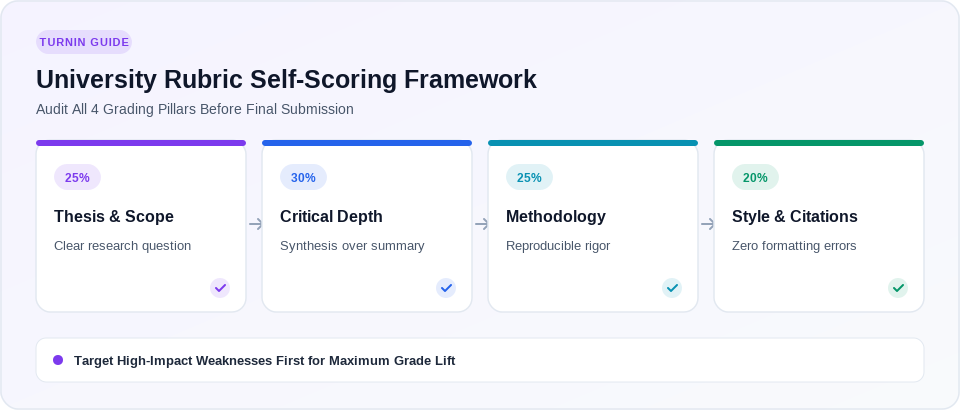
The Four-Pillar Dissertation Self-Scoring Rubric
Before editing a single sentence, print your table of contents alongside your core research questions and grade each chapter honestly on a 1-to-4 scale (1 = Major Gaps, 2 = Pass/Threshold, 3 = Merit/Strong, 4 = Distinction). A total score of 14–16 signals Distinction readiness; 10–13 points to specific chapters needing structural repair; anything below 10 calls for cutting scope and tightening your thesis before polishing grammar.
| Grading Pillar | Distinction Standard (4/4) | Common Merit Trap (2–3/4) | High-Impact 48-Hour Fix |
|---|---|---|---|
| Thesis Clarity | Specific, falsifiable central claim echoed in every chapter opening and conclusion | Broad topic statement ("This paper explores...") that shifts focus mid-draft | Write a one-sentence claim per chapter and cut off-topic paragraphs |
| Critical Synthesis | Sources grouped by themes and debates; evaluates strengths, bias, and gaps | "Author A said X; Author B said Y" summaries without analytical tension | Add explicit comparison bridges (*however*, *extends*, *contradicts*) |
| Methodological Rigor | Design, sample, instruments, and ethical/validity limits clearly justified | Chronological narration of steps without explaining *why* alternatives were rejected | Add a brief justification sentence for every major design decision |
| Academic Style & Citations | Concise, objective register; zero formatting drift or unverified references | Wordy passive phrasing, inconsistent headings, or mismatched in-text citations | Run a line-level clarity edit and verify every reference against the bibliography |
Be ruthless during this audit. Students routinely award themselves a 4 on Thesis Clarity because *they* know what they meant to argue. Test your draft by asking a peer—or running an automated AI paper evaluation—to extract your main thesis from your introduction and conclusion alone. If the two summaries do not match, your thread drifted somewhere in the middle.
Auditing Methodological Rigor and Critical Synthesis
Across master's and doctoral rubrics, Critical Synthesis and Methodological Rigor carry the heaviest marking weight—often 55% to 65% of the total grade combined. Fortunately, both can be dramatically strengthened without collecting new data.
Upgrading Descriptive Literature Reviews
Scan the first sentence of every paragraph in your literature review. If more than half begin with a researcher's surname (*"Jones (2021) found..."*, *"Lee (2023) examined..."*), your chapter is organized by author rather than by argument. Rewrite those topic sentences around conceptual claims or methodological debates, then place the citations inside or at the end of the sentence as evidence.
Defending Your Methodology Without Overclaiming
Examiners do not expect a flawless dataset; they expect transparent judgment. If your sample size is modest (for instance, *n* = 18 interviews or a single-region survey), do not hide it. State the boundary explicitly, explain why purposive sampling still answered your specific research question, and pair every limitation with a concrete boundary on how far your findings generalize.
To catch blind spots quickly, pair your self-audit with a comprehensive academic paper check that flags unsupported claims, abrupt chapter transitions, and missing methodological justifications before you move to final copyediting.

Your 48-Hour Pre-Submission Upgrade Plan
Trying to fix everything simultaneously leads to burnout and missed deadlines. Follow this prioritized five-step sequence over your final 48 hours to lock in maximum rubric gains first:
- Hours 0–8: Run a Reverse Outline for Thesis Alignment. Extract the first sentence of every paragraph in Chapters 1 through 5 into a blank document. Verify that each section advances your central thesis; delete tangential background paragraphs or move them to an appendix.
- Hours 8–20: Convert Summary Paragraphs into Critical Synthesis. Target any literature or discussion section scoring 2/4 or 3/4. Add explicit analytical commentary explaining *how* each cited study supports, qualifies, or challenges your hypothesis.
- Hours 20–30: Stress-Test Methodology and Evidence Links. Check that every research question stated in Chapter 1 is directly answered using named data or tables in your results and discussion chapters, and verify that every limitation includes a mitigation note.
- Hours 30–40: Tighten Academic Register and Sentence Economy. Cut filler phrases (*"it is important to note that"*, *"due to the fact that"*), standardize tense across chapters (past tense for completed methods, present tense for established theory), and refine phrasing with an academic grammar and style polisher while keeping your own scholarly voice intact.
- Hours 40–48: Complete a Final Similarity and Citation Pre-Check. Cross-check every in-text citation against your reference list, then run a similarity and AI pre-submission check to catch accidental unquoted phrasing, missing quotation marks, or overly repetitive phrasing. Remember: Turnin's pre-check tools are designed solely to guide responsible revision—your university's official submission and grading system always remains the final authority.
Frequently Asked Questions About Dissertation Self-Evaluation
How high should my self-evaluation score be before I submit?
Aim for at least 14 out of 16 across the four rubric pillars, with no single pillar sitting below 3. A 4 in Academic Style cannot rescue a 2 in Methodological Rigor, so always invest your remaining hours in your lowest-scoring pillar first.
Does polishing grammar trigger false AI detection flags?
Light copyediting—fixing subject-verb agreement, prepositions, and punctuation—rarely alters your personal syntax. However, heavily rewriting entire paragraphs into generic, template-like transitions can make prose sound overly uniform. Always review suggested edits sentence by sentence so your authentic analytical voice and discipline-specific terminology remain intact.
How is Turnin's evaluation different from my university's official Turnitin report?
Turnin provides independent pre-submission writing evaluation, style polishing, and similarity/AI pre-checks so you can spot structural gaps and accidental citation mistakes early. Because institutions configure their own official thresholds, repository exclusions, and grading policies, your university's official Turnitin and examination board results always take precedence.