
Turnitin Similarity Colors Explained: What Is a Safe Score?
Decode Turnitin's blue-to-red similarity bands, learn why a 12% single-source match triggers flags while 22% scattered citations can pass, and audit quotes, templates, and methods before submission.
Key Takeaways: Turnitin's color bands (0% Blue to 75–100% Red) measure text overlap—not academic misconduct. A 12% green report driven by one unquoted 11% source is far riskier than a 22% report made of scattered 1% bibliography and citation matches. Always audit your Top Sources list first, verify quotes and methods phrasing, and treat your university's official system as the final authority.
Every semester at the writing center, a student walks in looking pale over an 18% similarity score—while another student relaxes at 12% without opening the detailed breakdown. Five minutes into reviewing both reports, the surprise flips: the 18% paper is completely clean (just properly cited references and standard lab terminology), whereas the 12% paper has a single unquoted block copied nearly word-for-word from an open-access journal.
That gap between headline percentage and actual academic risk is why understanding Turnitin's five color bands—and knowing how instructors read them—matters far more than chasing an arbitrary number.
What Turnitin's Five Similarity Colors Actually Measure
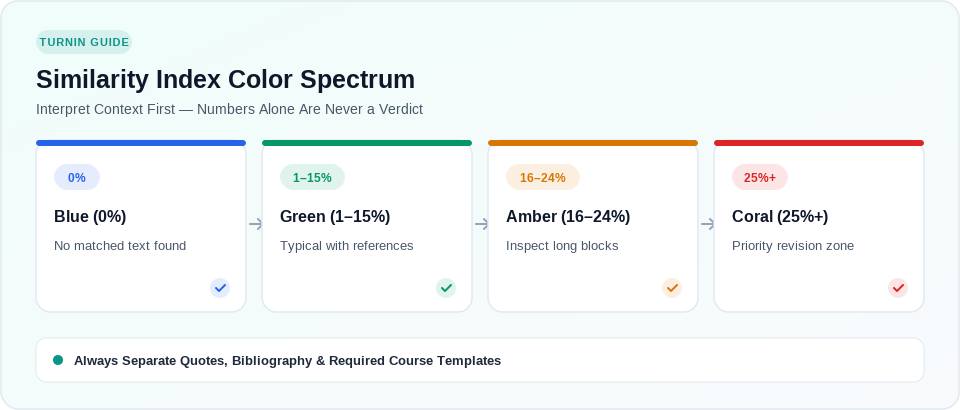
Turnitin groups every Similarity Index into five color-coded bands ranging from 0% to 100%. These colors give graders a fast visual triage cue, not an automatic verdict on plagiarism.
- Blue (0% match): No matching text was found in student repositories, academic journals, or indexed web pages. While 0% sounds ideal, it can look unusual in a research paper packed with direct quotes and a long reference list unless your instructor excluded those sections.
- Green (1%–24% match): Often called the "typical range" for well-cited undergraduate essays and theses. Most university departments treat anything under 15%–20% as routine when matches are fragmented across many small 1%–2% citations.
- Yellow (25%–49% match): A cautionary band that prompts closer inspection. It frequently appears in literature reviews with heavy block quoting, reused lab-report templates, or methods sections containing standard statistical phrasing.
- Orange (50%–74% match): High overlap that almost always triggers a manual integrity review. Unless the submission is a short worksheet repeating long prompt questions, an orange flag usually signals insufficient paraphrasing or missing quotation marks.
- Red (75%–100% match): Critical overlap. Outside of accidental duplicate submissions to a university repository, a red score points to wholesale copying or an unexcluded template shared by an entire cohort.
Why a 12% Single-Source Match Is Worse Than 22% Scattered Citations
Instructors rarely judge a paper by its top-line percentage alone; they click straight into the Match Overview panel to see how those percentages are distributed.
Consider two realistic 2,500-word psychology term papers:
- Paper A scores 22% (Green), split across 24 separate sources—none higher than 1.5%. Sixteen of those hits sit inside the APA reference list, four are short properly quoted definitions, and four are common phrases like *"participants provided written informed consent prior to data collection."*
- Paper B scores 12% (Green), yet 11% comes from Source #1—a single 2022 systematic review—because the student kept the original sentence skeletons and swapped out a handful of synonyms (classic patchwriting).
On paper, Paper B looks "safer." In reality, Paper B is the one flagged for an academic integrity meeting. You can see what that source-level distribution looks like by inspecting an interactive Turnin sample report before your deadline.
Before vs. After: Fixing a Patchwritten Source Cluster
Notice how easily a high-risk single-source match turns into clean scholarly synthesis once you step back from the original sentence structure:
- Before (Patchwritten — triggers a contiguous 11% single-source match):
*Original source:* "Urban heat islands intensify nocturnal thermal stress in low-income neighborhoods due to sparse tree canopy and dense asphalt surfaces (Chen et al., 2022)." *Draft:* "City heat islands increase nighttime heat stress in lower-income districts because of limited tree cover and thick asphalt roads (Chen et al., 2022)."
- After (True academic synthesis — 0% contiguous match, accurate attribution):
*Revision:* "Nighttime cooling lags behind in under-resourced urban blocks, largely because dark pavement retains daytime radiation while sparse canopy cover limits shade—a disparity documented by Chen et al. (2022)."
The difference isn't thesaurus tricks; it's grasping the causal claim, closing the source PDF, and explaining the mechanism in your own prose.
How to Audit Quotes, Templates, and Methods Sections
Not every highlighted line needs rewriting. Deleting a valid quotation or mangling a standard protocol just to shrink your score often weakens your scholarship. Instead, audit each highlighted block by category:
| Match Category | Typical Score Impact | Why It Triggers | Safe Advisor Action |
|---|---|---|---|
| Direct Quotes | 2%–10% | Verbatim text matches published papers even with quotation marks | Verify quotation marks, page numbers, and keep quotes brief |
| Reference List & Bibliography | 5%–15% | Standardized DOIs, titles, and author strings match existing records | Leave intact; confirm your LMS enables bibliography exclusion |
| Course Templates & Cover Sheets | 5%–30% | Every student in the module uploads identical headers and prompts | Keep required headers; check if your syllabus asks you to omit prompts |
| Methods & Materials Boilerplate | 3%–12% | Standard reagent names, equipment models, or IRB ethics clauses | Retain exact technical terms; rewrite surrounding procedure steps in your own voice |
| Single-Source Clusters (>3%) | 3%–25%+ | Consecutive sentences lifted or lightly edited from one source | Paraphrase from scratch from your own notes and cite the core idea |
One crucial precaution before running any pre-submission scan: make sure your draft is checked privately without being stored in a permanent student paper database. Submitting a working draft to a standard repository by mistake can cause your final LMS upload to match 100% against yourself days later. Turnin's private, non-repository check avoids leaving a permanent copy behind while giving you a diagnostic preview.

5-Step Pre-Submission Audit Checklist
Work through these five steps at least 24 hours before your submission portal closes:
- Run a private pre-check first: Upload your near-final manuscript to a pre-submission Turnin similarity check using non-repository handling so your draft stays out of institutional archives.
- Audit the Top Sources sidebar before the total percentage: Look for any single source contributing 3% or more, or any continuous three-line highlight inside your body paragraphs.
- Verify every direct quote and citation format: Confirm that copied wording sits inside quotation marks with exact page numbers, and standardize your reference list using the Turnin citation and reference formatter.
- Rewrite patchwritten paragraphs from understanding: Close the source document, summarize the argument in plain language, and re-check any stiff or overly robotic phrasing through Turnin's AI writing and paraphrasing review tool so your prose sounds natural and genuinely yours.
- Cross-check your syllabus filters: Confirm whether your instructor's portal excludes bibliographies and small matches under 1%—and remember that while Turnin helps you diagnose overlap responsibly, your university's official Turnitin settings and instructor rubric always govern the final evaluation.
Frequently Asked Questions About Turnitin Similarity Scores
Is 0% blue always the best Turnitin similarity score?
No. In an evidence-based essay or lab report, 0% is rare unless your instructor enabled strict exclusions for quotes and references. A clean 8%–18% Green score made up of short, properly cited matches usually reflects stronger academic engagement than an artificially scrubbed 0%.
Why did my Turnitin score jump after I added my reference list?
Reference entries follow rigid APA, MLA, or IEEE formatting, so identical titles, journal names, and DOIs match thousands of prior papers. Don't alter accurate citations to lower the number; most instructors filter out the bibliography during grading.
Will checking my draft early lock my paper in the university repository?
Only if the check is configured to store submissions in the standard repository. Always confirm non-repository mode on third-party pre-checks—and if your university offers a dedicated "Draft Coach" or practice slot in your LMS, double-check its storage settings before uploading.