The visa clock starts before graduation
From the UK’s visa approval slump to Germany’s push to retain STEM graduates, late-2026 policy signals point to a practical lesson: plan your dissertation, academic standing and job search around the date your university can certify completion.

At 1:07 a.m., the line in the registry email that matters is not “dissertation submitted” but “your award will be considered at the next board.” Two dates that once looked like routine university administration can now sit on opposite sides of a visa deadline. As the UK, Australia and Canada tighten or reassess parts of their international-student systems for 2026–27, and Germany looks to retain more STEM graduates, that gap belongs in your degree plan from the first week.
1. Four countries, four different bottlenecks
The UK’s headline number is striking: *Times Higher Education* reported 96,000 fewer student visa approvals alongside rising refusal rates (Times Higher Education, 2026). That is a fall in approvals, not a count of additional refusals, and it does not measure an individual graduate’s chance of getting permission to work. The more consequential story for students already on campus is separate. *University World News* reported that study and graduate routes were being cut out of settlement pathways under the revisions it covered (University World News, 2026). Permission to stay and work after a degree is not the same as time that counts towards permanent residence. Check which settlement route the reporting refers to, when any change takes effect and whether it applies to your cohort.
Australia’s signal arrives earlier in the student journey. Early recruitment figures reported by *The PIE News* point to a difficult 2027 amid concerns over student visa approvals (The PIE News, 2026a). An early intake reading is neither a final enrolment tally nor evidence that the post-study work rules have changed. It does, however, make a familiar risk harder to ignore: if you defer or change programmes to salvage a delayed start, your new completion timetable may need a fresh eligibility check.
In Canada, a parliamentary secretary’s call for the sector to press Ottawa for stronger support for international students, research and the arts and humanities is a political signal, not an amendment to the Post-Graduation Work Permit (PGWP) rules (The PIE News, 2026b). Germany, by contrast, wants more of the STEM talent it educates to stay. The constraint identified by *ICEF Monitor* is practical: an English-taught degree can get a student into the country without giving them the German they need to enter much of its labour market (ICEF Monitor, 2026).
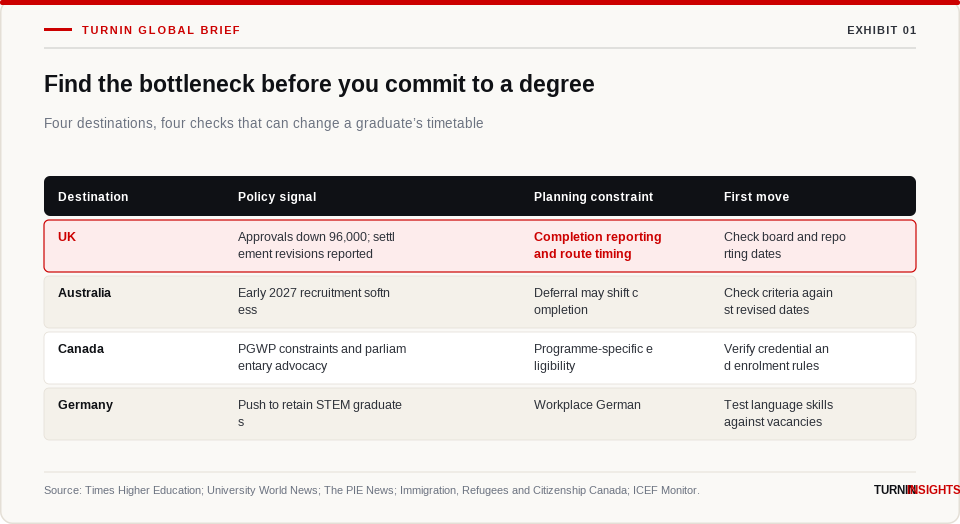
| Destination | Late-2026 signal | What it does not establish | What to verify before committing |
|---|---|---|---|
| UK | Fewer student visa approvals; settlement revisions reported | That the Graduate Route has ended, or that one settlement rule applies to everyone | Graduate Route timing for your cohort, university reporting and the relevant settlement rules |
| Australia | Early signs of a softer 2027 intake | That a weaker intake changes graduate visa eligibility | How a deferral or programme change affects your completion date and applicable criteria |
| Canada | PGWP constraints remain a live policy issue | That parliamentary advocacy changes who qualifies | The specific programme, applicable language and field rules, and enrolment conditions |
| Germany | A push to retain more international STEM graduates | That English-medium study guarantees an English-speaking job | Local role requirements, workplace German and graduate residence options |
2. Plan backwards from the date the university can certify
A dissertation has a hand-in date. A degree has a set of decisions: marks are confirmed, outstanding requirements cleared and completion recorded. The first date is usually yours to control. The others depend on people who may meet only once or twice a term. The graduation ceremony can be later still, and it is rarely the date you need for planning. Ask the registry, in writing, what counts as official completion, when it can first be confirmed, and what the university can issue or report. Ask the international student team separately how that process fits the immigration rules for your route.
Consider a taught master’s student in Britain who submits on 2 September. Her results are due in October, with a November board. She has pencilled in a job start after submission, assuming that the Graduate Route will be available as soon as she hands in. The relevant question is when the university can report successful completion and how that date sits against her current permission and the application requirements. If an outstanding module moves her case to a later board, the issue is no longer whether she can finish a few extra pages over a weekend. It is whether the university can confirm her degree on the timetable she had planned around.
Build two calendars: the expected route through the degree and the plausible late route. Get the actual dates for reassessment, deferred assessment and the next board rather than adding an arbitrary two weeks. Put your current permission expiry and intended job start on both. If the late route leaves little room, speak to the university before requesting an extension, booking travel or promising an employer a start date. An approved academic extension is not, by itself, an extension of immigration permission.
3. A zero-resit plan starts with the rubric
Zero resits is a planning aim, not a guarantee or a reason to forgo an accommodation or push through illness. It means treating every required assessment as a potential constraint on timely completion. Students tend to lavish attention on the dissertation because it is large and visible. A low-credit compulsory module can be the one that sends the degree to another board. Ask how your course handles failed components, compensation and deferred assessment rather than assuming a strong average will carry an outstanding requirement.
Run the following checklist at the start of term, then refresh it after your first marked assignment:
- Map the non-negotiables. List every required module, component pass mark, submission portal and reassessment window. Check for any ethics approval or placement sign-off that sits outside the standard assessment calendar.
- Turn the rubric into things a marker can find. If the criterion is “justify the method,” point to a paragraph that compares two plausible methods and explains the choice. Use a paper evaluation to flag thin sections, then test those flags against the actual rubric and supervisor feedback.
- Set a decision date for data access. Agree when to stop waiting on a partner, a dataset or participant recruitment. Have a narrower design ready, subject to supervisor and ethics approval, while there is still time to use it.
- Leave space between a full draft and submission. Agree a draft date with your supervisor. Reserve a later pass to check quotations, tables and references against their sources; a text check can complement that review if your university permits it and the material is appropriate to upload.
- Close the loop after hand-in. Save the submission receipt, check when marks are final and verify that all components are recorded. Confirm the completion document or report you actually need rather than waiting for a ceremony invitation.
Here is what rubric discipline looks like on the page. “Interviews were chosen because they provide rich data” names a method with a favourable adjective attached. “I chose interviews over a survey because the study asks how teams interpret escalation rules; they can explain the reasoning behind decisions, although their accounts cannot establish how often breaches occur.” The second version gives the marker a choice, a reason and a limit. Fix that paragraph while there is still time to change the design, not the night before submission when the only thing you can change is the prose.

4. Start the job search before the dissertation peaks
The worst month to discover what employers want is the month you are finishing your analysis and chasing references. In your first term, read a dozen vacancies in two plausible job families. Mark what repeats: a tool, a language level, a professional accreditation, a requirement to explain findings to non-specialists. Sort those requirements into what your course will teach, what you can build alongside it and what will take longer than the programme. The third list can change which roles you target.
A Canadian applicant should do a different kind of screening before paying a deposit. PGWP eligibility is not a blanket property of every programme at a designated learning institution. Depending on the credential and relevant application dates, language and field-of-study rules may apply; enrolment history can also matter (Immigration, Refugees and Citizenship Canada, n.d.). Check the exact programme and credential against the official criteria, not the institution’s general marketing page. If you are already enrolled and considering dropping to part-time status or taking leave, ask how the specific change would be treated before acting. A political appeal for more support offers no guarantee about your own file.
For a STEM student in Germany, the useful language target is not simply “better German.” Take a vacancy you would actually apply for and identify the work behind the words: explaining a fault to a technician, following a safety briefing or writing a handover note. Practise those tasks alongside formal language study. A student who can explain a failed test clearly in German may have more to show at a local interview than one who can discuss the entire dissertation only in English. The retention push identified by *ICEF Monitor* will matter most where graduates can cross that gap (ICEF Monitor, 2026).
By mid-degree, aim to have one work sample you can share without exposing confidential research: a memo built on public data, a reproducible analysis or a design note that explains a trade-off. Write a short account of what you did, what changed after feedback and what you would do differently. In Britain and Australia, ask employers when their recruitment rounds open and what they need to confirm work authorisation. Be clear about conditional availability. An interview can go ahead while you are still studying; a start date is a different commitment.
5. Three decisions students are already facing
Q: My supervisor recommends an extension. Should I turn it down to protect my visa timetable? A: Not automatically. A rushed submission that fails may delay completion more than a short extension. Ask whether the later submission would still reach the same board and when completion could be certified in each scenario. Then take both timelines to your international student adviser. If illness or disability is involved, seek support promptly rather than trying to solve the problem by calendar arithmetic alone.
Q: If a UK settlement pathway changes, or Australia’s intake weakens, should I switch destinations? A: Only if the change undermines something essential to your plan. If settlement is the main reason you are paying an overseas tuition premium, test the finances without assuming permanent residence. If you chiefly want a specialist degree and a first job, compare the programme, likely recruitment cycle and fallback market. Australia’s early figures tell you little about the value of a particular degree; a confirmed eligibility change for your cohort would tell you much more.
Q: I have a job offer but no official completion confirmation. What do I tell the employer? A: Give the date the university expects to confirm completion, explain that certification and work authorisation are separate, and ask for a start date that can move if either is delayed. Do not present submission, a provisional pass or a job offer as proof of a right to work. Get the applicable conditions checked before agreeing to start, including if the employer suggests part-time work in the meantime.
The most useful email to send this week is probably short: “If I pass everything at the first attempt, on what date can the university confirm completion? If I miss that board, when is the next one?” Those two dates will not settle the immigration debate. They will tell you whether your dissertation, your permission to stay and your first job can fit on the same calendar.
References
ICEF Monitor. (2026, November 18). To boost STEM graduate retention, Germany needs to help more international students to learn German.
Immigration, Refugees and Citizenship Canada. (n.d.). Post-graduation work permit: Who can apply. Government of Canada.
The PIE News. (2026a, November 26). Australia faces challenging 2027 as early international student figures emerge.
The PIE News. (2026b, November 25). Push immigration minister to back international students, Canadian MP urges.
Times Higher Education. (2026, November 26). UK student visa approvals crash by 96,000 as refusal rates soar.
University World News. (2026, November 24). Study and graduate routes axed from UK settlement pathways.