UK and Australian visas in 2027: How to choose a university and plan your dissertation
The UK Graduate visa depends on when you apply. Before accepting a UK or Australian offer, check your university’s resit dates, completion reporting and deposit refund terms.
At eleven at night, your supervisor leaves a note in the margin of your dissertation: “This chapter needs to be redone.” You open the university calendar and realize that submission is followed by three more hurdles: the release of your marks, confirmation of course completion, and your visa expiry date. When you apply for a UK Graduate visa affects how long it will last, and Australia's recruitment warnings are a reminder that an offer of admission is not a visa approval. When comparing offers, first ask which university's schedule leaves you enough time for one round of reworking.
1. UK: The Graduate visa loses six months, but settlement is a separate question
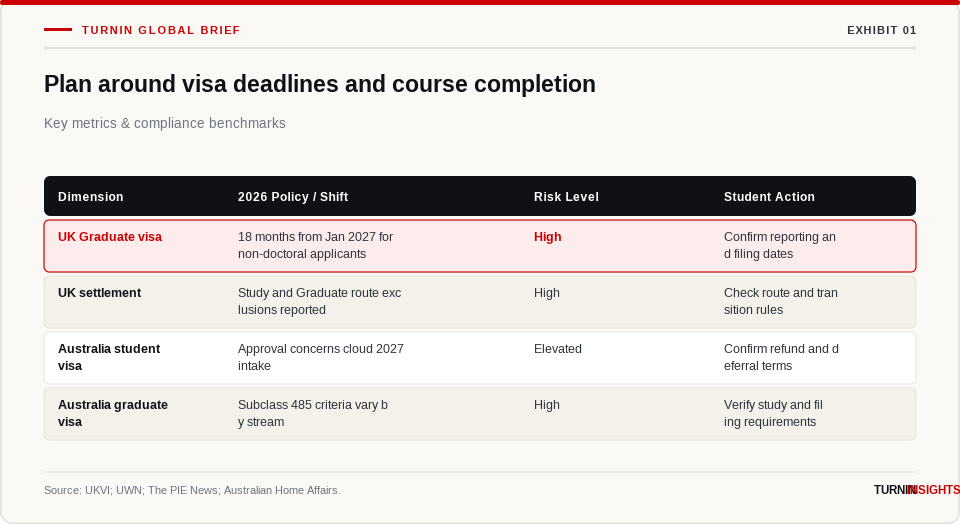
Take November 29, 2026 as the policy snapshot. According to the UK government's Graduate visa page, non-doctoral graduates who apply on or before December 31, 2026 will receive a two-year visa; those who apply from January 1, 2027 onward will receive an 18-month visa. Graduates with a PhD or another recognized doctoral-level qualification still get three years. The cutoff is based on the date you submit your application, not when you enroll, submit your dissertation, or attend your graduation ceremony. You must be in the UK, your university must already have reported to the Home Office that you successfully completed your course, and you must apply before your current Student visa expires (UK Visas and Immigration, n.d.).
If you're already studying in the UK, the most useful email isn't one asking your supervisor to release your marks early. It's one asking your university's international student team: When will completion be confirmed for my cohort, when will it be reported to the Home Office, and how will I know the report has been sent? If you're still choosing a taught master's programme for 2027, plan around 18 months for now rather than copying the job-search calendar of someone who graduated two years ago. Those six lost months might be exactly when the next hiring round takes place. If most of the jobs you're targeting recruit in the autumn, send out some initial applications, take written assessments, and contact alumni while you're still studying.
That same week, *University World News* reported that the UK's study and graduate routes were excluded from settlement pathways (University World News, 2026). Keep two questions separate when reading this story: Can you apply for a Graduate visa, and can that period of residence count toward the specific settlement route you intend to use? For the first, check the visa requirements. For the second, check the specific route, the date the rules take effect, and any transitional arrangements. The headline does not mean that all previous periods of residence cease to count, and getting a Graduate visa does not automatically start a countdown to permanent residence.
2. Australia: Industry concerns about visa approvals don't mean you're more likely to be refused
Drawing on early recruitment indicators, *The PIE News* reported that Australia's international education sector expects challenges to continue in 2027, with student visa approvals an ongoing concern (The PIE News, 2026). Early recruitment figures are not final enrolment figures, much less a basis for estimating the likelihood of refusal for a particular field of study, nationality, or individual. For applicants, what this news really changes is the order in which you pay for things. Before your visa is approved, check the tuition deposit refund terms, the latest date you can register, and whether you can defer entry if you arrive late.
Make two checklists at the same time. For the Student visa (subclass 500), check your Confirmation of Enrolment, supporting documents, and the Genuine Student requirement. For the Temporary Graduate visa (subclass 485), check the age, qualification, Australian study requirement, and other eligibility criteria for the stream that will apply at the time. A university's willingness to admit you does not mean the immigration authorities have determined that your study arrangements meet the graduate visa requirements. If you plan to transfer, seek credit exemptions, or change how you study, find out how you will demonstrate that you still meet the study requirement before accepting the new arrangements (Australian Government Department of Home Affairs, n.d.-a, n.d.-b).
| Decision | UK: What to check | Australia: What to check |
|---|---|---|
| Before paying a deposit | Timing of resits, dissertation resubmissions, and rounds of completion confirmations | Refund, deferral, and latest arrival terms if your visa has not been approved |
| Before changing your course arrangements | Whether the change will delay confirmation of completion and the university's report to the Home Office | Whether a transfer or credit exemptions will affect your ability to meet the 485 study requirement |
| Before graduating | Whether the university has reported completion, when your Student visa expires, and when you will apply | The applicable 485 stream, evidence of completion, and the application deadline |
3. GPA floor: Admissions look at your average, but graduating on time also depends on individual marks
When comparing two programmes, don't just copy down the GPA on the admissions page. First note the final grades you need for an unconditional offer. Then look through the course handbook for the pass marks in core modules, whether the dissertation must be passed separately, and whether resit marks are capped. If you have a scholarship, check its renewal conditions separately. Don't mechanically convert UK marks to a four-point GPA scale, and don't assume that one Australian university's pass rules apply at another. Sometimes what delays graduation isn't a drop in your overall mark, but failing a required module that higher marks elsewhere cannot make up for.
Suppose a core module resit is scheduled for August and both universities allow you to take it. The first can confirm the result in September, but the second has to wait for the next committee meeting. If your visa leaves you little time to spare, two offers that look similar are no longer equivalent. Ask the programme office a specific question: “If I take and pass the resit in August, what is the earliest I can get confirmation of completion from the university?” If they can only give you dates from previous years, treat them as estimates, not promises. Comparing these wait times is especially important if your marks are close to the threshold.
4. Working backward on your dissertation: Ask when completion will be confirmed before setting a submission date
Submitting your dissertation usually just means you've finished your part. Marking, review, resubmission, and university confirmation may still follow. UK applicants also have to wait for the university to notify the Home Office, while Australian applicants need to check what counts as evidence of completion under the applicable 485 rules. Put your student visa expiry date at the far right of your calendar and work backward from there. For an interview-based dissertation, for example, if ethics approval or participant recruitment runs two weeks late, the first thing to go is often your supervisor's chance to read a full draft. Rather than squeezing your interviews into a few rushed phone calls in the final week, agree in advance with your supervisor on a cutoff: if you still haven't recruited participants by that date, narrow the scope of the study or switch to approved alternative materials.
- Before accepting an offer: Save the course handbook for that year, your offer conditions, and the refund terms. Note the pass requirements for compulsory modules and the dissertation instead of just bookmarking the admissions page.
- After classes begin: Ask the programme office for the timetable for regular results, resits, and resubmissions. Separately, ask the international student team how completion is confirmed or reported, and mark any provisional dates as such.
- When choosing a topic: Put ethics approval, access to data, and the dates your supervisor can read drafts into your plan. If your argument hasn't taken shape yet, you can use the Dissertation Evaluation to see whether your evidence addresses your research question. If you're working with interviews or unpublished data, follow your university's rules on uploads first.
- Before submitting: Set aside an uninterrupted block of time for a round of structural revisions, then use the Pre-submission Check to help check citations and references. The tool's results cannot replace your university's academic integrity rules or guarantee a pass.
- As you approach completion: Update your calendar using written confirmation from your university and official visa pages. If your expected completion date is close to your visa expiry date, contact your university's international student team or a qualified immigration adviser immediately. Don't assume that submitting your dissertation, taking a resit, or waiting for your marks will automatically extend your permission to stay.
5. Three common questions: When is it worth choosing a different university?
Q: I can submit my dissertation in December. Can I still get the two-year UK Graduate visa? Submission alone isn't enough. Under the current published requirements, you have to wait for your university to report that you successfully completed your course, then submit a valid application on or before December 31, 2026, and before your Student visa expires. Confirm the reporting date with your university first. If it falls in the new year, non-doctoral applicants should plan for 18 months rather than rushing to apply before the cutoff without meeting the requirements (UK Visas and Immigration, n.d.).
Q: My Australian Student visa hasn't come through yet. Should I buy a plane ticket and sign a lease? First look at the university's latest arrival date, whether you can defer, and the refund deadlines for your deposit and accommodation. If you have to book first, compare the actual costs of changeable or refundable options. If you can't even get a written answer about deferral terms, don't treat a non-refundable expense as a way to speed up a visa decision.
Q: Should I pick the higher-ranked programme or the one with the clearer timetable? Start by calculating how much time and how much in living expenses you would need if you had to resit one core module and revise your dissertation once. If you can manage that at either university, compare supervisors, courses, and links to employers. If a single resit could take you up against your visa expiry date at one university, while the other has clear dates for resits and resubmissions, the latter offers more than peace of mind. It gives you room to finish your degree and take the next step.
References
Australian Government Department of Home Affairs. (n.d.-a). *Student visa (subclass 500).* https://immi.homeaffairs.gov.au/visas/getting-a-visa/visa-listing/student-500
Australian Government Department of Home Affairs. (n.d.-b). *Temporary Graduate visa (subclass 485).* https://immi.homeaffairs.gov.au/visas/getting-a-visa/visa-listing/temporary-graduate-485
The PIE News. (2026, November 26). *Australia faces challenging 2027 as early international student figures emerge.* https://thepienews.com/australia-faces-challenging-2027-as-early-international-student-figures-emerge/
UK Visas and Immigration. (n.d.). *Graduate visa.* GOV.UK. https://www.gov.uk/graduate-visa
University World News. (2026, November 24). *Study and graduate routes axed from UK settlement pathways.* https://news.google.com/rss/articles/CBMid0FVX3lxTE1MSWdwSEItQW1QeEVRa2o5VDkwNmFCbVBLMndvMmZ5NjdzMUplTmFNYmtTTGhnMG9IR1hnOGhCWmFxN1JZU2pLbDFQNFlqSWNpUU56T053VlNJWF83clZaUmo2RjZCckdqUnA3d3FUa0pDZVpycXRj?oc=5