UK Visa Approvals Down 96,000, Australia Cooling, Germany Surging: How International Students Must Re-Engineer Their Academic Timelines
Late-2026 higher-education data signals a structural reset across the Big Four study destinations. With UK student visa approvals dropping sharply, study and graduate routes stripped from settlement pathways, and universities tightening budgets, international students can no longer afford resits, delayed dissertations, or last-minute career planning.

Executive Takeaway: Global mobility is not ending—it is repricing risk. When UK student visa approvals fall by 96,000, settlement credits disappear for study and graduate routes, and universities announce multi-million-pound cost cuts, an overdue essay or a disputed Turnitin flag stops being a minor academic hiccup and becomes a direct threat to your visa window and post-graduation career.
Open any university international-student group chat this week and you will feel a quiet shift in tone. Two years ago, students debated which city had the liveliest campus life or which ranking table mattered most. Today, they forward screenshots of immigration headlines and ask a far sharper question: *If I stumble on one core module or my dissertation slips by a term, what happens to my visa and job search?*
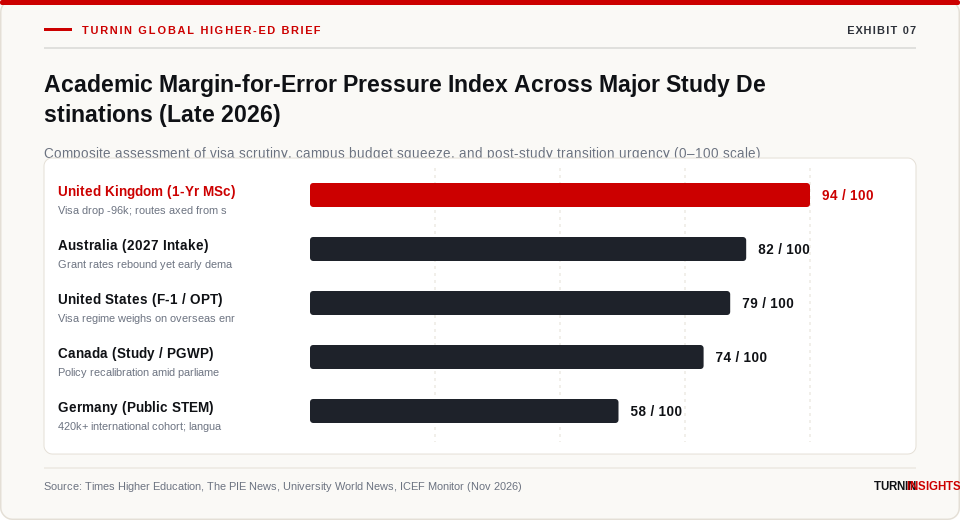
The numbers released across late November 2026 explain why that anxiety has moved from the margins to the center of campus life. According to *Times Higher Education* (2026a), UK student visa approvals have fallen by roughly 96,000 alongside climbing refusal rates, while *University World News* (2026a) reported that both study and Graduate Route periods have been axed from UK permanent settlement pathways. Inside the universities themselves, financial pressure is already visible: BBC Education (2026) documented Bangor University's £15 million cost-reduction drive through voluntary redundancies—a reminder that leaner departmental staffing leaves less informal hand-holding when students fall behind.
Elsewhere across the traditional "Big Four," the story is remarkably similar. *The PIE News* (2026a) and *Times Higher Education* (2026b) note that although Australian visa grant rates recently rebounded, early 2027 international demand has softened markedly. In the United States, tighter visa enforcement has begun biting into Indian student enrolments (University World News, 2026b), while Canadian lawmakers are actively pressing their immigration minister to restore stronger backing for international cohorts and research collaborations (The PIE News, 2026b). Meanwhile, Continental Europe is seizing the opening: ICEF Monitor (2026) reports more than 420,000 international students now studying in Germany, drawn by tuition-free public universities and English-taught STEM tracks—though retention after graduation still hinges heavily on German language proficiency.
1. Why Immigration Policy Now Dictates How You Write Assignments
Students often treat immigration law and academic coursework as two separate compartments. In reality, three operational mechanisms connect them tightly:
- Zero Tolerance for Administrative Delay: A single failed module or unresolved academic-integrity review can push degree conferral past a critical sponsorship deadline. In a compressed 12-month UK master's program, a 60-day resit panel does not just cost a re-marking fee; it can force a CAS extension under far stricter visa scrutiny and knock you out of autumn graduate recruitment cycles.
- Thinner Institutional Safety Nets: When university budgets tighten (BBC Education, 2026), formative feedback loops are among the first casualties. Writing centers book out three weeks ahead of submission windows, and supervisors increasingly expect draft chapters to arrive structurally clean rather than half-formed.
- Employer Screening Starts Earlier Than Ever: A 2026 survey from City St George's, University of London found that 97% of international students now prioritize employability when choosing a UK university. When visa pathways reward employer sponsorship over passive years of residence, your transcript classification (First/Distinction) and demonstrable research portfolio do the heavy lifting.
2. The Re-Engineered Academic Calendar: Old Habits vs. 2026–2027 Reality
To insulate your degree and post-study options from macro policy turbulence, replace reactive deadline-chasing with a structured operating calendar:
| Milestone | Legacy Student Habit | High-Risk Failure Mode in 2026–2027 | Resilient Operating Standard |
|---|---|---|---|
| Weeks 1–4 (Term Start) | Postpone dissertation topic until spring | Rushed research design leads to ethics-approval bottlenecks | Lock in an industry-relevant topic early; align coursework essays as mini literature reviews |
| Mid-Term Assessments | Draft overnight and submit 15 minutes before deadline | Unintended citation gaps or clumsy paraphrasing trigger misconduct panels | Enforce an internal T-48h freeze for rubric alignment and pre-submission integrity checks |
| Language & Local Integration | Rely solely on English inside campus bubbles (especially in Germany/EU) | Strong STEM GPA still stalls in local hiring due to B1/B2 language gap | Pair technical coursework with structured local language blocks from Semester 1 |
| Final Dissertation Window | Treat thesis as a purely academic exercise to be archived | Graduate with no employer-ready analytical evidence | Repurpose empirical findings into a sanitized 2-page executive brief for recruiters |
3. Three Practical Safeguards Every International Student Should Adopt This Term
Safeguard A: Audit Against the Rubric Before You Chase Word Count
Most grade penalties stem not from weak effort, but from misallocated effort—writing 1,200 words of descriptive background when the marking matrix awards 50% of points to critical evaluation and methodological justification. Forty-eight hours before submission, run your penultimate draft through an objective AI paper rubric evaluation to spot missing analytical criteria while there is still time to revise deeply.
Safeguard B: Eliminate Preventable Similarity and AI-Flag Friction
Never submit an unchecked manuscript into a high-stakes university portal—especially if you write in a second language and rely on heavy editing tools. Using a non-repository Turnitin similarity and pre-submission check lets you verify that no paraphrased paragraph inadvertently mirrors a source text, while keeping your draft completely out of institutional databases. If overly formulaic phrasing still reads artificially smooth, refine those specific sentences carefully with an academic naturalization and tone check rather than running reckless synonym spinners that degrade clarity.
Safeguard C: Build a Verifiable Drafting Trail
Keep every outline, annotated PDF, and version milestone inside a cloud editor with timestamped revision history. Should a university system ever flag a legitimate paper for review, presenting a clean progression of drafts alongside verifiable references turns a stressful four-week inquiry into a straightforward five-minute resolution.
4. Strategic Advice by Destination Cohort
- For UK Students: Treat your 12-month master's like a sprint with three non-negotiable deliverables—clean Term 1 grades, an ethics-cleared dissertation proposal by February, and employer-facing case studies derived from your coursework before June.
- For Australia & Canada Applicants: Read past headline grant-rate rebounds (Times Higher Education, 2026b). Ensure your statement of purpose demonstrates coherent academic progression, verifiable financial readiness, and a realistic post-study career plan grounded in current labor demand.
- For Germany & European STEM Students: Capitalize on tuition advantages without underestimating academic rigor. German universities expect independent literature synthesis from day one, and—as ICEF Monitor (2026) highlights—investing early in German language proficiency multiplies your post-graduation retention odds.
5. Frequently Asked Questions
Q1: Does losing Graduate Route credit toward UK permanent settlement mean a UK master's no longer pays off? Not necessarily—it changes the ROI equation. A UK degree still carries global brand equity and access to Skilled Worker sponsorship, provided you graduate on time with strong grades (Merit/Distinction) and start targeting sponsoring employers in Term 1 rather than after submitting your dissertation.
Q2: Why are university budget cuts relevant to my essay scores? Fewer teaching hours and tighter departmental budgets mean less informal pre-submission feedback from lecturers. Students who build independent quality-control routines—rubric audits, citation verification, and non-repository pre-checks—consistently outperform peers who rely on last-minute tutor rescue.
Q3: How early should I start aligning coursework with my post-graduation job search? From your very first assessed paper. Choosing real-world datasets, policy controversies, or sector case studies lets every assignment do double duty: earning high academic marks now and proving analytical competence to hiring managers six months later.
References
- BBC Education. (2026, November 26). *University's £15m savings could be felt 'beyond the campus', union warns*. BBC News. https://www.bbc.co.uk/news/articles/c699emngkkn5o
- City St George's, University of London. (2026, January 28). *Not just degrees: 97% of international students prioritise employability when choosing a UK university*. City St George's News. https://www.citystgeorges.ac.uk/
- ICEF Monitor. (2026, November 18). *To boost STEM graduate retention, Germany needs to help more international students to learn German*. ICEF. https://monitor.icef.com/2026/11/to-boost-stem-graduate-retention-germany-needs-to-help-more-international-students-to-learn-german/
- The PIE News. (2026a, November 26). *Australia faces challenging 2027 as early international student figures emerge*. The PIE News. https://thepienews.com/australia-faces-challenging-2027-as-early-international-student-figures-emerge/
- The PIE News. (2026b, November 25). *Push immigration minister to back international students, Canadian MP urges*. The PIE News. https://thepienews.com/push-immigration-minister-to-back-international-students-canadian-mp-urges/
- Times Higher Education. (2026a, November 26). *UK student visa approvals crash by 96,000 as refusal rates soar*. Times Higher Education. https://www.timeshighereducation.com/
- University World News. (2026a, November 24). *Study and graduate routes axed from UK settlement pathways*. University World News. https://www.universityworldnews.com/