
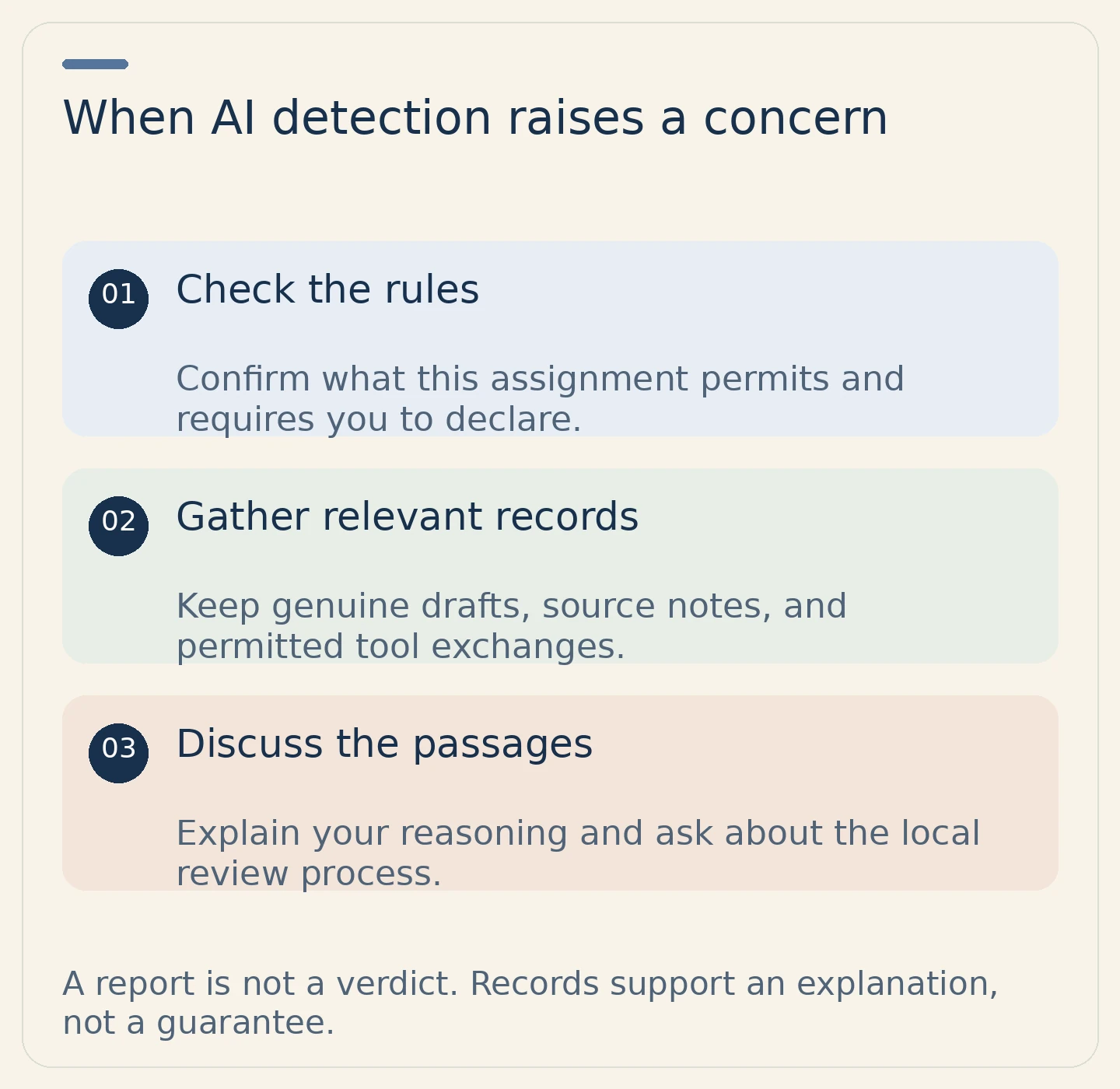
A highlighted passage in an AI writing report can be unsettling, especially when you wrote the paper yourself. The useful response is not to make your sentences look less detectable. It is to establish what the report says, check the rules for this assignment, and explain how your work developed. None of these steps guarantees a particular detector result or a favorable decision.
1. Read the report without turning it into a verdict
Turnitin’s report guidance distinguishes its AI indicator from the similarity score. The AI percentage concerns qualifying prose, not the probability that a student cheated. Turnitin acknowledges possible misclassification and says the report should not be the sole basis for adverse action.
Before responding, ask to see the relevant passages and confirm which submitted file was assessed. Keep the submission receipt and the report available to you. Do not infer an institution’s decision from a cropped screenshot or a number someone has copied into an email. For a separate explanation of report interpretation, see the AI writing risk guide.
2. Check permission at the assignment level
Read the assignment brief, course guidance, and any required declaration together. Make a short list of the tools and functions you intend to use: brainstorming, translation, grammar feedback, reference searching, or drafting. Ask about the specific function rather than asking whether “AI is allowed.” Until the answer is clear, avoid the disputed use.
Oxford’s guidance, for example, ties assessed AI use to written permission for the particular assessment and requires the prescribed declaration. That is Oxford’s policy example, not a rule for every university. Use your own course’s instructions.
Original illustrative question: “May I use grammar suggestions on sentences I have drafted, and what disclosure would you require?” Keep the answer with the brief. Permission for one assignment should not substitute for checking another.
3. Avoid editing for an imagined detector
Do not add jargon, awkward sentence variation, deliberate mistakes, or invented personal experiences to influence a report. Do not treat a distinctive voice or fluent language as evidence that a detector will accept your work. Those are not appropriate goals for revision.
Instead, give each change an academic reason. Replace an imprecise term because it misstates your argument. Shorten a sentence because the relationship between two claims is unclear. Remove an anecdote if it does not belong in the assignment. If a tool has supplied substantive text outside the permitted scope, stop using it and ask how to address that use honestly; disguising it is not a remedy.
4. Build paragraphs from sources you have actually checked
For each important claim, record the source, the relevant location, and what it does and does not support. Draft your explanation from your understanding, then compare it against the source for accuracy. Distinguish borrowed wording, paraphrase, and your own analysis. Follow the required citation style rather than treating a bibliography alone as sufficient attribution.
Original illustrative example, not a research finding: your outline says “remote classes improve access.” Before making that claim, ask which learners, what kind of access, and what evidence your chosen source provides. If the source addresses travel time but not learning outcomes, limit the sentence accordingly. Do not invent a study to fill the gap. The citation readiness guide offers a separate reference-checking workflow.
5. Keep a proportionate record of the writing process
Save useful milestones as you work, not a reconstructed history afterward. A small, organized record is easier to explain than an indiscriminate archive. Retain only material you are authorized to store or share.
| Keep | What it helps explain |
|---|---|
| Brief and written clarifications | Which instructions you worked under |
| Outline and dated draft versions | How the structure and argument changed |
| Reading notes with source locations | Where a claim or quotation came from |
| Relevant permitted tool exchanges | What assistance you requested and used |
These materials can support an account of your process; they do not automatically prove authorship or resolve a concern. Do not manufacture missing notes or backdate files. If something was not saved, say so.
6. Make the final check about the paper
Read the final version against the brief. Can you explain the main argument without a tool? Does each citation support the nearby claim? Are quotations marked, references traceable, and any required assistance declaration accurate? Confirm that the file you upload is the version you checked.
Avoid setting yourself a universal “safe” AI score. Nor should you upload coursework or other people’s material to unrelated checkers without checking permission and data-handling terms. If you identify an actual citation or disclosure error, correct it through the course’s permitted procedure instead of chasing a different number.
7. Respond to a concern with a focused explanation
Ask which passages and which assignment rule are in question. Prepare a short chronology linking the relevant draft, reading note, and revision decision. Share pertinent material through the institution’s approved channel, without exposing unrelated private information.
Original illustrative opening: “Could we review the highlighted paragraph together? I can show the outline, the source note behind the claim, and the revision where I narrowed it.” Acknowledge any tool use accurately. Ask what happens next, what response deadline applies, and where student advice is available. Follow the actual local review or appeal procedure rather than assuming the report settles the matter.
8. Questions students commonly ask
Should I make the writing less polished?
No. Revise for clarity, precision, and the assignment’s requirements. Deliberately weakening the prose does not address a concern about how it was produced.
What if I have no version history?
Explain that limitation honestly. Offer whatever relevant notes, sources, or draft material you genuinely retain, and ask how else you can explain your reasoning.
Can a low result replace a disclosure?
No. Complete the declaration required by your assignment. A detector result is not permission to omit assistance you were instructed to disclose.