
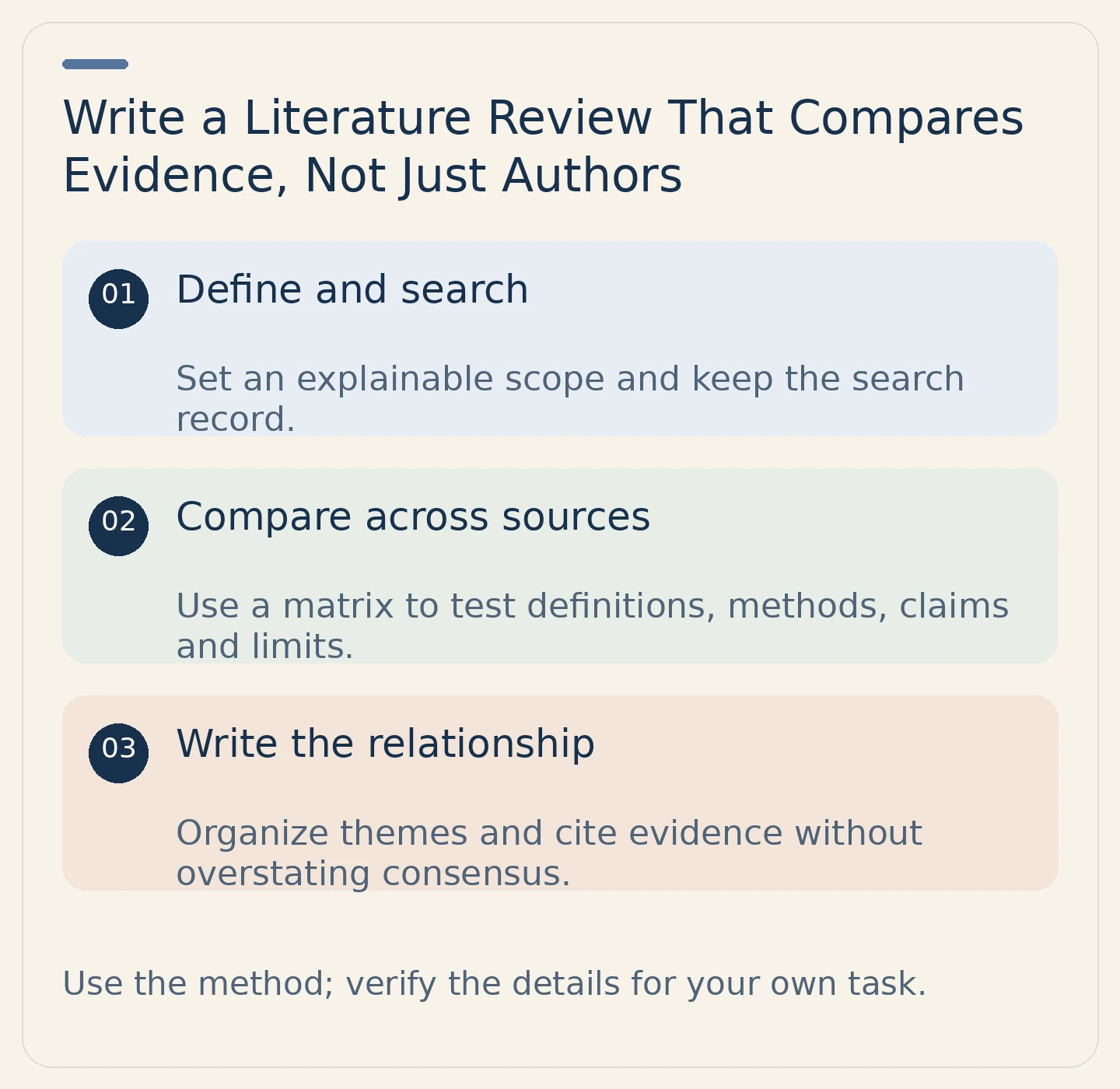
A literature review explains how relevant work relates to a question. It does not simply retell articles in the order you found them or combine rewritten abstracts. To write one well, define a manageable scope, read comparable aspects of the sources and organize the discussion around relationships: agreement, differences, methods, development and unresolved questions.
Define the purpose and type of review
Read the assignment, expected length, source requirements and citation style. Clarify whether the review is a standalone task or establishes a foundation for a larger project. Identify the concepts, material, population or setting needed to answer the question. Check permitted tools and assistance, including any AI-use requirements.
Do not label an ordinary narrative course review “systematic” merely because you kept a spreadsheet. If a systematic or other specified review design is required, use the relevant disciplinary method and supervision. For a narrative review, you can still explain how you searched and selected material without overstating completeness.
Design a search you can explain
List central concepts, useful synonyms and relevant subject vocabulary. Choose databases or collections appropriate to the field and keep the search terms and dates. Follow citation trails from useful works where appropriate. Search beyond a single convenient phrase, but keep your selections tied to the question.
Choose scope criteria for reasons you can defend. A time limit may be appropriate for a current issue but may exclude essential historical theory. A small study may offer relevant qualitative insight rather than deserve automatic exclusion. There is no universal minimum source count or “last five years” rule independent of the assignment and review purpose.
Read into a comparison matrix
Record source identity and real evidence locations while keeping exact quotations separate from summaries and your analysis. Extract what you need for comparison rather than copying everything into notes.
| Matrix field | What it makes comparable |
|---|---|
| Question and definitions | Whether the sources actually investigate the same concept |
| Material, population and setting | How far a finding or interpretation may apply |
| Method or analytical approach | What kind of evidence supports the conclusion |
| Main claim and qualifications | What the source establishes and with what limits |
| Relevant passage and locator | Where to verify the account and citation |
| Relationship to other sources | Agreement, contrast, complement or unresolved difference |
After filling rows for individual sources, look across the columns. That shift is where a list of reading begins to become a synthesis. If two sources are not comparable, explain the difference instead of forcing them into a single verdict.
Choose a structure that serves the question
A thematic structure groups recurring issues. A chronological structure can explain how an idea changed. A methodological structure helps compare what different approaches reveal or overlook. A debate-based structure makes sense when a central disagreement organizes the field. You can combine approaches if the transitions remain clear.
Illustrative example, not real research: a review of feedback practices could group teaching sources by how they define “useful feedback”—speed, specificity or students’ later revisions. It would compare evidence within and across those dimensions rather than simply write one paragraph per author. The example supplies an organizing method, not proof of findings or consensus.
Write analytical paragraphs with traceable attribution
Start with the issue the paragraph addresses. Present the relevant sources, compare the basis for their claims and explain what the relationship means for the review question. Keep each source’s scope visible. Differences may arise from definitions, methods, materials or setting; do not assume one study is wrong because its conclusion differs.
Cite borrowed ideas even when paraphrased. Quote exact wording when it matters, with required formatting and actual locators. University of Toronto guidance explains both the need for acknowledgment and the importance of integrating quotations into your own discussion. Check that a multi-source citation does not imply every listed work supports every part of a sentence.
Describe gaps without claiming more than you searched
“I did not find a study in these searches” is not equivalent to “no research exists.” State the boundary of your review and the unresolved question the examined evidence leaves. A gap may concern a relationship between findings, an underexplored setting or a methodological limitation, but it needs support rather than a dramatic claim of novelty.
Distinguish your evaluation from the authors’ reported conclusions. A review’s contribution often lies in that comparison and judgment, not in pretending the sources form unanimous agreement.
Complete the citation and submission checks
Verify source identities, quotations, real locations and reference correspondence under the assigned style. Review claims for overstatement and sources you only know through secondary accounts. If Turnitin reporting is permitted, investigate matches in context; its student guide says similarity is not a plagiarism judgment. A low score does not prove good synthesis.
Finally read the review as a connected argument, check required assistance disclosures and inspect the final file. Retain searches, notes, genuine drafts and submission confirmation. Turnin is supplementary guidance, not an official institutional or Turnitin submission system.
Related practical guides
For a separate evidence check, use the citation readiness guide; for the final handoff, use the pre-submission checklist. These are supplementary resources, not your institution’s submission system or policy.
Sources and scope
Further reading: University of Toronto: How Not to Plagiarize; University of Toronto: Using Quotations; Turnitin: Understanding the similarity score for students. Institutional examples apply to their own settings; follow the requirements governing your work.