
Paraphrasing changes how an idea is expressed; it does not change where the idea came from. A sound paraphrase preserves the source’s meaning, uses an independent structure suited to your purpose and acknowledges the source. A citation alone does not turn copied wording into a paraphrase, while different wording alone does not make a borrowed idea yours.
Understand the passage before rewriting it
Read the relevant context, not just a sentence that fits your argument. Identify the central point, who or what it concerns, the evidence behind it and its qualifications. Decide why your paper needs it. You may need a detailed paraphrase, a shorter summary, or an exact quotation because the language itself matters.
Record the actual source and location in your notes. Mark copied wording immediately and keep your explanation and analysis separate. University of Toronto guidance on avoiding plagiarism recommends this distinction so that source language does not lose its identity during drafting.
Compare four different writing moves
The passage below is invented solely for illustration. It is not a quotation from a publication or a report of research: “Recorded lectures may give some students more flexibility in when they study, but they do not by themselves establish better learning outcomes.” The teaching label is not a publishable reference.
| Writing move | Illustrative version | What it demonstrates |
|---|---|---|
| Unmarked copying | Recorded lectures may give some students more flexibility in when they study, but they do not by themselves establish better learning outcomes. | Exact wording needs quotation treatment and attribution if used from a real source |
| Surface rewriting | Recorded classes might offer certain students greater flexibility in study timing, but alone do not establish improved learning outcomes. | The wording changes slightly while the source structure remains closely followed |
| Independent paraphrase | The teaching passage separates flexibility in study schedules from evidence that learning has improved; it allows the first possibility without claiming the second. | Meaning and limitations are retained in a different explanatory structure |
| Writer’s analysis | For this essay, that distinction means a proposal should assess scheduling access separately from learning outcomes. | The application is the writer’s reasoning and must not be presented as the source’s finding |
In a real paper, cite the source for the paraphrase and the evidence underlying the analysis. Do not append invented authors, dates or page numbers to make the teaching example look scholarly.
Use a repeatable paraphrasing method
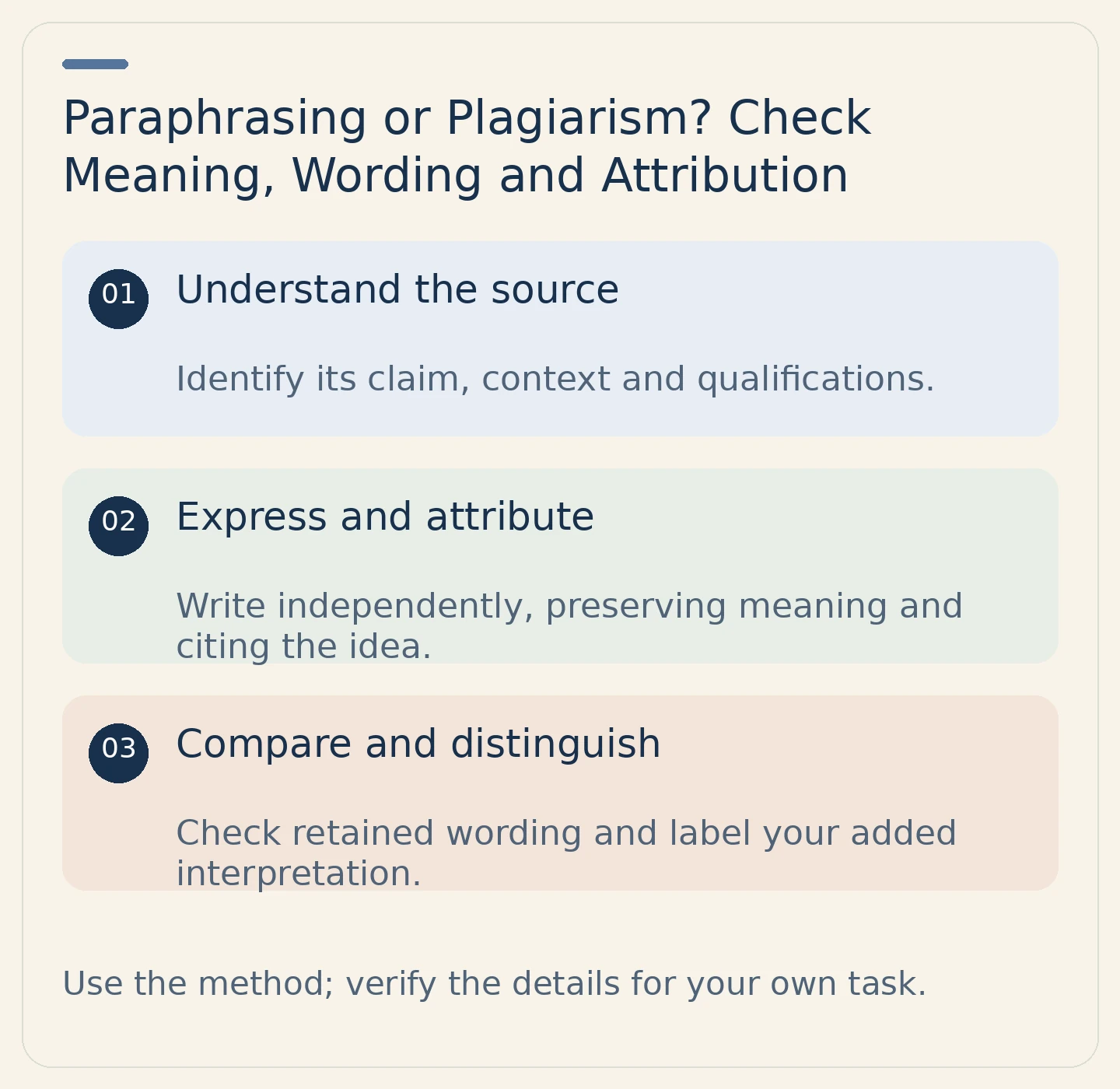
First, explain the relevant idea aloud or in notes without looking at the original. Next, draft a sentence that serves your paragraph’s question rather than following the source’s order. Reopen the source and check the result carefully. Have you kept its scope, uncertainty and relationships? Have distinctive phrases remained without quotation marks? Add the required citation and locator information under the assigned style.
This is not an exercise in making every word different. Preserve established technical terms when changing them would make the account inaccurate. If distinctive wording is essential, quote it rather than disguising it. The University of Toronto’s quotation guidance discusses choosing between quotation, paraphrase and summary according to the role of the material.
Separate a paraphrase from an added explanation
Do not insert plausible factors into the source’s account and call the result a better paraphrase. If the source only discusses flexibility, you cannot attribute claims about platform design, feedback frequency or student motivation to it without support. Add such ideas only as your own clearly identified analysis with appropriate evidence, or omit them.
The same rule applies to causal language. An association cannot be rewritten as proof that one factor caused another. A finding about a limited group cannot silently become a statement about everyone. Independent expression and faithful meaning must be checked together.
Translation and summaries still need attribution
Translating a passage does not remove its source. Follow the applicable guidance for translated quotations and paraphrases. A summary condenses a larger argument, but still needs acknowledgment when it uses another author’s ideas. Common knowledge depends on discipline and audience; ask the instructor when a particular claim’s status is unclear.
A source in the bibliography does not by itself identify every borrowing in the text. Keep attribution close enough that readers can follow which statements come from that source and where your judgment begins.
Final self-check before submission
- Can I explain the source’s point without copying its sentence pattern?
- Does my account preserve its qualifications and avoid added unsupported claims?
- Are exact words quoted and borrowed ideas cited using the required style?
- Can readers distinguish evidence from my interpretation?
- Have I checked the actual source, version and real locators?
If permitted, inspect Turnitin matches as an additional check. Its student guide explains that a similarity score is not a plagiarism verdict; neither low similarity nor a successful synonym swap establishes good paraphrasing. Review the surrounding argument, required disclosures and final file too. Turnin is supplementary guidance, not official Turnitin or a guarantee of an academic outcome.
Related practical guides
For a separate evidence check, use the citation readiness guide; for the final handoff, use the pre-submission checklist. These are supplementary resources, not your institution’s submission system or policy.
Sources and scope
Further reading: University of Toronto: How Not to Plagiarize; University of Toronto: Using Quotations; Turnitin: Understanding the similarity score for students. Institutional examples apply to their own settings; follow the requirements governing your work.