
A Turnitin AI-writing indicator is not a percentage of proven misconduct. It is an output from a detection model that requires interpretation alongside the actual text and applicable academic rules. Before deciding what to do, distinguish the AI Writing Report from the Similarity Report and identify what information you can actually access. Do not infer authorship, permission or academic quality from either number alone.
Read the indicator’s meaning and limits
Turnitin’s official Using the AI Writing Report guide says that the model can misidentify human-written and AI-related text. It states that the result should not be the sole basis for adverse action against a student. Human scrutiny and the institution’s academic policies remain necessary.
The guide defines the reported percentage in relation to qualifying long-form prose, not indiscriminately to every item in the uploaded file. It explains that non-prose and unconventional forms, including tables and code, are not reliably covered in the same way. Consequently, the percentage is not a straightforward count of every word you can see in a mixed-format document.
Access and availability also matter. The official guide describes student access when the report is made available. Do not assume every course enables the function or gives students the same view. Follow the instructions for your assignment and the report you actually received.
Keep three questions separate
| Information | What it concerns | What it cannot establish alone |
|---|---|---|
| Similarity matches | Text overlapping material in comparison sources | Whether the borrowing is appropriate or constitutes plagiarism |
| AI-writing indicator | Qualifying text the model identifies as likely AI-related | Who wrote it, whether use was permitted or whether misconduct occurred |
| Academic review | The work, evidence, process and applicable rules | A fair conclusion from one unexplained technical number |
The AI indicator is independent of the similarity score. A low similarity result therefore does not cancel an AI-related concern, and an AI indicator does not tell you which sources need quotation marks. Treat them as different inputs, not two versions of the same score.
Begin with policy, not stylistic guesses
Read the current assignment and course guidance. Is AI use prohibited, allowed for particular activities, or allowed subject to disclosure? Check translation and language-editing rules too. Permission for one task does not automatically extend to another. If the policy is unclear, ask a specific question about what you actually used or intend to use.
Do not diagnose a report by guessing that formal language, repeated transitions, a second-language writing background or “too smooth” sentences caused it. This guide does not establish such mechanisms. Improving clarity is worthwhile, but varying sentence lengths or adding personal-sounding phrases cannot guarantee a different or more accurate detection result.
Review the actual work and its source trail
Read the relevant passages in context. Ask whether claims are accurate, whether evidence supports them and whether source attribution is clear. Check quotations against the original and verify citations beyond the appearance of a DOI. These are academic checks, not instructions for making text appear less detectable.
Preserve genuine working materials: notes, outlines, saved drafts, relevant feedback and records of permitted tool use. Organize what already exists; do not manufacture earlier drafts or prompts to create a false history. Records can help you explain development, but they do not automatically prove compliance or overrule the institution’s review process.
Illustrative distinction: a paragraph can be entirely human-written yet misrepresent a source, while an allowed use of a tool may still require disclosure. Correct the source problem and follow the disclosure rule separately. Neither decision should be outsourced to a score.
Respond constructively to a concerning result
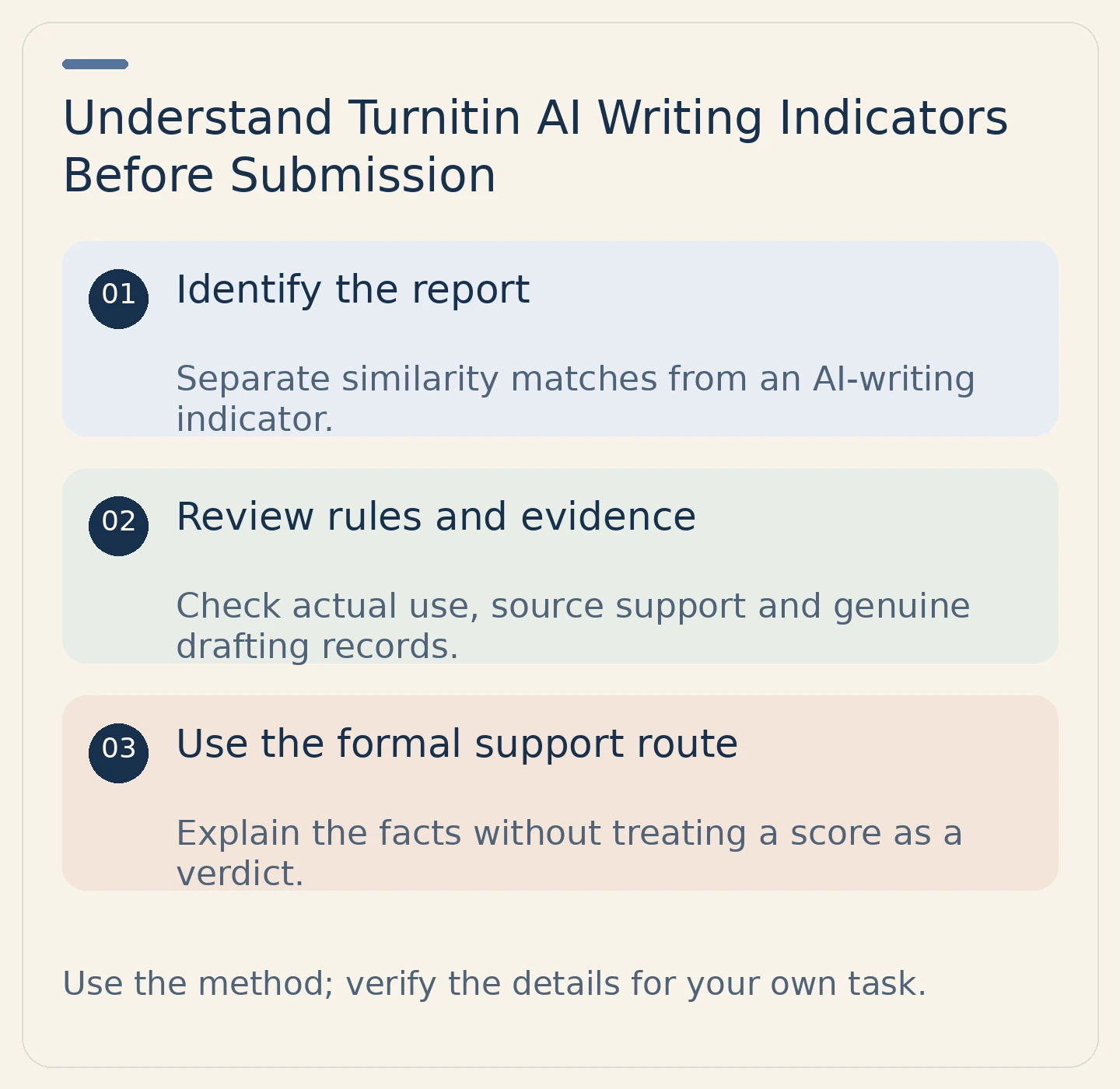
First identify the report and the specific question being raised. Next compare the actual use with the task’s rules. Then gather relevant sources and genuine process records, verify the passages and contact the instructor or designated academic support route. Ask how to provide an explanation and what procedure applies.
If you used assistance outside the permitted scope, do not assume that rewriting or adding a statement automatically resolves it. Describe the situation honestly and seek guidance. If you did not use the alleged assistance, give a factual account supported by available materials rather than accepting an indicator as a confession.
Before final submission
Check the argument, evidence, citations, permitted-use declaration and required file. Keep genuine records and the submission confirmation. Turnin is independent of Turnitin and is not your institution’s official submission portal. No editing method or checking service can promise a particular report result or institutional outcome.
Related practical guides
For a separate evidence check, use the citation readiness guide; for the final handoff, use the pre-submission checklist. These are supplementary resources, not your institution’s submission system or policy.
Sources and scope
Further reading: Turnitin: Using the AI Writing Report; Turnitin: Understanding the similarity score for students. Institutional examples apply to their own settings; follow the requirements governing your work.