
A high similarity result is a reason to inspect the paper, not a complete explanation of what went wrong. The same total can reflect very different combinations of quotations, references, required wording and problematic borrowing. Diagnose the causes before editing. Otherwise you may remove valuable evidence while leaving the real attribution problem untouched.
Establish the report’s context
Confirm the assignment, submitted version, local expectations and any visible exclusions or settings. Check whether you are permitted to view a draft report or resubmit. Do not assume controls, processing times or repository arrangements from a different course.
Turnitin’s official student guide explains that similarity is not a plagiarism judgment and that no fixed score applies universally. Necessary quotations can match, while a low total cannot establish that every idea has been acknowledged. The aim is an accurate, well-supported paper that meets the task, not a cosmetically smaller result.
Diagnose by the role of the matched material
Read the passage and the surrounding argument. Identify where the wording came from, how it is used and whether readers can tell. Do not assign a fixed risk level based only on the category: a required quotation can be appropriate, while an apparently minor reference-list issue may conceal a wrong source.
| Possible cause | What to check | Appropriate response |
|---|---|---|
| Legitimate quotation | Accuracy, quotation formatting, citation and analytical purpose | Retain necessary language; shorten only if the argument benefits |
| References or required wording | Source identity, format and course instructions | Correct errors and preserve required material |
| Close paraphrase | Dependence on original wording or sentence structure | Re-explain from understanding, verify meaning and cite |
| Missing attribution | The actual source of words, ideas or data | Recover and acknowledge it; correct quotation treatment |
| Dependence on one source | Whether the paper adds reasoning and answers the task | Develop analysis or seek relevant additional evidence |
| Your earlier work | Which submission matched and what reuse rules apply | Clarify permission and acknowledgment before deciding what to retain |
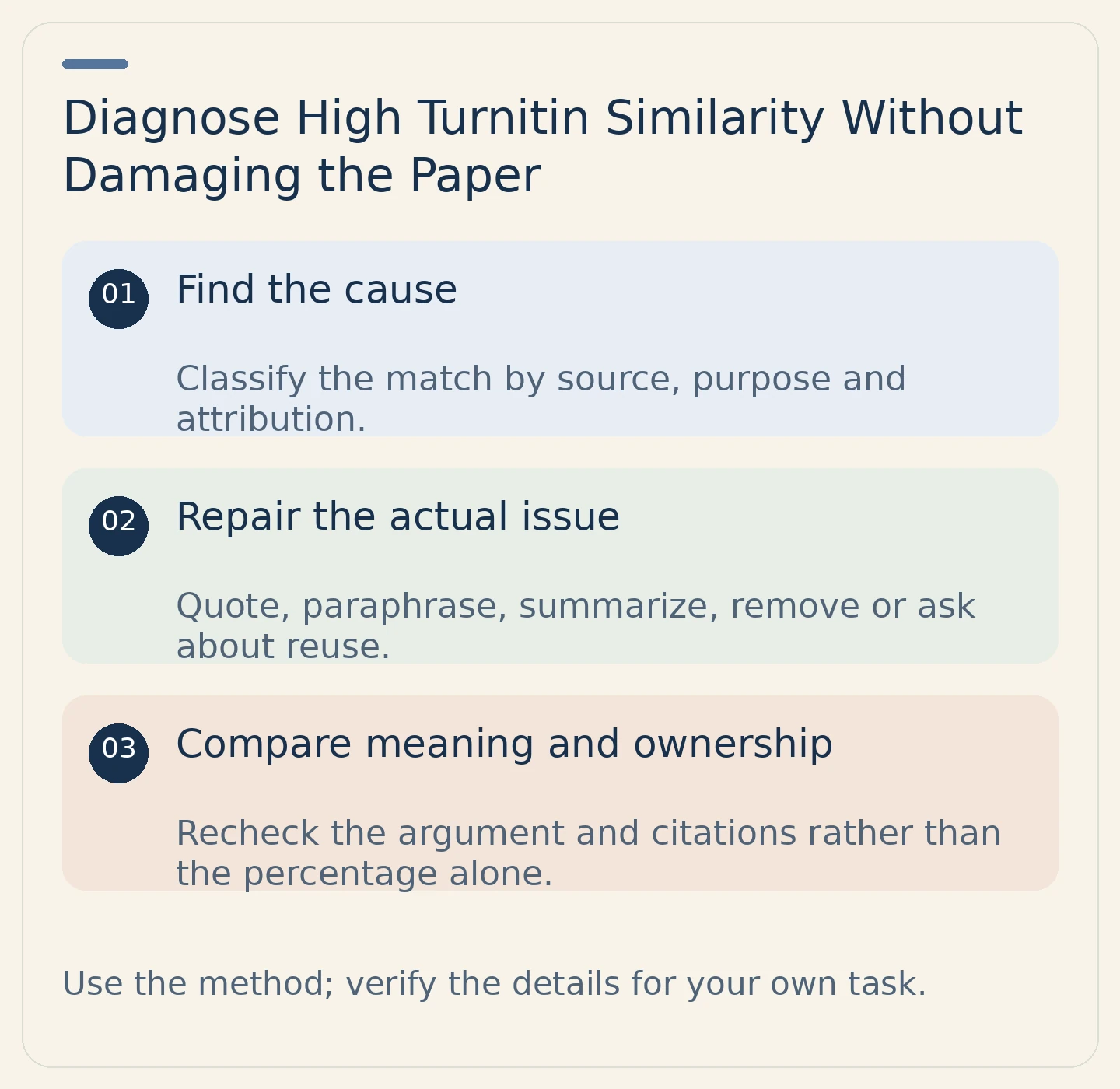
Prioritize the issues that affect authorship and meaning
Begin with unmarked copied language, unsupported central claims and unclear ownership in core arguments. This does not make bibliography checks unimportant; it prevents minor cosmetic edits from consuming the time needed for substantive repair. A long quotation is not automatically improper, but it needs an appropriate purpose, correct documentation and enough analysis for the assignment.
If a source cannot be found, do not attach a guessed reference. Search the material you consulted and remove or replace unverifiable claims if necessary. Source existence, firsthand reading and support for the exact statement are separate checks.
Choose between quotation, paraphrase, summary and removal
Retain exact wording when the language itself matters, marking and citing it under the assigned style. Paraphrase when the specific idea matters but the wording does not; read for understanding, set the source aside, draft independently and compare for accuracy. Summarize when only the broader point is needed. Remove material that does not advance the answer.
University of Toronto guidance on quotations explains why source material should serve your discussion rather than displace it. Its plagiarism guidance also emphasizes that changing wording does not remove the obligation to cite the idea. Do not delete references, replace accurate terms with misleading synonyms or manipulate formatting to alter a report.
Treat matches to your own work as a separate question
An earlier draft in the same workflow and a previously assessed assignment may raise different issues. Ask the instructor about the actual context. Do not assume that self-citation alone authorizes reusing assessed text or that every match to your name proves misconduct. Permission, disclosure and assessment rules need checking independently.
Illustrative decision: a previous essay contains a useful explanation you want to reuse in a new assignment. Before copying it, establish whether reuse is allowed and how it should be acknowledged. If permission is absent or unclear, ask; do not infer permission from the fact that you authored it.
Recheck the revised paper, not just a new percentage
Compare meaning before and after revision. Have you preserved the source’s qualifications? Is each borrowed claim attributed? Does the paragraph now explain the evidence rather than merely rephrase it? If one claim changes, revisit the introduction and conclusion too.
AI-writing indicators are separate from similarity; this diagnosis does not infer AI use from a high matching result. Follow any applicable assistance policy and disclosure requirements on their own terms.
Before submission, read the full paper for task alignment and clarity, verify citations and references, inspect figures and the actual export, and upload the intended version. Retain genuine drafts and the confirmation. Turnin is not official Turnitin, and no checking or editing method can guarantee an institutional outcome.
Related practical guides
For a separate evidence check, use the citation readiness guide; for the final handoff, use the pre-submission checklist. These are supplementary resources, not your institution’s submission system or policy.
Sources and scope
Further reading: Turnitin: Understanding the similarity score for students; University of Toronto: Using Quotations; University of Toronto: How Not to Plagiarize. Institutional examples apply to their own settings; follow the requirements governing your work.