
A reliable academic paper begins before the first paragraph. If your notes blur a source’s wording with your own thoughts, even careful editing may not recover the distinction later. Build a source trail that survives the journey from reading to outline, draft, revision and final upload. Then use any permitted Turnitin report to investigate source use, not to decide whether the paper is good enough by a number alone.
Start with the task, not a pile of quotations
Read the assignment and rubric. Record the question, expected genre, source requirements, length, citation style and submission arrangements. Check the rules for collaboration, translation, proofreading and AI assistance for this particular task. Decide what you need to establish before searching: a comparison requires comparable evidence, while an evaluation needs an explicit basis for judgment.
Make a provisional outline with a working answer and the reasons supporting it. Leave room for your position to change. Research should test your answer, not merely decorate a conclusion you have already decided to defend.
Keep three kinds of notes visibly separate
For each useful source, retain its bibliographic identity, the version consulted and a stable retrieval route. Record the actual page, section or other available locator beside the material, rather than assuming you can find it again at the deadline. Use this reusable note structure:
| Note field | What belongs here | How it helps the draft |
|---|---|---|
| Exact wording | A clearly marked quotation and its real location | Prevents copied language from becoming an unmarked paraphrase |
| Source summary | Your account of the author’s point and qualifications | Gives you a concise idea to integrate and cite |
| My analysis | Your question, comparison or interpretation | Keeps your contribution distinguishable from the source |
| Planned use | The claim this evidence supports or challenges | Stops relevant-looking material becoming irrelevant padding |
The University of Toronto’s guidance on avoiding plagiarism recommends marking copied words in notes and recording publication details. Adopt the habit immediately, including when collecting material on another device or in another language. Translation does not erase the origin of an idea.
Turn a note into a reasoned paragraph
Start from the paragraph’s purpose, not the source’s sentence order. Explain the relevant idea from understanding, check it against the original, and add the citation. Preserve technical terms and qualifications. If the exact wording is important, quote it accurately using the assigned style rather than forcing an unnatural synonym.
Illustrative example, not a research finding: imagine a teaching passage that distinguishes access to a learning resource from effective use of it. Your summary records that distinction. Your separate analysis asks whether the essay’s proposed intervention addresses access alone. The resulting paragraph can introduce the distinction with attribution, apply it to your question, and explain the remaining uncertainty. It must not present your application as something the teaching passage demonstrated.
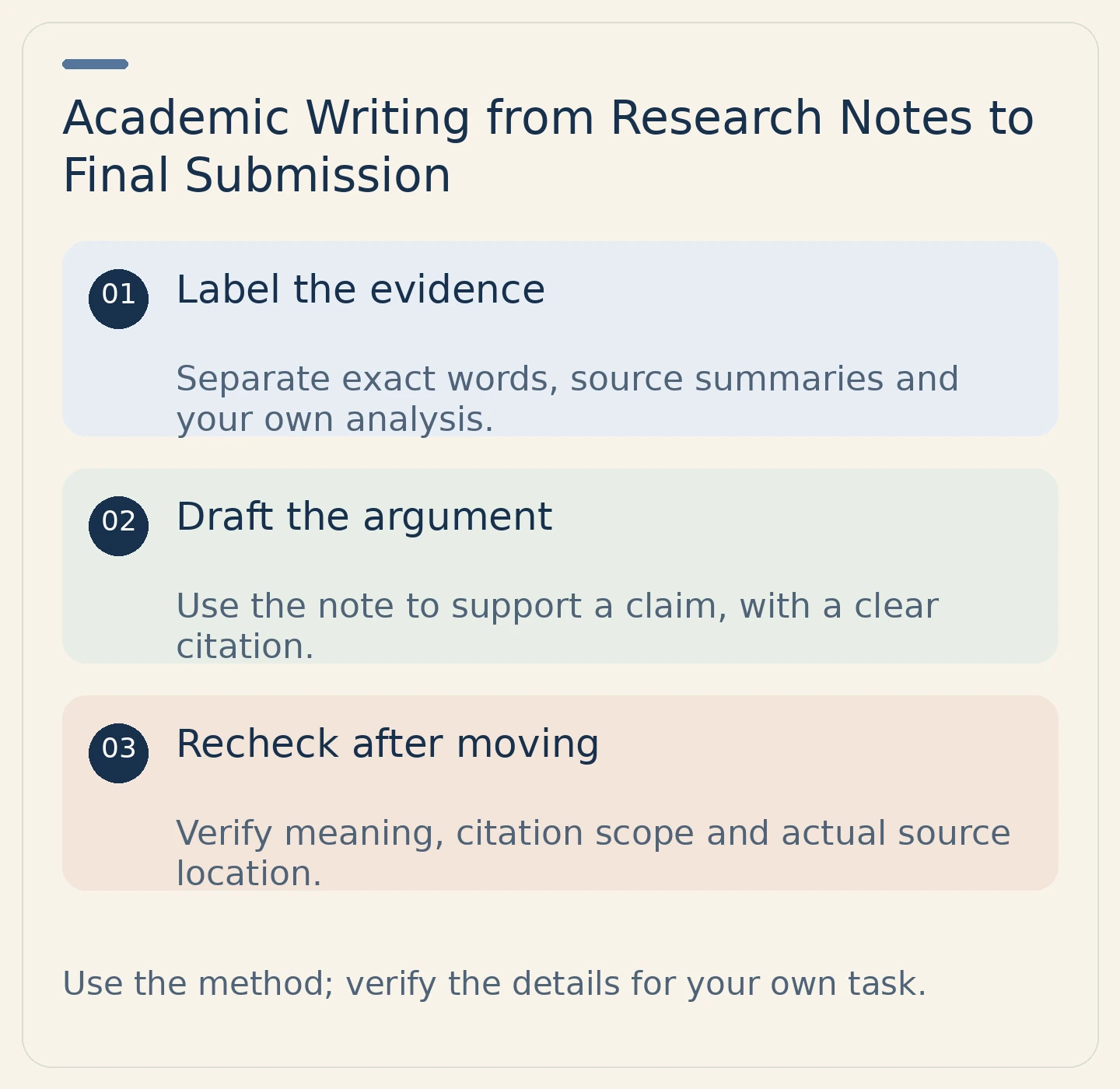
After moving the paragraph, check the citation again. A source label attached to an earlier sentence may no longer cover the borrowed idea. Reopen the actual source whenever the scope or meaning is unclear.
Pause when the trail breaks
An isolated quotation without a location is unfinished material, not permission to invent a page number. Search the edition you actually used. If you cannot verify it, remove the quotation or replace it with evidence you can check. When you encountered an author through another publication, obtain the original where possible; otherwise follow the assigned rules for secondary citation and make the route honest.
Review sources and report feedback together
Audit borrowed ideas, data and quotations throughout the draft, including captions and appendices. Check the correspondence between citations and references as your style requires. A correct-looking reference is not enough: the source must support the precise claim.
If your course provides draft-report access, read meaningful matches in context. Turnitin’s student guide explains that similarity is not itself a plagiarism judgment and that legitimate quotations can match. Do not delete necessary references or scramble accurate language to change a percentage. Repair missing attribution, copied wording or excessive dependence on a source.
Finish with a reader and file check
- Confirm that the introduction answers the task and the conclusion stays within the evidence.
- Read for paragraph logic, clear terminology and unnecessary repetition before polishing punctuation.
- Verify quotations and citations after the final language edits.
- Open the required submission file and inspect references, figures and special characters.
- Upload the intended version through the authorized route and retain the confirmation, notes and genuine drafts.
Related practical guides
For a separate evidence check, use the citation readiness guide; for the final handoff, use the pre-submission checklist. These are supplementary resources, not your institution’s submission system or policy.
Sources and scope
Further reading: University of Toronto: How Not to Plagiarize; University of Toronto: Using Quotations; Turnitin: Understanding the similarity score for students. Institutional examples apply to their own settings; follow the requirements governing your work.