
Citation checking involves more than matching names in the text to names in a reference list. You also need to establish that a source exists, that you consulted the relevant material and that it supports the precise claim attached to it. Treat these as separate checks within a complete writing workflow. A reference manager or similarity report cannot establish all three for you.
Begin with the assignment and evidence plan
Confirm the task, rubric, source expectations, citation style, length and submission rules. Check permitted tools and assistance, including any disclosure requirements. Write a working answer and outline the evidence needed for its main points. This gives citation work a purpose: documenting the material that genuinely supports your argument.
As you research, save bibliographic details, the version consulted and actual page or section locations. Mark copied language as quotation immediately. Keep source summaries separate from your analysis and note how each item may contribute to the paper. Read the underlying source rather than treating a search snippet or generated summary as consultation.
Draft first-hand understanding with attribution
Build paragraphs around your own claims and reasoning. Explain the evidence, then identify its significance and limits. Paraphrase from understanding, compare with the original for accuracy and cite the idea. If exact wording matters, use quotation formatting and the locators required by the assigned style. The University of Toronto’s source guidance explains why a bibliography alone does not tell readers which ideas are borrowed.
Do not postpone every citation until the draft is complete. Insert enough accurate information during writing to keep the source trail intact. Temporary reminders are useful only if you resolve them before submission; they are not publishable references.
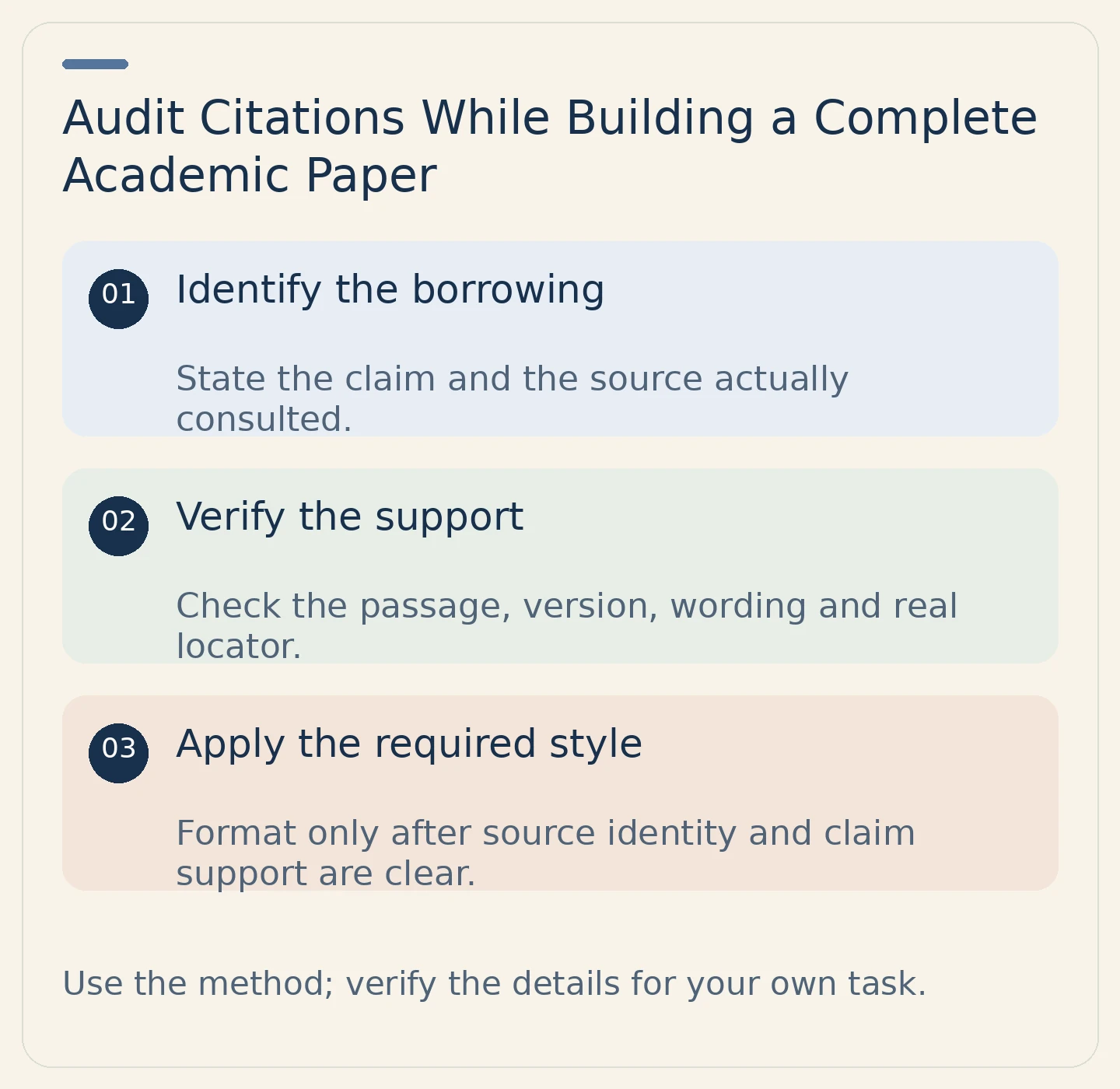
Run a claim-to-source audit
Use one row per important borrowing, not just one row per reference. The same source may support one sentence but not another.
| Audit field | Question | If the check fails |
|---|---|---|
| Claim | What exactly am I asserting? | Narrow vague or exaggerated wording |
| Actual source | Which consulted work contains the support? | Recover it or replace the unsupported material |
| Evidence location | Where does the source support this point? | Find the real passage; never invent a locator |
| Identity and version | Are author, title, date and edition correct? | Correct the record against the material used |
| Expression | Is this a quotation, paraphrase or my analysis? | Restore quotation marks or clarify attribution |
| Required format | How should this source type be documented? | Consult the assigned style and course guidance |
A DOI that resolves proves a retrieval route, not that the article supports your conclusion. Read the relevant passage in context. Likewise, a polished citation can identify the wrong edition or attach a real source to a claim it never made.
Resolve difficult cases honestly
If a source has no page numbers, check the style’s permitted alternatives for that source type. Do not manufacture pagination. If the author is unclear, inspect the publication itself and then consult the relevant rule; a missing personal name does not justify guessing one.
Different versions may have different wording or locations. Cite the version actually consulted and check quotations against it. When an idea reaches you through another author, obtain the original where practical. If that is not possible, follow secondary-citation rules without pretending to have read it firsthand.
Illustrative audit example: a paragraph claims that an intervention improved outcomes, but the consulted passage describes only participants’ expectations. Correcting the reference punctuation will not repair the mismatch. The author must find suitable outcome evidence, narrow the claim to expectations or remove it.
Check the reference system without inventing universal rules
Apply the required correspondence between in-text citations, notes and reference entries. Exceptions depend on the system and source type: personal communications and a separate bibliography of further reading may be handled differently. Do not force every assignment into the same one-to-one rule.
Recheck citation scope after moving paragraphs or accepting language edits. A removed reporting phrase can make a source’s view sound like your own conclusion.
Complete the wider review
If permitted, use Turnitin matches as another source-use check. The official student guide explains that a similarity score is not a plagiarism judgment. Investigate actual passages; a low score does not validate an unsupported citation.
Finally check task alignment, reasoning, readability and required disclosures. Open the final file, inspect quotations, footnotes, captions and references, and submit the intended version through the authorized route. Keep the confirmation and genuine records. A successful audit leaves a reader able to locate your evidence and understand what it establishes.
Related practical guides
For a separate evidence check, use the citation readiness guide; for the final handoff, use the pre-submission checklist. These are supplementary resources, not your institution’s submission system or policy.
Sources and scope
Further reading: University of Toronto: How Not to Plagiarize; University of Toronto: Using Quotations; Turnitin: Understanding the similarity score for students. Institutional examples apply to their own settings; follow the requirements governing your work.