
Finishing the content and submitting the correct document are different achievements. A paper can be carefully revised yet lose footnotes in conversion or be replaced accidentally by an earlier draft. Protect the final handoff with a simple version-and-file routine, while remembering that technical checks cannot substitute for a strong argument and accurate sources.
Start with the actual assignment contract
Record the question, genre, rubric, length, required sources, citation style and deadline. Check the accepted file types, naming rules, identification or anonymity requirements, attachments and authorized submission route. Do not assume PDF, DOCX, a visible name or an anonymous file is always required.
Confirm rules for collaboration, proofreading, translation, AI assistance and reuse of earlier work. If draft reporting or resubmission is available, read the local conditions before relying on it. A technically accepted upload does not establish compliance with the academic requirements.
Build a reviewable source document
Read relevant sources and save their identities, versions and real locations. Mark copied wording, distinguish summaries from your own analysis and keep a clear trail into the draft. Outline a working answer and the reasons supporting it, then develop paragraphs with evidence and your explanation.
Paraphrase from understanding and verify against the original. Quote exact wording where necessary and cite borrowed ideas. The University of Toronto’s source guidance explains why independent wording still needs acknowledgment. Do not trust a formatted reference without checking that the material exists, was actually consulted and supports the claim.
Finish the content review before the handoff
Read the full paper for task alignment, logical structure and proportionate conclusions. Check evidence, quotation accuracy, citation scope and reference correspondence under the assigned style. Then review language for clarity, terminology and preserved qualifications.
If the course permits a Turnitin draft report, inspect meaningful matches in context. The official student guide explains that similarity is not a plagiarism judgment or a universal pass threshold. Correct genuine source-use problems rather than altering accurate language to change a number. Complete required assistance disclosures before calling the source document ready.
Freeze a version you can identify
Choose an unambiguous filename under the course’s rules and retain the reviewed source document. A private version label or dated folder may help you distinguish it from earlier drafts; do not put extra information into the submitted filename if the instructions prohibit it. Keep the working file and the upload file visibly separate.
The important rule is not a particular naming convention. It is knowing which content version produced the export you are about to submit. “Final,” “final-new” and “final-revised” are not reliable evidence of that relationship by themselves.
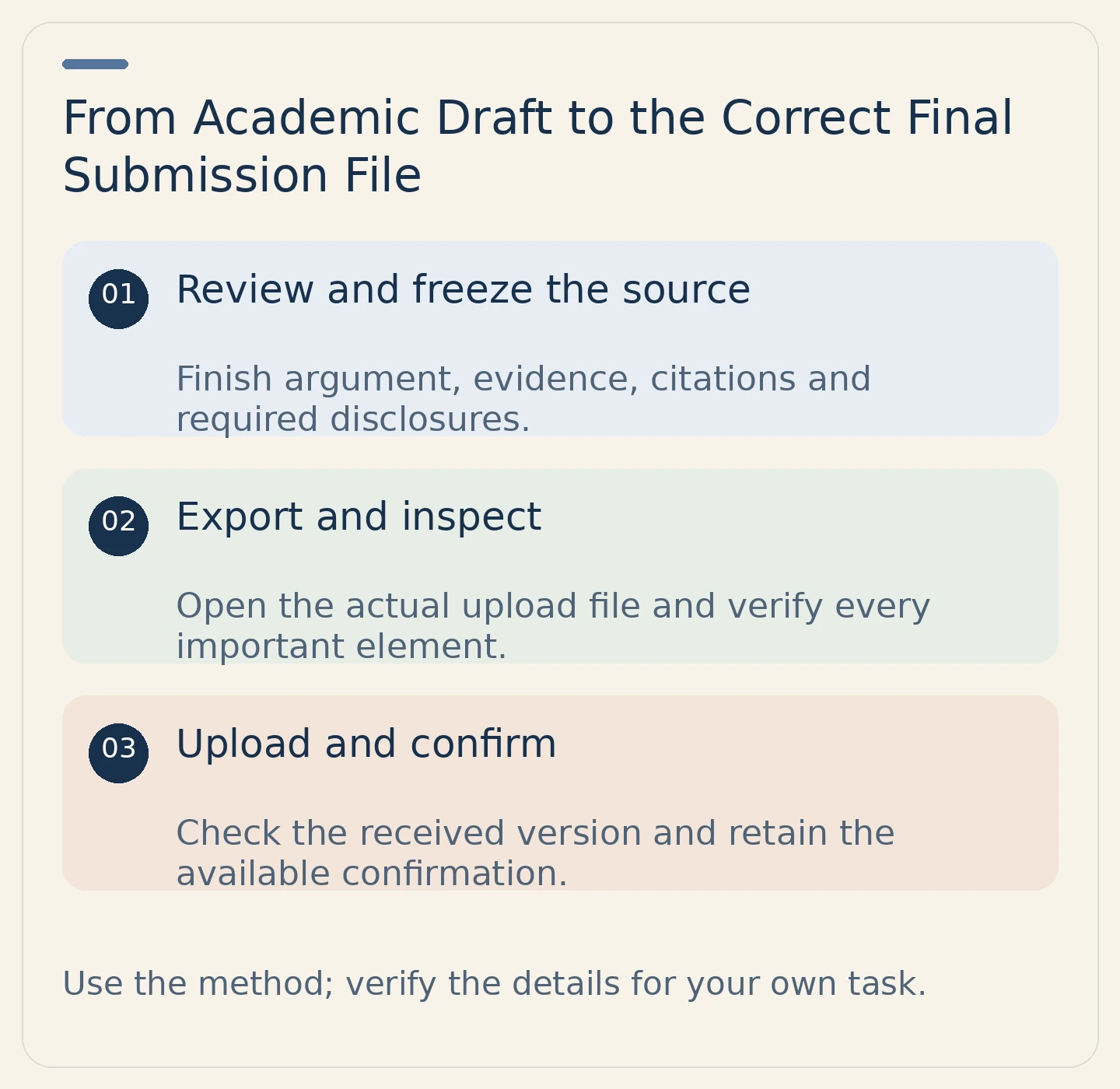
Open and inspect the exported file
Treat the export as a new document. Open it in a suitable viewer and compare important sections with the source file. Inspect more than the first page.
| Area | What to verify in the actual upload file |
|---|---|
| Quotations and references | Quotation marks, block formatting, citations and reference entries survived |
| Notes and cross-references | Footnotes, endnotes, numbering and internal references remain usable |
| Figures and tables | Content, labels, captions and source notes are complete and legible |
| Technical content | Equations, symbols, special characters and line breaks remain meaningful |
| Submission requirements | Required identification or anonymity, attachments and file type are correct |
| Final cleanup | Comments or tracked changes are handled according to instructions |
If something changed during export, fix the source or conversion process and produce a new file. Do not silently accept missing source notes because the upload page recognizes the file type.
Restart the chain after a late edit
Illustrative example, not a real submission record: you correct a quotation locator in the source document after exporting. The older export still contains the wrong locator. Generate a fresh export, check the affected passage and confirm that this is the file chosen for upload. Changing the source alone does not change a separate submitted file.
The same applies to a revised figure, corrected conclusion or updated declaration. Review the affected connections, then regenerate and inspect the file again. Avoid making a last-minute change whose consequences you cannot check.
Confirm what was received
Upload through the designated channel. Where the system allows it, inspect the received filename, preview or downloaded submission and verify the intended version and attachments. Save the receipt or confirmation. Do not assume unlimited replacement rights if the wrong file arrives; follow the course’s correction or support procedure.
Retain the reviewed source, actual submitted file and genuine notes and drafts. The final chain should be explainable: this reviewed content produced this inspected file, which was received through this submission route. That closes the technical handoff without confusing it with academic approval.
Related practical guides
For a separate evidence check, use the citation readiness guide; for the final handoff, use the pre-submission checklist. These are supplementary resources, not your institution’s submission system or policy.
Sources and scope
Further reading: University of Toronto: How Not to Plagiarize; University of Toronto: Using Quotations; Turnitin: Understanding the similarity score for students. Institutional examples apply to their own settings; follow the requirements governing your work.