
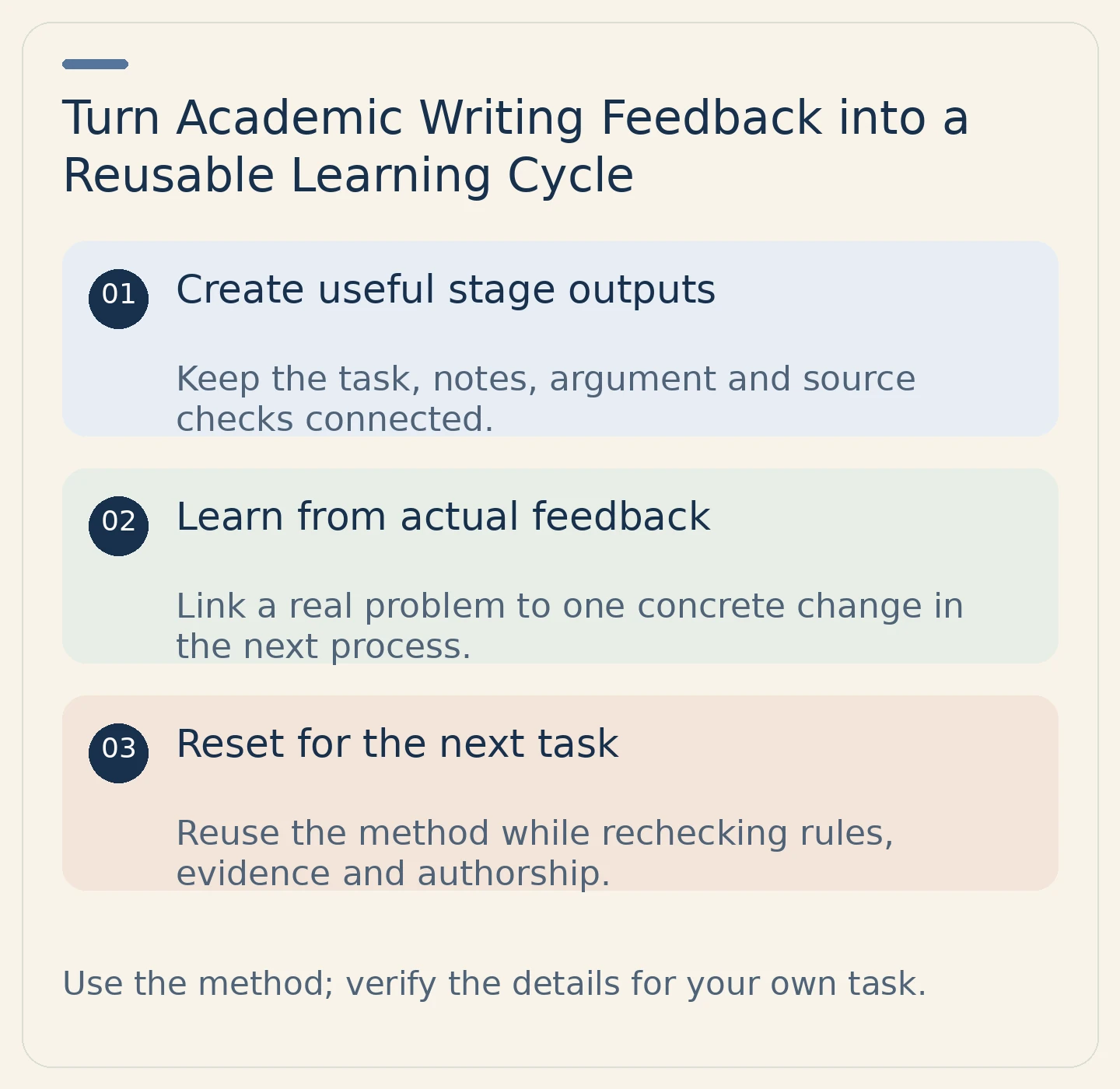
A useful writing checklist changes as you learn. It should preserve the steps that help you read, reason, cite and communicate, while adapting to each new assignment. After submission, use actual feedback to improve the method rather than simply storing another marked paper. Reuse your process—not assessed text, unverified references or permission rules from an earlier course.
Reset the task at the beginning of every assignment
Read the question, rubric, genre, source requirements, citation style, length and submission arrangements. Confirm the permitted scope of collaboration, proofreading, translation, AI support and reuse. A policy you remember from another class may not apply here.
Write a task statement and provisional answer. Identify the main reasons you need to develop and the evidence that could test them. This early thinking gives research a purpose but leaves room for your position to change as you read.
Give each stage a visible output
The output need not be elaborate. It should make the next step easier and offer a small check that the previous work is usable.
| Stage | Useful output | Lightweight checkpoint |
|---|---|---|
| Understand the task | Requirements note and working question | Does it include every part of the prompt? |
| Read and take notes | Traceable quotations, summaries and analysis | Can I recover the actual supporting passage? |
| Plan and draft | A developed answer with reasons and evidence | Can I explain what each section contributes? |
| Verify attribution | Checked borrowing and reference details | Are source views distinct from my interpretation? |
| Revise and prepare | Clear argument and inspected upload file | Do conclusions, citations and the final version agree? |
| Reflect after submission | One or two changes to the next process | Does each change address a real observed problem? |
Use the checkpoints to notice problems while they are manageable. Do not confuse producing a neat table with having completed the intellectual work.
Keep reading and drafting connected
Save the identity, version and real locations of useful sources. Mark exact wording immediately and keep it separate from summaries and your analysis. The University of Toronto’s plagiarism guidance recommends clear records and acknowledgment of borrowed ideas, not just a bibliography at the end.
Draft around the answer you are developing. Explain evidence in relation to the question rather than collecting quotations. To paraphrase, read for understanding, set the source aside, draft independently and compare with the original. Preserve qualifications and cite the idea. Quote exact language when its wording matters, using the required style and actual locators.
If you write in an additional language, keep technical terms consistent and check that language edits preserve scope, uncertainty and source ownership. Seek focused, permitted help without outsourcing your argument or accepting wording you cannot explain.
Make revision a source of information about your habits
First check task fit, structure and reasoning, then source accuracy and attribution, then language and formatting. If permitted, use Turnitin matches to investigate actual source use. Its official student guide explains that similarity is not a plagiarism judgment. An unchanging or lower score is not, by itself, evidence that you learned a better writing method.
Record recurring problems concretely. “My writing is bad” gives no useful direction. “I moved evidence but left the citation behind” suggests a specific checkpoint after paragraph movement. “I described both texts without comparing them” suggests writing shared comparison criteria before the next outline.
Reflect on real feedback without inventing success
After receiving comments, choose a small number of issues that you understand and can act on. Separate the problem, its likely process cause and the next action. If a comment is unclear, seek clarification rather than treating your guess as the instructor’s meaning.
Illustrative reflection, not a real student result: “The feedback says my conclusion went beyond the evidence. Next time I will compare each concluding claim with the evidence already discussed before polishing the final paragraph.” This is a proposed habit, not proof that a future grade will improve.
Keep what worked only when you can identify why it helped. A last-minute successful upload is not evidence that leaving no buffer is a good method. A favorable report does not validate weak citations.
Reuse methods while resetting evidence and permission
Carry forward a blank note template, a source-audit method or a focused question for feedback. Rebuild the content, evidence and argument for the new task. Do not reuse previously assessed prose or shared project material without checking the applicable permission and acknowledgment rules. Self-authorship does not automatically authorize resubmission.
Close each cycle responsibly
Inspect the required file after export, verify disclosures and attachments, upload the intended version and retain confirmation. Preserve genuine notes, drafts and feedback in line with institutional guidance. Review your process template before the next assignment and remove steps that are only busywork. The aim is a flexible system that helps you think more clearly, not a fixed checklist that replaces judgment.
Related practical guides
For a separate evidence check, use the citation readiness guide; for the final handoff, use the pre-submission checklist. These are supplementary resources, not your institution’s submission system or policy.
Sources and scope
Further reading: University of Toronto: How Not to Plagiarize; University of Toronto: Using Quotations; Turnitin: Understanding the similarity score for students. Institutional examples apply to their own settings; follow the requirements governing your work.