
A source can be reputable and still be wrong for the claim you want to make. An official report may describe one population, while your paper discusses another; a scholarly article may explain a concept without testing the outcome you are asserting. Strong academic writing requires evaluating the fit between evidence and claim, then carrying that judgment into the paragraph itself.
Define the evidence your assignment needs
Read the question, rubric, required source types, citation style and submission rules. Check permitted collaboration, language support and AI use. Write a working answer and identify what kind of support each main point needs: a definition, an interpretation of a text, a comparison, or evidence about a particular outcome. These are different jobs, not interchangeable opportunities to add references.
Search using the central concepts and relevant context. Read promising sources beyond a title, abstract or search snippet. Record full bibliographic details and actual locations while keeping quotations, source summaries and your analysis separate.
Evaluate a source in relation to a particular claim
Do not reduce source evaluation to a hierarchy in which “official” or “peer reviewed” automatically wins. Ask who produced the material, what question it addresses, how its evidence was obtained and what its limitations mean for your argument. A publication date matters differently for a historical primary text and a claim about a current policy.
Use a small decision table while reading:
| Check | What to record | Possible decision |
|---|---|---|
| Relevance | The exact claim this source could support | Keep for that claim, not every nearby assertion |
| Evidence | Data, textual reasoning or other support actually supplied | Use cautiously if the support is indirect |
| Context | Population, definitions, period and setting | Limit the wording to the applicable context |
| Identity | Author, publisher, publication type and version | Investigate unclear provenance before relying on it |
| Limitations | What the source cannot establish | Seek additional evidence or remove an overclaim |
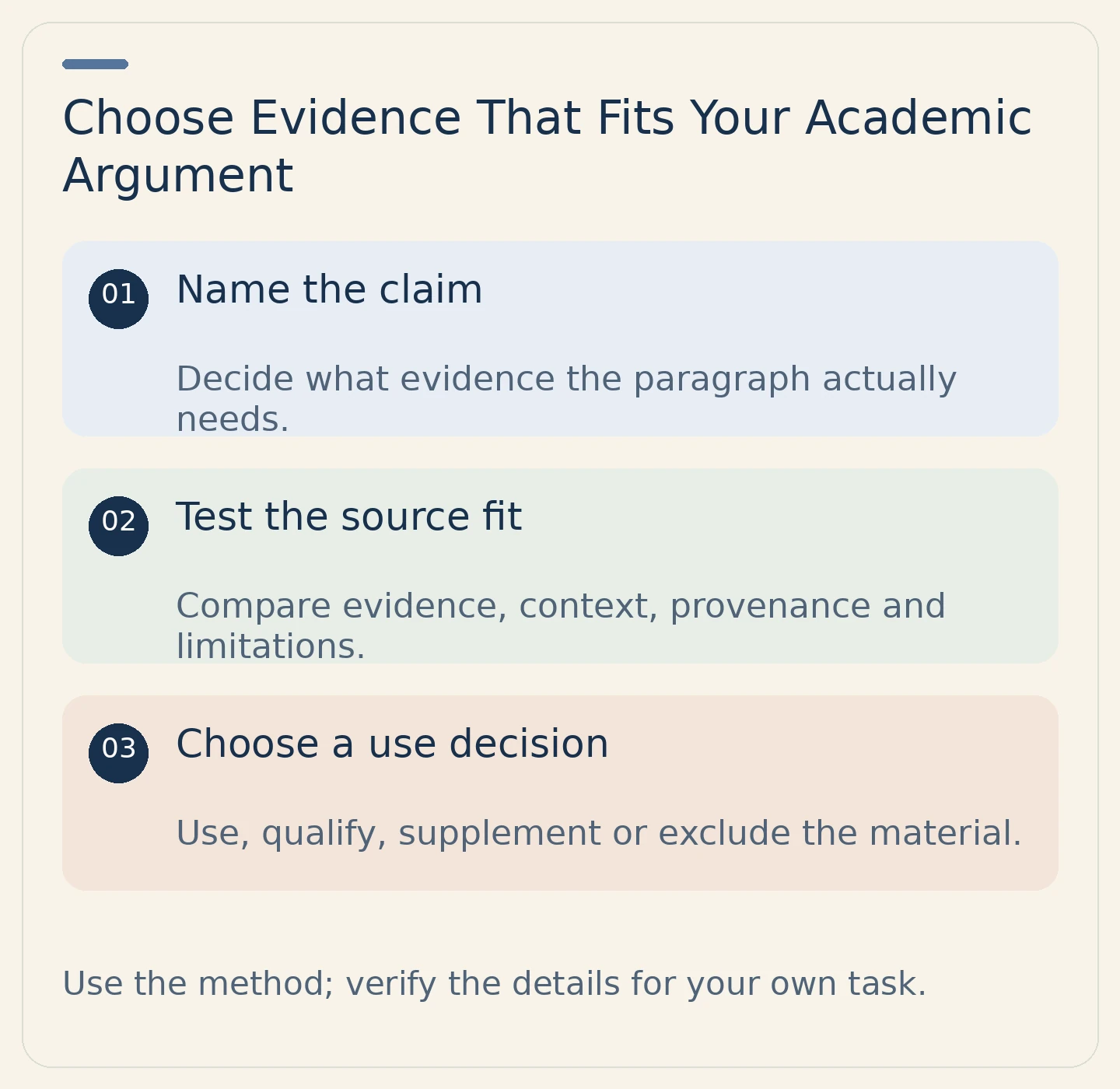
These checks help you choose an action: use, qualify, supplement or exclude. They are not a numerical credibility score. A source you exclude from one claim may still be useful for background or for showing a disputed position.
Investigate disagreements before choosing sides
When two sources seem to conflict, compare the questions they ask. Are they defining the same term? Studying the same population? Measuring the same outcome over a comparable period? Read the methods and the authors’ own limitations where relevant. Sometimes the apparent disagreement is a difference in scope rather than a direct contradiction.
Illustrative example, not a real finding: one teaching source discusses students’ satisfaction with feedback, while another concerns the accuracy of revisions. You cannot treat satisfaction and revision accuracy as the same outcome, or conclude that one source disproves the other. A better paragraph distinguishes the outcomes and explains why both may matter to the assignment’s question.
Turn evaluation into a paragraph
Plan the paragraph around your point rather than a list of publications. Introduce what the evidence establishes, explain the relationship to your argument and state the relevant limit. Use language such as “in the setting examined” only when it accurately describes the source, not as decorative caution.
Paraphrase independently from understanding, then compare your account with the original. Preserve qualifications and necessary technical terms. Quote exact wording when its language matters, and cite borrowed ideas even when the phrasing is yours. The University of Toronto’s guidance on source acknowledgment supports this distinction between your argument and the work you draw upon.
Review attribution and report feedback
Check source identity, quotation accuracy and real locators before standardizing citation format. Confirm citation-reference correspondence under the assigned style. Do not cite an original work as though you read it when you only encountered a secondary account.
If draft-report access is permitted, inspect meaningful Turnitin matches and their context. The official student guide explains that matching text is not itself a plagiarism verdict. A low score cannot tell you whether a source supports your conclusion. Correct copied wording or missing attribution, but evaluate evidence across the entire paper, including unhighlighted claims.
Final submission checklist
- Does every major claim have evidence suited to its scope?
- Have disagreements been represented fairly rather than resolved by reputation alone?
- Does your own explanation connect the evidence to the working answer?
- Are sources, citations, captions and references accurate after revision?
- Is the prose clear, the required assistance disclosed and the uploaded file complete?
Retain the final version, source notes and submission confirmation. The useful result of evaluation is not a longer bibliography; it is a more defensible argument.
Related practical guides
For a separate evidence check, use the citation readiness guide; for the final handoff, use the pre-submission checklist. These are supplementary resources, not your institution’s submission system or policy.
Sources and scope
Further reading: University of Toronto: How Not to Plagiarize; Turnitin: Understanding the similarity score for students. Institutional examples apply to their own settings; follow the requirements governing your work.