
The wait hidden in almost done
Imagine a group member waiting to write an analysis because another person has promised a comparison table. The message says the table is almost done. An hour later, it is still almost done. No one knows whether the missing piece is a heading, half the material, or a decision about what the table should compare. The delay is inconvenient, but the uncertainty makes it harder to manage.
A group can sometimes absorb late work. It has more difficulty planning around work whose condition cannot be described. Almost done sounds reassuring while withholding the information someone else needs to decide whether to wait, begin a different section, or ask for a smaller handoff. Reliability lives partly in this ordinary space between what a promise sounds like and what another person can do with it.
A promise has an object
A useful commitment names something recognizable: a table with the first two comparisons entered, an annotated diagram, or a paragraph explaining one disagreement. It need not promise the final form of the entire contribution. In fact, a smaller object may be more helpful if it releases the next task. The group can inspect it, discover a misunderstanding, and decide what remains necessary before more effort accumulates.
Specificity also reveals dependencies. A table cannot be finished if the group has not agreed on the comparison categories. Calling that an individual delay conceals a shared decision. Once the promised object is described, the group can distinguish work that is incomplete because it needs time from work that is blocked because an assumption has not been settled. Those situations call for different responses.
Put uncertainty before the deadline
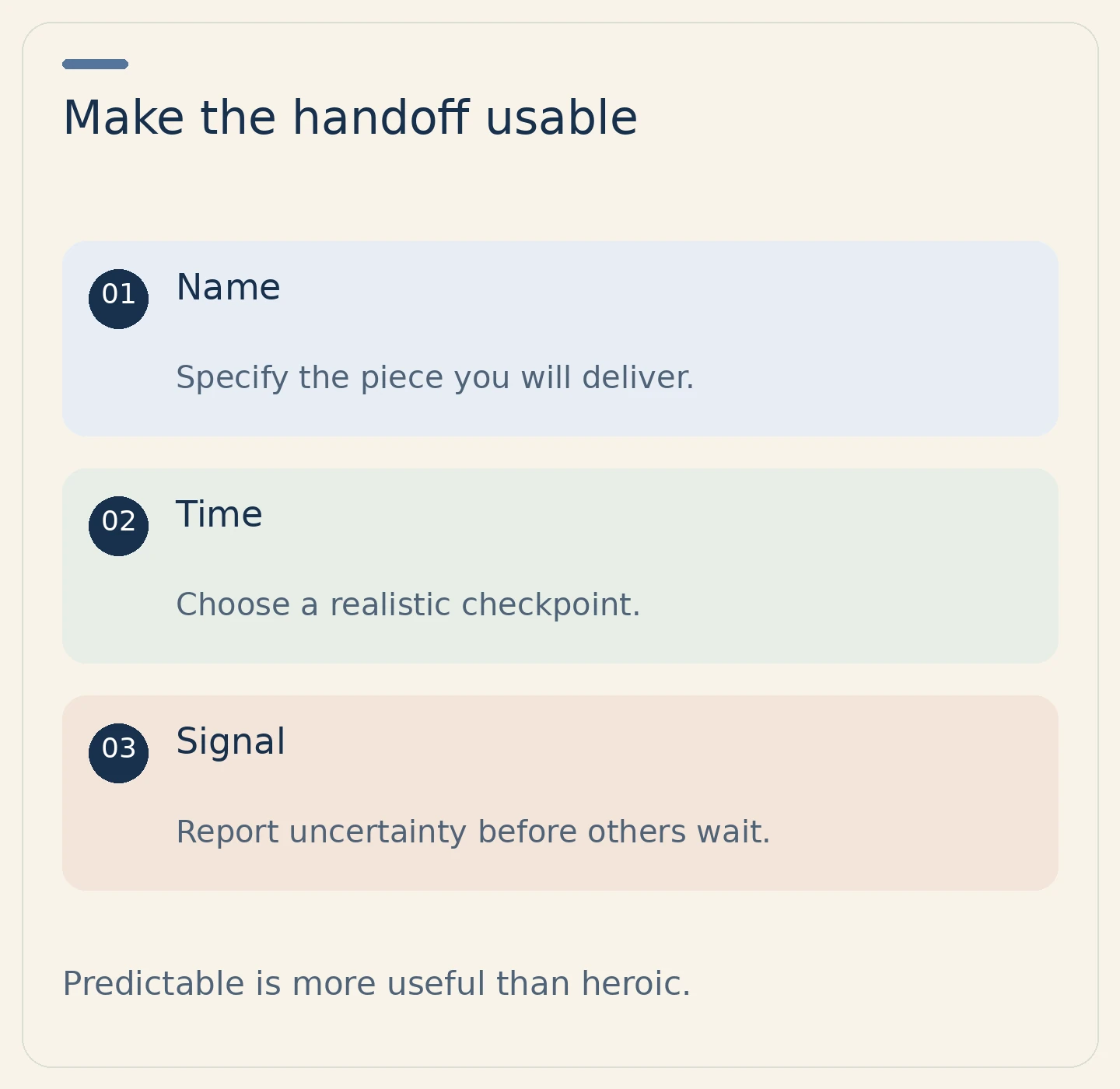
The imagined contributor could replace almost done with a short, concrete account: the first comparison is drafted; the second depends on a missing definition; a partial table will be available at the agreed checkpoint. This is not an impressive update. It is a useful one. It allows the waiting member to begin what can be begun without mistaking a provisional piece for a finished judgment.
The small experiment is to make one next promise contain a deliverable and a realistic time for checking it. If the promise becomes doubtful, update it before the other person has organized their evening around it. Early uncertainty can feel like letting the group down, but concealed uncertainty transfers the difficulty to someone else. Honesty gives the group a chance to choose rather than simply inherit the delay.
Not everyone has equal room
Specific promises should not become a demand that every person make the same schedule or disclose private circumstances. Paid work, caring responsibilities, accessibility needs, and unexpected interruptions can change what is feasible. A group can ask what will be available and when without requiring a personal explanation for every limit. The purpose of the commitment is coordination, not a ranking of whose life permits the most visible availability.
When rescue becomes the arrangement
There is also a danger in making the most reliable person responsible for every failure. Repeated rescue can hide a broken arrangement. If someone always repairs the handoff at midnight, the group may never reconsider its scope or division of work. Reliability includes naming a limit: this piece can be delivered, but the whole missing section cannot. A boundary can make a promise more trustworthy rather than less generous.
Quiet work that others can use
The partial table in the imagined group might not look polished. It may nevertheless let the next member test a comparison and discover that the headings need changing. A grand final delivery the following day would have arrived too late for that discovery to shape the work. What mattered was not only the amount produced but the point at which it became available to another person.
This changes the picture of a good collaborator. The admirable figure is not always the person who performs an exhausting rescue in the final hours. It may be the person whose modest, accurate updates let everyone else work with fewer guesses. A small promise becomes significant because it creates a piece of shared time: an interval in which another person's plans can reasonably rest on yours.