
A finished draft in the group chat
Imagine opening a group chat while struggling with a section that refuses to settle. Another person has posted a polished page and announced that their draft is complete. The comparison feels immediate: they are finished; you are still stuck. Yet the two visible facts do not contain the information needed to judge the difference. The page says little about the work that came before it.
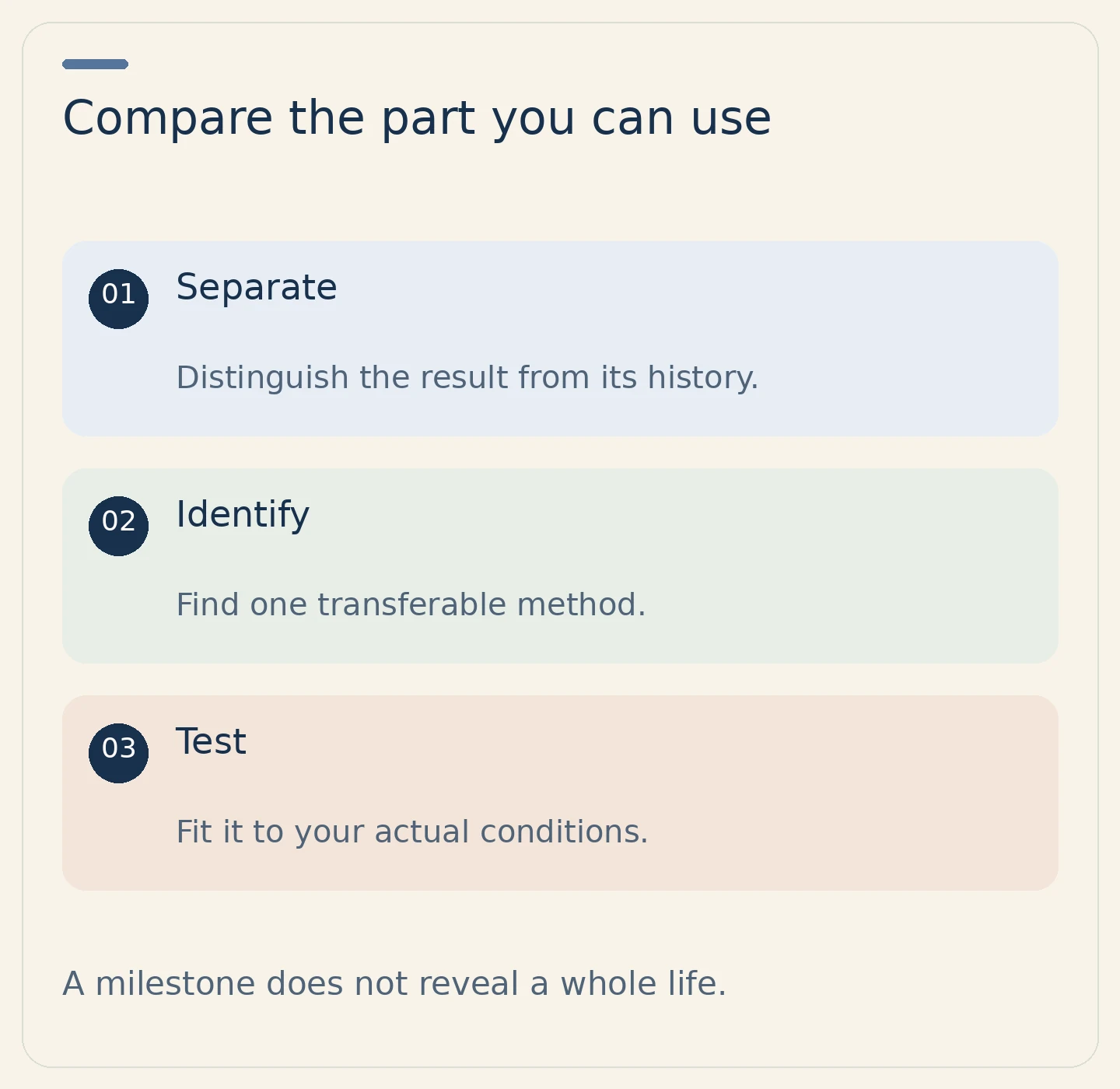
Perhaps the other writer began with material from an earlier project. Perhaps their question is narrower, their draft rougher than the excerpt suggests, or their available working time different. None of these possibilities should be invented as an explanation that makes the comparison feel better. Their value is to mark what is unknown. A milestone is an event in someone else's process, not a complete account of that process.
Missing conditions are not excuses
Recognizing different circumstances can sound like an attempt to avoid responsibility. But a realistic account of a task requires its conditions. Comparing completion dates without knowing starting points is not a demanding assessment; it is an incomplete one. A person can still ask whether their own approach needs changing. That question becomes more useful when it is not answered by imagining that another person's life is simply more disciplined.
There is a similar danger in idealizing the other writer's method. A finished draft does not prove that every habit behind it should be copied. An approach can work because of knowledge, support, or task features that do not transfer. Borrowing the appearance of the process may therefore add strain without improving the work. The comparison needs to move from a whole person to a specific practice with identifiable conditions.
Ask about the movable part
A small experiment is to identify one method behind a visible result that could reasonably be tried. If a conversation is welcome, the question might concern how the writer narrowed the topic or where they began when the middle became difficult. The useful answer is something bounded, such as drafting the comparison before the opening, rather than an account of how to become as productive as they appear.
Then the method needs adapting. Drafting the comparison first might suit the current essay, or it might fail because the relevant material has not yet been selected. That failure is information about fit, not proof that the borrower lacks the other person's ability. A method is portable only to the extent that its working conditions can be recreated or sensibly changed. Copying a schedule without those conditions is closer to imitation than learning.
Keep the unknowns unknown
The group chat can also prompt intrusive speculation. It is tempting to explain another person's speed through imagined privilege, effortless talent, or hidden shortcuts. Such stories may protect pride temporarily, but they are still stories. Respecting the limits of the available information means not turning an incomplete comparison into either self-accusation or an accusation against the person whose progress happened to be visible.
Sometimes the most accurate conclusion is that the update offers no useful method at all. It may simply be news shared by someone pleased to have finished. Not every glimpse of another person's work needs to become a lesson about one's own. Leaving the update at that scale preserves the possibility of being glad for someone without submitting to a timetable their message never actually proposed.
A smaller, more informative comparison
The imagined writer might eventually test one borrowed practice: write the unresolved comparison in plain sentences before revising the surrounding section. The relevant comparison is now between their own work before and after that experiment. Did the missing distinction become clearer? Did the task become more manageable? These questions can be answered from the actual material rather than from the brightness of someone else's announcement.
Other people's progress can be a source of useful contact with unfamiliar methods. It becomes less useful when it is treated as evidence of how an entire life should be arranged. A milestone shows that someone reached a point. It does not establish the road you must take or the hour at which you should arrive. The transferable gift, when there is one, is usually smaller than the life the comparison first invited you to borrow.