
Not every reversal is growth
Changing an opinion can be thoughtful, careless, socially convenient, or simply temporary. The fact of change does not tell us which. A record of the reason is more revealing than a celebration of being open-minded. It shows whether new material altered the judgment, whether a premise failed, or whether the writer merely moved toward the view that felt easier to hold in the moment.
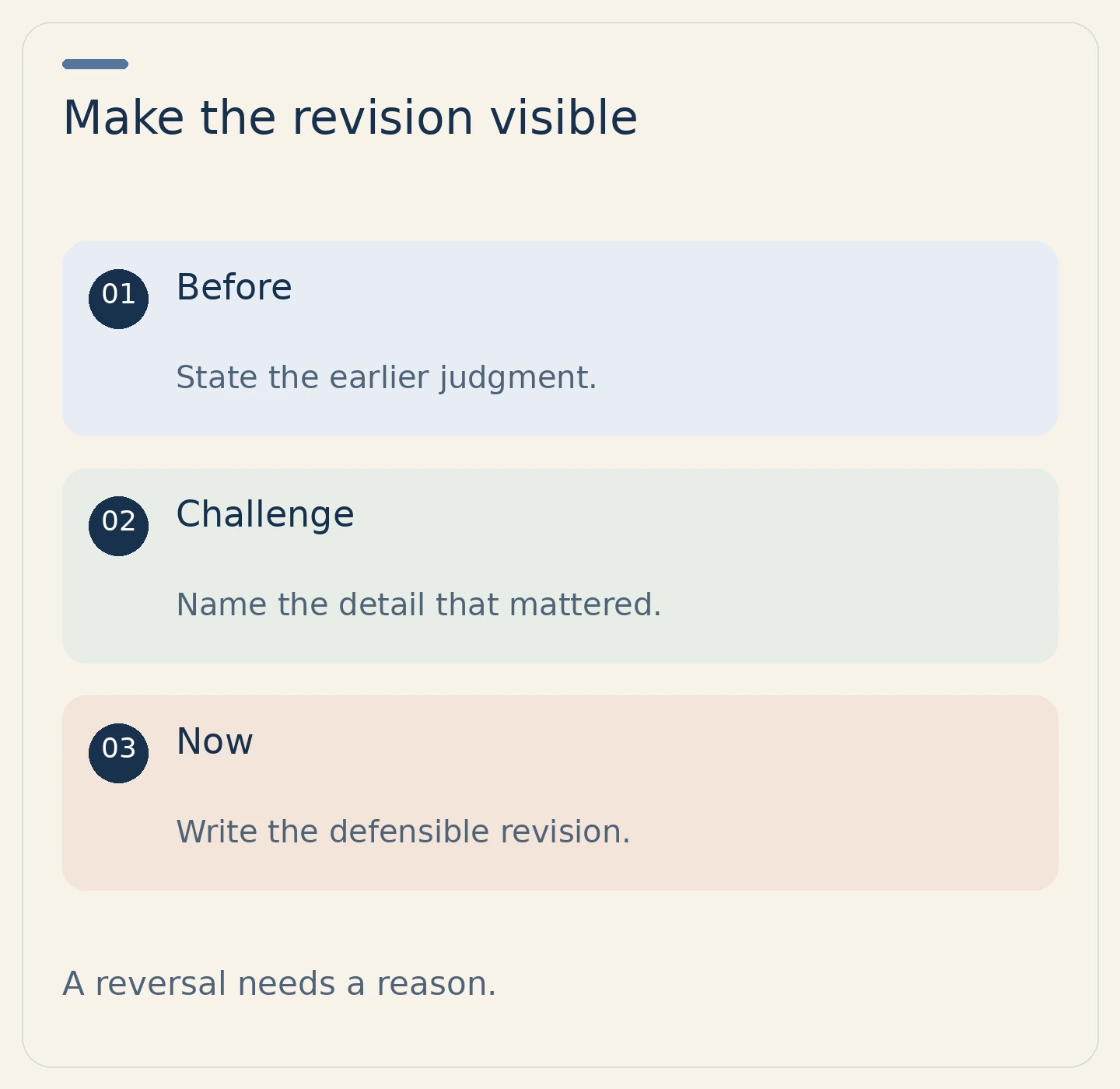
This matters because an earlier opinion can become embarrassing once its limits are visible. The temptation is to erase it and write as though the new view had always been obvious. Yet the contrast contains useful information. It identifies what the writer previously assumed and what kind of detail was strong enough to disturb that assumption. Removing the history can hide the very development worth understanding.
A deliberately constructed reading scene
Imagine a reader beginning with the judgment that booking systems always make shared facilities fairer. In this constructed example, a later passage describes a booking arrangement that requires users to commit far ahead, while some potential users cannot predict their availability. No real study is being reported here. The scene is a way to inspect how a specific detail could challenge a broad initial claim.
The detail does not prove that booking systems are unfair. It challenges the word always. The reader can now distinguish protection from arbitrary competition from the possibility of excluding people whose schedules are uncertain. A narrower judgment might be that bookings can improve fairness when the way of reserving access does not systematically disadvantage the people the facility is meant to serve. The new view has conditions the old one lacked.
Keep three lines, not a confession
A small experiment is to record the old judgment, the challenging detail, and the claim that can now be defended. Each line needs enough specificity to show a relationship. The middle line is especially important. Without it, the record contains two opinions but no account of why one replaced the other. The reader can mistake motion for progress because the second statement sounds more nuanced.
The note need not dramatize personal transformation. A modest correction may be more accurate than a story of sudden enlightenment. Perhaps the detail merely lowers confidence, or reveals that a term was being used in two different senses. Those are changes too. Recording their scale avoids the pressure to make every reading session produce a major conversion in order to count as intellectually alive.
Do not revise beyond the reason
A challenging example can be vivid without being decisive. The reader needs to ask how far it warrants moving. In the constructed booking scene, the scheduling barrier refutes an unrestricted claim, but it does not establish the frequency of that barrier or the best alternative arrangement. A responsible record preserves that limit. It does not turn one compelling detail into permission for an equally sweeping reversal.
The new judgment also remains revisable. Another detail may show that flexible reservations or alternative access change the issue. Keeping the reason visible helps the writer respond proportionately rather than defend the latest position merely because it is now their own. The purpose of the note is not to produce a final, superior self. It is to keep the connection between the claim and its support available for further inspection.
The old sentence still has a use
The imagined reader may later revisit the first statement with less embarrassment. It was too broad, but its attraction is now understandable: predictable allocation looked like protection from favoritism. The revised account preserves that concern while recognizing another. Intellectual development can involve adding a neglected condition rather than declaring every part of the earlier thought worthless. A reasoned change often carries something forward.
That continuity gives the record its value. It shows not only that the writer changed sides, but what they learned to notice. A crossed-out opinion can look like a mistake removed from view. An explained revision becomes a map of attention: this detail mattered, this assumption no longer held, and this is the smaller claim that survived. The movement is meaningful because the route, not just the destination, remains visible.