How to Lower Turnitin AI Score Ethically: Revision Playbook
Understand why AI detectors flag uniform cadence and generic transitions, then apply sentence-level revision moves with real Before-and-After rewrites to strengthen critical voice ethically.

Key Takeaways: AI detectors do not read intent—they measure statistical predictability, uniform sentence rhythm, and generic transitional phrasing. Lowering a flagged AI score ethically means replacing vague boilerplate with specific empirical evidence, source citations, and varied analytical syntax—never running your draft through a synonym spinner.
Few moments in university life feel as disorienting as writing an essay from scratch—especially in a second language—only to see an unexpected AI-writing flag on a pre-check report. When you spent hours reading journal articles and drafting every sentence yourself, it is tempting to reach for a quick fix.
Pause before opening an online "paraphraser." Automated synonym swapping destroys technical precision while leaving the underlying statistical skeleton intact. As writing-center advisors see every semester, the most reliable way to lower an elevated AI score—and earn a stronger grade—is targeted, sentence-level revision that restores genuine scholarly reasoning.
Why AI Detectors Flag Even Human-Written Academic Drafts
Commercial AI classifiers estimate how likely a passage is to come from a large language model by measuring perplexity (how predictable each word choice is) and burstiness (how much sentence length and structure vary across a paragraph).
Cautious academic prose often mimics those statistical signatures, creating false positives for four common reasons:
- Monotonous sentence cadence: Four consecutive 18-to-22-word declarative sentences following a rigid *Subject–Verb–Object* template look highly uniform to a statistical model.
- Overused transitional signposts: Opening back-to-back sentences with *"Moreover," "Furthermore," "Additionally,"* and *"In conclusion"* creates a predictable scaffold that language models lean on heavily.
- Heavy grammar-polishing tools: Accepting every "clarity" rewrite from an automated grammar editor strips away natural phrasing and replaces it with smoothed, median-probability prose.
- Prompt-echoing summaries without evidence: Broad truisms (*"In today's rapidly evolving digital era, technology plays a pivotal role..."*) without a named study, dataset, or methodological caveat trigger high predictability scores.
Sentence-Level Revision Moves vs. Destructive Synonym Spinning
Trying to "humanize" text by blindly replacing words with thesaurus synonyms almost always backfires. Swapping *"academic performance"* for *"scholarly attainment"* alerts human graders immediately while keeping the repetitive clause structure underneath completely unchanged.
Ethical sentence-level revision works on logic and evidence, not cosmetic word swaps:
| Draft Symptom | Why AI Detectors Flag It | Ethical Sentence-Level Revision Move | Resulting Academic Benefit |
|---|---|---|---|
| Uniform 20-word sentences | Low syntactic variance (low burstiness) | Pair a crisp 9-word claim with a nuanced 28-word qualification | Sharpens rhetorical emphasis |
| Generic transitions (*Moreover*, *Furthermore*) | High-probability token openers | Link ideas via logical contrast (*Yet*, *Unlike prior trials*) | Clarifies exact causal relationships |
| Unanchored generalizations | Predictable textbook phrasing | Insert a named study, metric, sample size, or local context | Demonstrates real literature synthesis |
| Balanced "both-sides" filler | Neutral, non-committal hedging | Take an explicit stance and explain why one factor dominates | Strengthens critical evaluation |
| Over-smoothed grammar-app edits | Flattened lexical choices | Restore precise discipline terms and active verbs | Preserves authentic authorial voice |
Before-vs-After Academic Paragraph Rewrites
Notice how introducing specific citations, causal mechanisms, and rhythmic variation transforms flagged prose across disciplines.
Example 1: Education & Educational Technology
Before (Uniform cadence, vague framing, zero evidence):
Remote learning has become increasingly important in higher education in recent years. Moreover, it offers significant flexibility for students with work or family responsibilities. Furthermore, digital platforms enable instructors to share resources efficiently. However, online courses also present challenges related to engagement and isolation. Therefore, universities must balance technological convenience with effective pedagogical strategies.
*Why it flags:* Five 12-to-18-word sentences, four predictable transition adverbs (*Moreover, Furthermore, However, Therefore*), and zero empirical grounding.
After (Varied rhythm, cited evidence, sharp analytical tension):
Asynchronous coursework solves a scheduling problem, not an instructional one. While flexible modules let working undergraduates view lectures outside standard hours, retention data tell a sharper story: surveying 1,400 first-year students, Morales et al. (2024) found that unmoderated video courses saw a 19% drop in weekly discussion participation compared with synchronous seminars. Without structured peer checkpoints, convenience quietly becomes isolation. Effective online design therefore depends less on uploading content faster than on building low-stakes feedback loops into each week.
Example 2: Business & Sustainability Strategy
Before (Abstract claims, repetitive structure):
Corporate sustainability initiatives play a crucial role in modern business strategy. Companies that adopt environmentally friendly practices can improve brand reputation and attract socially conscious consumers. In addition, sustainable operations often reduce long-term energy costs. Nevertheless, implementing green supply chains requires substantial initial investment for smaller enterprises.
After (Concrete mechanism, disciplined stance, clear attribution):
Green branding rarely pays for itself in year one. Although surveys routinely link visible ESG commitments to higher brand trust, small manufacturers face a sharp capital bottleneck when retrofitting legacy equipment (Chen & Patel, 2023). Lower utility bills eventually offset part of that outlay, yet a four-to-seven-year payback horizon leaves cash-constrained suppliers vulnerable unless buyers co-finance compliance audits.
Before revising an entire paper blindly, inspect how detection markers actually cluster by reviewing a sample Turnin diagnostic report. Most flags concentrate in broad framing paragraphs rather than your data analysis.

A 5-Step Ethical Revision Playbook Before You Submit
Follow this practical workflow to strengthen your analytical voice and keep your writing unmistakably yours:
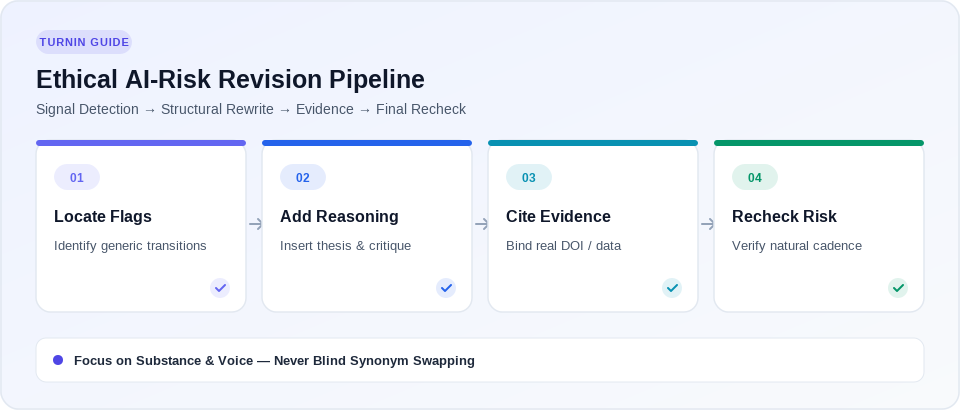
- Locate flagged clusters before editing. Run a diagnostic scan with Turnin's AI detection check to pinpoint which paragraphs read statistically flat, instead of rewriting strong sections needlessly.
- Audit every "floating" claim for missing evidence. Highlight any sentence lacking a named mechanism, example, metric, or peer-reviewed citation, and anchor it to your reading notes.
- Break rhythmic monotony deliberately. Read each paragraph aloud. Whenever three sentences share the same length or open with generic adverbs like *Moreover*, combine clauses or lead with an analytical contrast.
- Revise critically—never spin. If you use Turnin's guided AI-reduction workspace as an editing aid, treat flagged lines as prompts to inject your own argument, counter-evidence, and discipline terminology rather than swapping words mechanically.
- Run a final holistic pre-check. Finish with a Turnin similarity and AI pre-check to confirm that added citations are properly attributed and no accidental patchwriting remains. Save your outlines, annotated PDFs, and document version history—and remember that Turnin is an independent preparation platform, so your university's official Turnitin or institutional system and academic integrity policy always prevail.
Frequently Asked Questions
Does an online synonym paraphraser lower a Turnitin AI score safely?
No. Synonym spinners keep the same predictable sentence structure classifiers measure while introducing unnatural phrasing that professors spot immediately. Many universities also treat concealed paraphrasing tools as an integrity violation. Revising with real evidence and varied syntax is both safer and academically stronger.
What AI detection percentage is considered safe for university submission?
No universal threshold applies across all institutions. Many universities examine scores above 20% closely—and recognize that lower percentages carry higher false-positive rates on standard academic phrasing—alongside your citations and draft history. Always check your syllabus and defer to your university's official report.
How can I protect myself if my original draft triggers a false positive?
Strengthen overly uniform introduction or conclusion paragraphs with specific course readings, concrete examples, and varied sentence rhythm. Equally important, retain your Google Docs or Word version history, outlines, and research notes as clear proof of your authentic writing process.