When AI Detectors Penalize Non-Native Writers: An Evidence-Based Playbook for Compliant Academic Writing in 2026
Empirical audits and higher-education investigations continue to confirm that automated AI detectors disproportionately flag international students. Grounded in peer-reviewed evidence and 2026 institutional norms, this playbook explains how false positives happen, how to preserve authentic scholarly voice, and how to document compliance transparently.

Executive Takeaway: Honest international students are rarely flagged because their ideas lack originality; they are flagged because test-prep sentence templates and aggressive auto-polishing strip away the natural lexical variance that automated detectors associate with human prose. Protecting yourself in 2026 requires three disciplines: knowing your module's exact AI policy, writing with concrete analytical specificity, and maintaining an unbroken drafting trail.
Ask almost any postgraduate student writing in their second language what keeps them awake during submission week, and you will hear a remarkably consistent fear. It is no longer just the difficulty of reading thirty dense journal articles in English—it is the dread of pouring forty genuine hours into an essay only to receive an automated misconduct notice claiming half the manuscript was machine-generated.
That fear rests on hard evidence, not campus rumor. In a landmark empirical evaluation published in *Patterns*, Stanford researchers Liang et al. (2023) tested seven widely deployed GPT detectors and found that more than 61% of authentic TOEFL essays authored by non-native English writers were misclassified as AI-generated, whereas native US eighth-grade essays triggered near-zero false positives. Three years later, the operational fallout has still not disappeared: *University World News* (2026a) reported that automated AI detectors continue to unfairly penalize international students across higher education, even as parallel research asks how AI can responsibly broaden educational access (University World News, 2026b) and leading business schools such as ESCP redesign curricula to teach critical judgment alongside AI fluency (Study International, 2026).
1. The Technical Mechanism Behind Non-Native False Positives
Automated AI classifiers do not verify authorship the way a forensic investigator would. Instead, they estimate two statistical properties of prose: perplexity (how predictable each next word is relative to a language model's probability distribution) and burstiness (how much sentence length and syntactic complexity fluctuate from one sentence to the next).
Now think about how millions of international students were trained to pass IELTS, TOEFL, or GRE analytical writing:
- Stick to safe, high-frequency academic collocations (*plays a crucial role*, *highlights the importance of*, *in light of these findings*).
- Maintain uniform 20-word sentence lengths to minimize grammatical errors.
- Open every body paragraph with a predictable textbook signpost (*Furthermore*, *Moreover*, *In addition*).
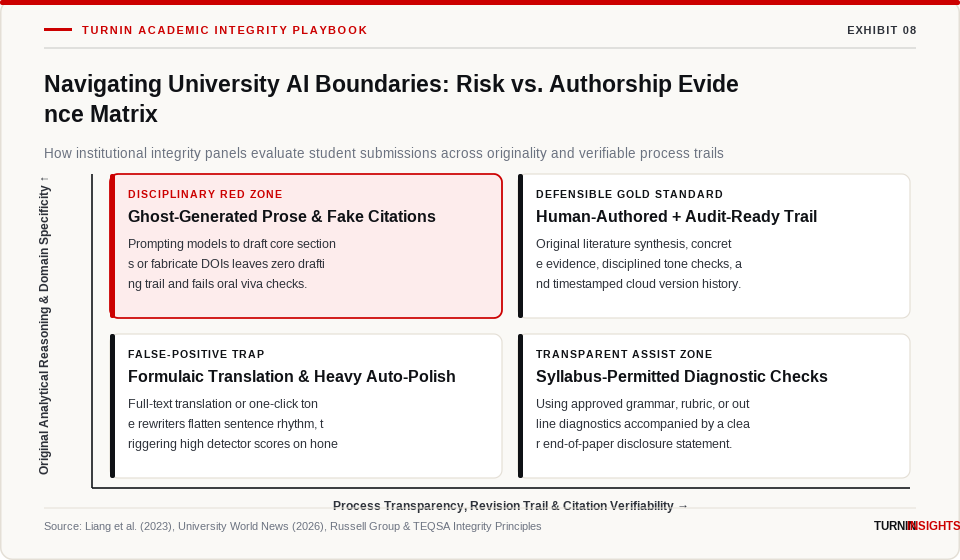
Statistically, disciplined second-language prose looks strikingly similar to the "most probable next token" output of a large language model (Liang et al., 2023). When a student then drafts in their first language and runs the entire document through a neural translator or a one-click "make it more formal" tool, whatever personal cadence remained gets ironed completely flat.
Interestingly, ICEF Monitor (2026) observed a parallel dynamic in how students themselves consume information: even as applicants rely more heavily on AI tools for initial study-abroad discovery, they increasingly crave authentic peer voices to validate real-world decisions. University markers react the exact same way when reading coursework—they immediately recognize the difference between generic boilerplate and a writer actively wrestling with real sources.
2. Before and After: What Authentic Scholarly Specificity Looks Like
Eliminating false-positive triggers does not mean injecting grammatical errors or swapping normal verbs for obscure thesaurus words. It means anchoring every claim to named institutions, concrete figures, and genuine analytical tension. Compare these two versions of the same paragraph:
| Dimension | Formulaic "High-False-Positive" Draft | Specific, Human-Authored Academic Revision |
|---|---|---|
| Sample Text | *Moreover, it is essential to recognize that artificial intelligence is transforming higher education in multifaceted ways. Universities must carefully navigate the balance between technological innovation and ethical standards to ensure equitable outcomes for all learners in the modern era.* | *Business schools are already moving beyond blanket bans toward structured accountability. ESCP, for instance, has begun redesigning management coursework around cross-cultural judgment under ambiguity rather than rote recall (Study International, 2026)—a shift that forces assessment rubrics to reward verifiable reasoning over polished surface prose.* |
| Why It Triggers / Clears | Stuffed with predictable abstract filler (essential, multifaceted, navigate the balance, modern era) and zero named evidence. | Names a specific institution, anchors the claim with a real 2026 citation, varies sentence length (12 words then 35 words), and links directly to assessment design. |
Notice how the revised passage is not only far less likely to trip a statistical detector—it also scores markedly higher on *Critical Analysis* and *Use of Evidence* in any UK, Australian, or North American marking rubric.
3. Four-Part Compliance Protocol for Every Assessed Paper
Step 1: Archive Your Module's Exact AI Policy Before Drafting
Universities no longer enforce one monolithic rule across every course. A statistics seminar may allow code debugging with disclosure, while a history tutorial prohibits any external paraphrasing tool. Screenshot the exact AI assessment tier from your module handbook and save it inside your assignment folder on day one.
Step 2: Draft Where Your Process Leaves Verifiable Proof
Avoid pasting finished blocks of text into an empty document hours before submission. Write iteratively inside Google Docs, Word Online, or Overleaf with version history enabled, and retain your annotated PDFs. If a marking panel ever asks how a chapter evolved, a clean timeline of outlines, revisions, and source notes—paired with an explicit document version comparison between your early draft and final manuscript—provides decisive authorship verification.
Step 3: Run Pre-Submission Diagnostics Responsibly
At least 12 to 24 hours before your portal closes, run two disciplined checks:
- First, verify quotation boundaries, paraphrase originality, and reference accuracy through a non-repository Turnitin similarity check so your draft is never prematurely stored in an institutional database.
- Second, if your non-native phrasing or translated passages still sound unnaturally uniform, use an academic tone and naturalness diagnostic to locate overly mechanical transitions—then rewrite those passages yourself using specific data points, contrasting scholarly perspectives, and natural sentence rhythm.
- Optionally, sanity-check your argument structure against marking criteria with an AI paper rubric review so you catch logical gaps early.
Step 4: Include a Crisp Disclosure Statement Whenever Permitted Tools Are Used
When a syllabus permits light grammar checking or structural feedback, transparency builds credibility. A two-sentence appendix note—specifying the tool, its narrow scope (e.g., spelling and punctuation verification), and confirmation that all arguments, data analyses, and citations were independently authored and verified—aligns cleanly with 2026 Russell Group, TEQSA, and North American academic integrity guidelines.
4. What to Do If You Receive an Academic Misconduct Inquiry
- Stay calm and avoid hasty admissions: Never apologize for "using AI" if you only used basic spellcheck or wrote the paper yourself. Request the full similarity/detection report and the specific flagged passages.
- Submit an organized authorship dossier: Package your cloud revision history, reading notes, source PDFs, and a concise 1-page explanation mapping how each section developed from your research question.
- Prepare to defend your own argument verbally: Academic integrity officers routinely ask students to explain two cited papers and one methodological limitation from memory. Knowing your own sources inside out remains the strongest proof of genuine scholarship.
5. Frequently Asked Questions
Q1: If universities admit AI detectors have false positives, why should I still check my paper before submitting? Because automated flags still act as administrative triggers. Even if you ultimately win an integrity hearing, the investigation can freeze your grade for weeks, delay progression boards, or complicate visa renewals. Preventing avoidable false positives is far less costly than appealing them.
Q2: Does basic spell-checking in Word or Grammarly count as unauthorized AI use? Most universities distinguish between mechanical proofreading (typos, subject-verb agreement, punctuation) and generative rewriting (substituting entire clauses or drafting new arguments). Stick to mechanical corrections, avoid one-click full-paragraph rewrites, and verify your module syllabus when in doubt.
Q3: What is the fastest way for non-native writers to sound naturally academic without memorizing clichés? Build a personal phrasebank directly from peer-reviewed articles in your own discipline—focusing on how authors frame disagreement, qualify limitations, and connect evidence to claims—rather than recycling generic test-prep templates.
References
- ICEF Monitor. (2026, November 26). *Use of AI for research about study abroad is increasing but so is demand for the advice of peers*. ICEF. https://monitor.icef.com/2026/11/use-of-ai-for-research-about-study-abroad-is-increasing-but-so-is-demand-for-the-advice-of-peers/
- Liang, W., Yuksekgonul, M., Mao, Y., Wu, E., & Zou, J. (2023). GPT detectors are biased against non-native English writers. *Patterns*, 4(7), 100779. https://doi.org/10.1016/j.patter.2023.100779
- Russell Group. (2024). *Russell Group principles on the use of generative AI tools in education*. Russell Group. https://russellgroup.ac.uk/media/6137/rg_ai_principles-final.pdf
- Study International. (2026, November 27). *ESCP: Rethinking business education for the age of AI*. Study International. https://studyinternational.com/news/escp-rethinking-business-education-for-the-age-of-ai/
- University World News. (2026a, November 14). *AI detectors unfairly penalise international students*. University World News. https://www.universityworldnews.com/
- University World News. (2026b, November 28). *New study – Can AI unlock access to higher education?* University World News. https://www.universityworldnews.com/