Reusing Your Own Papers: Self-Plagiarism & Citation Guide
Learn how to legally expand prior term papers, proposals, or capstones into new coursework or thesis chapters using written approval, self-citation, and non-repository overlap checks.
Key Takeaways: Submitting your own prior coursework without disclosure and permission is treated as self-plagiarism (text recycling or duplicate submission). To legally build on an earlier term paper, proposal, or capstone, secure written instructor approval first, ensure 60%–80%+ of the draft delivers new analysis (verify your syllabus rules), cite your earlier paper properly, and audit overlap using a diff check plus a non-repository similarity pre-check before uploading to your university portal.
Imagine spending October crafting a sharp 3,000-word seminar paper on urban microgrids, earning an A, and realizing in February that your core dataset fits naturally into your senior capstone. Copying your strongest literature review paragraphs feels harmless—after all, you wrote every word yourself. Yet the moment you upload that file to your campus portal, an automated similarity report could flag a 42% match against your own archived submission, triggering an academic integrity review for self-plagiarism.
In university writing, authorship does not grant a blank check for unlimited reuse. Most institutions classify uncredited text recycling and duplicate submissions as misconduct because graders award credit for *new* intellectual labor completed in the current course. Fortunately, scholarship is cumulative by design: once you understand where universities draw the line on permission, fresh analysis, and self-citation, you can ethically expand earlier work into stronger theses, capstones, and journal manuscripts.
Why Reusing Your Own Work Triggers Academic Integrity Flags
Universities distinguish sharply between duplicate submission (turning in essentially the same essay for two separate classes, often called "double-dipping") and authorized expansion (developing a preliminary proposal or seminar paper into a larger thesis chapter or publishable article). When instructors grade a paper, they evaluate whether you met that specific course's learning outcomes during that term.
Modern institutional similarity systems archive student submissions in a central database. When you submit a new file that borrows chunks from an earlier semester, the detector matches your prose word-for-word against your own prior record. Even worse, patching old paragraphs by swapping a few adjectives ("patch-writing") still leaves identical sentence skeletons and argument sequences intact. Without written authorization and clear self-citation, both your instructor and an academic conduct board will treat recycled prose as an attempt to pass off old credit as fresh work.
University Rules & Thresholds: Recycling vs. Legitimate Expansion
There is no single global percentage written into every syllabus, because reuse tolerances depend on academic level, discipline, and whether the earlier text was already graded. Always check your department handbook first, and use the benchmarks below as a practical starting point when planning an expansion.
| Reuse Scenario | Typical New-Content Expectation | Approval & Attribution Required? | Integrity Risk |
|---|---|---|---|
| Resubmitting a term paper to a second course | Prohibited (0% unapproved reuse) | Rarely permitted without special petition | Severe |
| Expanding a seminar essay into a capstone chapter | 60%–75%+ new analysis, sources & framing | Written instructor permission + self-citation | Moderate |
| Folding an approved thesis proposal into Chapters 1–3 | Methods & baseline literature may carry over | Graduate committee sign-off + clear disclosure | Low–Moderate |
| Adapting an unpublished thesis for a journal article | Substantial restructuring & tightened scope | Journal editor disclosure + cite archived thesis | Low (if disclosed) |
| Reusing standard lab apparatus or methods steps | Core technical phrasing often acceptable | Brief self-citation ("as detailed in...") | Low |
Notice what "70% new work" actually demands in practice. It does not mean running old paragraphs through a thesaurus. Instead, your expanded paper should introduce a broader research question, new primary data or case studies, updated peer-reviewed sources, and deeper critical synthesis that justifies earning fresh academic credit.
Written Approval & Self-Citation Formats (With Before/After Examples)
Legal reuse rests on two pillars: documented consent before you draft, and transparent attribution inside the text itself.
1. Securing Written Instructor Approval
Never assume verbal encouragement after lecture is enough if an integrity flag appears weeks later. Send a brief, polite email to your current instructor (and your prior instructor if both courses overlap closely) explaining exactly what you plan to build upon:
"Dear Professor [Name], Last fall in [Course Code], I wrote an unpublished 2,500-word paper examining coastal microgrid tariffs. For my capstone in your seminar, I would like to expand that baseline case study with three new municipal datasets and an updated regulatory framework, keeping roughly 15% of the foundational background while writing 85% new analysis. May I have your written permission to build on that prior paper and cite it accordingly?"
Save the approval email as a PDF alongside your project folder so you always have an audit trail.
2. Formatting Self-Citations (Before vs. After)
If an earlier essay was graded or deposited in an institutional repository, treat it like an unpublished manuscript or archived thesis rather than pretending it never existed.
- Before (Risky Unattributed Recycling):
Municipal microgrids reduce peak-hour transmission losses by 14% across coastal pilot districts when paired with decentralized battery storage. *(Copied verbatim from your Fall 2025 essay with no citation.)*
- After (Transparent Self-Citation & Expansion):
Extending preliminary observations from an earlier coastal pilot analysis (Author, 2025, unpublished coursework), this study incorporates 2026 utility logs to demonstrate that decentralized storage lowers peak losses only under dynamic pricing tariffs.
Follow your style guide's standard format for unpublished student work:
- APA 7th Edition:
Author, A. A. (2025). *Coastal microgrid efficiency in regional pilots* [Unpublished manuscript]. Department of Environmental Engineering, State University. - MLA 9th Edition:
Author Last, First. "Coastal Microgrid Efficiency in Regional Pilots." ENV 402, State University, Nov. 2025. Unpublished essay. - Chicago (Notes & Bibliography): Cite as an unpublished paper in a footnote (
First Last, "Title" (course paper, University Name, 2025)), or as a master's thesis if formally archived in your university library.
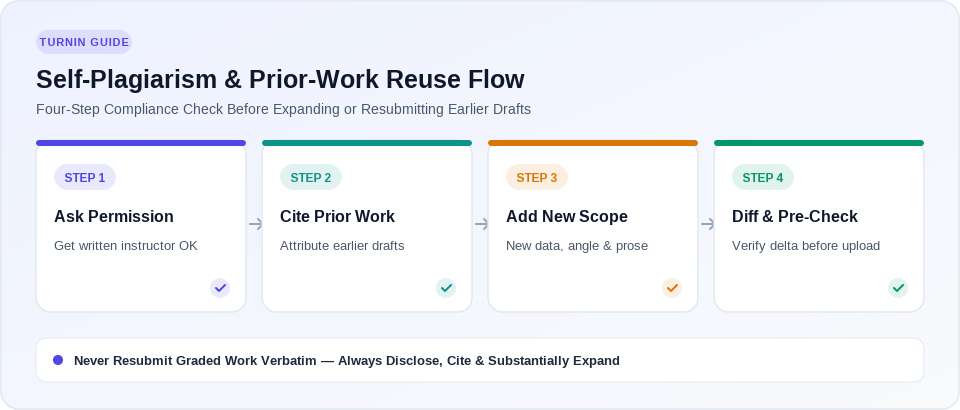
5-Step Audit Workflow Before You Submit Your Expanded Draft
Once your draft is complete, verify both originality and analytical depth before uploading to your university's LMS—especially since many school portals automatically index every upload into a permanent repository.
- Archive your written permission first. Confirm that your instructor's email approval matches the actual scope of overlap in your final draft, and verify whether any syllabus cap applies.
- Run a side-by-side diff against your earlier paper. Upload both your original assignment and your expanded manuscript into the Turnin Document Comparison tool to spot leftover copied sentences, unrevised transitions, or forgotten boilerplate blocks.
- Revise legacy passages into authentic new prose. Replace patched sentences with fresh synthesis that reflects your expanded thesis; if you used automated drafting aids while reorganizing older sections, review phrasing carefully alongside Turnin's AI phrasing and revision helper so every paragraph reflects genuine human scholarship.
- Evaluate whether the new draft adds real academic weight. Check your argument structure, evidence density, and critical progression using Turnin's Paper Evaluation tool to ensure the expanded version stands firmly on its own merits.
- Pre-screen with a non-repository similarity check. Before submitting through Canvas or Blackboard, run a non-repository Turnin similarity check so your preview draft is never stored in a shared database—preventing your final school upload from matching your own check file. Remember that Turnin is an independent pre-check service, and your university's official integrity system always serves as the final standard.
Frequently Asked Questions About Self-Plagiarism & Paper Reuse
Does a Turnin similarity pre-check store my draft in my university's database?
No—non-repository pre-checks evaluate your document without indexing it into institutional student repositories, which protects you from accidentally matching against your own practice upload later. By contrast, many university LMS submission portals archive files by default unless your instructor enables a no-repository setting, and your school's official submission platform always governs final grading and compliance.
Can I reuse my thesis proposal or prospectus inside my final dissertation?
In most graduate programs, yes—turning an approved prospectus or qualifying proposal into your dissertation's introductory chapters or methodology section is expected academic progression. Even so, confirm your graduate school's formatting rules, update older literature reviews with recent publications, and add a brief footnote or preface statement noting which sections evolved from your approved proposal.
If I completely paraphrase my old essay without citing it, does that avoid self-plagiarism?
No. Rewording every sentence from a previously graded paper while keeping the same thesis, dataset, and structure without instructor permission is still considered duplicate submission or covert text recycling. Academic integrity policies protect intellectual originality rather than mere word choice, so always obtain written consent, cite your prior work transparently, and contribute substantial new analysis.