Guardrails, Not Bans: How to Use AI Without Losing the Thread of Authorship
AI detectors can misread multilingual writing. International scholars need a better safeguard: clear permission, a record of how their argument developed, and a pre-submission review that keeps their work out of unwanted repositories.

At 1:07 a.m., a student opens a message about her dissertation draft: “Could you explain how you produced this section?” She knows where the argument came from, but the draft on screen doesn’t show the weeks of reading, false starts, and revisions behind it. A better safeguard than trying to sound less like AI is to know what help is permitted, keep a record of the decisions that shaped the work, and check the final draft without surrendering control of it.
1. A detector flag is not a finding
Imagine the passage that prompted the email. It begins, “This chapter examines three explanations for the decline in participation.” The student learned that kind of signposting in a university writing workshop. It is plain, conventional, and useful. Its predictability tells a reader something about the genre, but almost nothing about who wrote it.
That distinction is central to University World News’s reporting on how AI detectors unfairly penalise international students (University World News, 2026a). In a 2023 study, Liang and colleagues tested seven detectors on 91 English-language TOEFL essays written by non-native English speakers. The detectors incorrectly classified those human-written essays as AI-generated at an average rate of about 61%. The authors linked the disparity to features of linguistic predictability that detectors used as signals (Liang et al., 2023).
That figure is not a current error rate for every detector or a prediction about any one dissertation. It is evidence of a specific failure with a wider consequence: a tool can mistake patterns in someone’s English for evidence about how a document was produced. A high score cannot establish misconduct. A low one cannot establish authorship. Rewriting an honest sentence to make it less predictable may make it harder to read and won’t resolve the underlying question.
November’s higher-education coverage offered a useful contrast. University World News asked whether AI could widen access to higher education (2026b), while ICEF Monitor (2026) reported that students researching study abroad were using AI more but still wanted advice from peers. The same division of labour works on campus. A chatbot may help you formulate a policy question. A person responsible for the assessment can tell you which rule applies.
2. Get permission for the task, not just the tool
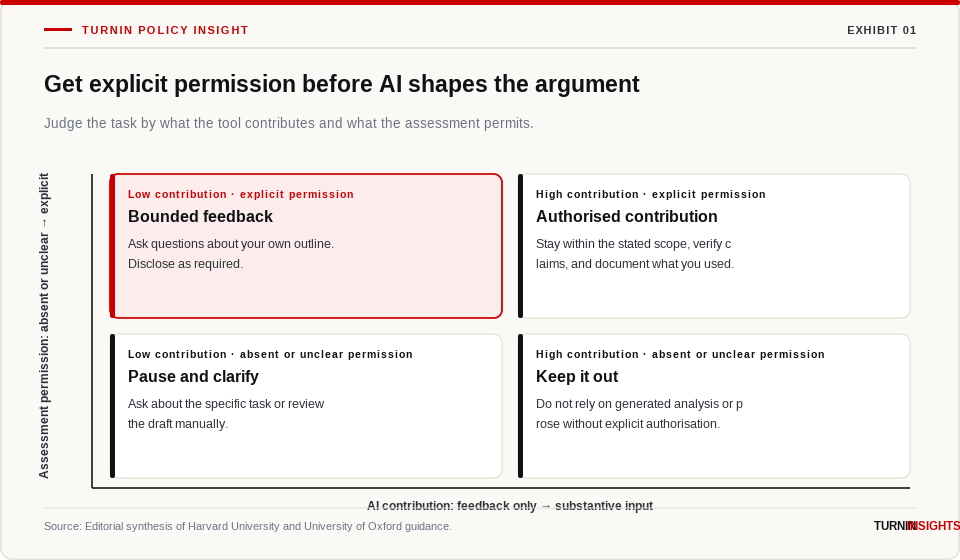
“Guardrails, not bans” is a useful way to read the 2026 US and UK policy landscape, not a single rule shared across campuses. Harvard’s guidance addresses matters such as protecting confidential information and checking generated output. Oxford’s plagiarism guidance treats AI use in assessment as a question of authorisation (Harvard University, n.d.; University of Oxford, n.d.). Neither page gives a student blanket permission to use AI on next week’s essay. Read the institutional policy alongside the assessment brief, module or syllabus instructions, and any applicable dissertation or research rules. If they appear to conflict, ask the person or office responsible for the assessment to clarify in writing.
Ask about a concrete action. “May I use an approved AI tool to ask questions about an outline I wrote, without generating text for submission? If so, where should I disclose it?” is easier to answer than “Is AI allowed?” If the deadline comes before the answer, use a manual review or another clearly permitted route. Disclosure records authorised assistance; it does not authorise prohibited assistance after the fact.
| What you want to do | A bounded approach, if permitted | Where the line can move |
|---|---|---|
| Brainstorm a research question | Bring two questions you drafted and ask what each would require you to investigate. | A model-generated hypothesis may be a substantive contribution, even if you write every sentence yourself. |
| Check the structure | Share a non-sensitive outline and ask where a reader would expect evidence or a definition. | Asking the tool to rebuild the argument may outsource the reasoning being assessed. |
| Check a sentence | Ask which phrase is ambiguous, then decide how to fix it yourself. | Translation, paraphrasing, and full-sentence rewriting may have separate rules, especially when language is assessed. |
Consider a student writing about commuter attendance. Her first outline goes from unreliable bus service straight to seminar absences. A useful prompt is, “Where would a sceptical reader ask for another explanation? Give me questions, not replacement prose.” The model asks whether work schedules might matter. She checks her sources and finds that they describe transport barriers but do not establish their effect on attendance. Her original claim, “Unreliable buses drove the fall in attendance,” becomes “Students described unreliable buses as a barrier; the available records do not establish how much they contributed to the decline.” The intellectual work is in checking the evidence and narrowing the claim. That is what she should be able to explain.
3. Keep a record of decisions, not a diary of keystrokes
A useful version history looks like an ordinary project. There is a rough outline, a draft with gaps, and a later version where a claim weakens or a section changes place. It should be easy to see not only that the text changed, but why. A folder full of files named final is less helpful than three dated drafts and a short note explaining a consequential revision.
- Save the applicable instructions. Keep the assignment brief, its date, and any written clarification. If the submission portal asks for an AI declaration, save the wording you submitted.
- Keep a starting point. Save your research question, preliminary outline, or source notes before the first permitted AI interaction. Make it clear which words are quotations and which are yours.
- Mark meaningful revisions. Use an institution-approved editor’s version history or save dated copies at natural milestones. A note like “Moved the limitations ahead of the recommendation after checking the sample” is more useful than a screenshot of every edit.
- Log material AI assistance. Record the date, tool, purpose, and what you accepted or rejected. Retain relevant prompts and outputs if required and permitted. Keep them in approved storage; don’t duplicate sensitive material merely to prove that you handled it.
- Preserve the submitted version. Keep the exact file, submission receipt, and disclosure together. If the portal converted a file or stripped comments, retain the local copy too.
Where the course allows a free-form declaration, it might read: “I used [tool] on [date] to identify gaps in a non-sensitive outline I had written. One question prompted me to recheck a causal claim against my sources. I revised the claim myself and did not include generated prose.” Change that wording to match what actually happened and use the required form if there is one. Never invent a prompt log or recreate a draft and present it as contemporaneous. Version history supports an account of the work; it is not a certificate of authorship, and its absence is not proof of misconduct.

4. Review the draft without depositing it
Start with checks you can run on your own copy. Read each section’s opening and closing sentences to see whether the argument moves. Trace every quotation and pivotal factual claim to the source you actually consulted. Compare the last two drafts for dropped citations, altered qualifiers, and conclusions that no longer match the results. Your editor’s local comparison feature may be enough. A document comparison tool is another option for approved, non-sensitive files if its data handling meets your institution’s requirements.
If you need a similarity review, use the university’s approved draft route and confirm that the specific assignment or workspace is configured not to add submissions to a comparison repository. Ask the administrator if the setting is not visible. Non-repository does not mean no upload, no retention, or no access by staff or vendors. Ask separately where the file goes, how long it is kept, who can access it, and whether it can be reused for training or other purposes. A draft stored in a comparison repository may surface as a match against your final submission. That match has an explanation, but it is a complication you can avoid.
Before using any external checking service, verify those same terms for the service and account you would actually use. If you cannot confirm them, keep the review local or ask the library or writing centre for an approved route. Leave interview transcripts, identifiable participant information, and restricted lab material out of unapproved tools. Removing names is not enough if the details still identify someone or the research agreement limits where the material may go.
Read a similarity report by looking at the matched passages, not by chasing a target percentage. A correctly quoted definition and an unattributed near-paraphrase can both produce a match, but only one needs an attribution fix. Conversely, a low score will not tell you that a source fails to support a claim. And an AI-likelihood score is a different measure altogether. Don't use one as a final verdict on your draft or as a reason to rewrite your English (Liang et al., 2023).
5. When the policy, the deadline, and the draft collide
My supervisor says AI is fine, but the assessment brief is stricter. Whose advice do I follow? Ask the assessment lead to clarify which rule controls that submission, and quote the relevant language rather than summarising it as “AI allowed.” A supervisor may be discussing exploratory research, while the brief governs assessed writing. If you use an approved accessibility or language-support tool, ask the relevant office how your accommodation applies to this specific assignment. You should not have to disclose private medical information to explain a permitted workflow.
I used AI for brainstorming and forgot to disclose it. What should I do? If you have not submitted, add an accurate declaration in the prescribed place. If you have, contact the relevant instructor or office promptly and ask how to correct the record. Describe the assistance as precisely as you can, including any generated wording you kept. If you lack the original prompt, say so. Recover genuine drafts or notes rather than filling gaps from memory and presenting them as records.
A detector flagged my work. How do I respond? Ask which passages are at issue, what policy applies, and what the response deadline is. If there is a formal process, ask what evidence you may submit and whether a student adviser can support you. Select the records that answer the concern: the source note behind a paragraph, the draft before and after a key revision, or the declaration that accompanied the submission. If you wrote in another language first, include relevant notes if they help and can be shared. You do not need to volunteer private material unrelated to the question.
The student who opened that late-night email could answer with two drafts and a source note: here is where the claim began; here is the evidence that made me change it. That is a better basis for a conversation than a detector score. Institutions have a responsibility here too: publish rules specific enough to follow, take disclosures seriously, and never make a student’s English carry the burden of proving who wrote it.
References
Harvard University. (n.d.). *Guidelines for using ChatGPT and other generative AI tools at Harvard*. https://provost.harvard.edu/guidelines-using-chatgpt-and-other-generative-ai-tools-harvard
ICEF Monitor. (2026, November 26). *Use of AI for research about study abroad is increasing but so is demand for the advice of peers*. https://monitor.icef.com/2026/11/use-of-ai-for-research-about-study-abroad-is-increasing-but-so-is-demand-for-the-advice-of-peers/
Liang, W., Yuksekgonul, M., Mao, Y., Wu, E., & Zou, J. (2023). GPT detectors are biased against non-native English writers. *Patterns, 4*(7), 100779. https://doi.org/10.1016/j.patter.2023.100779
University of Oxford. (n.d.). *Plagiarism*. https://www.ox.ac.uk/students/academic/guidance/skills/plagiarism
University World News. (2026a, November 14). *AI detectors unfairly penalise international students*. https://news.google.com/rss/articles/CBMid0FVX3lxTE5PRExfSkh4a0xNbGo1amc5ZzJsNkJnNjZtdDc1aDZaVzFVaXR0RC1QS0l5Nzk3bFoxY18tWVlpc091aW02WGx1QThPdEZNVUZ3T3Zfa3BSWHQyQ0NCaEhsMkl1dktRRFBqaTg2RjQycmlqYzVhd3ZN?oc=5
University World News. (2026b, November 28). *New study – Can AI unlock access to higher education?* https://news.google.com/rss/articles/CBMid0FVX3lxTE9wcHBoVEJoODBjOWpLSWdPek5tSVBSZHNMUGhlai1wQkpSR253TEJkMjBZQk5iRVVEZWg5bl9rUS1FUFJYUlJmM3pienE2Q0J6eThDaU9VdzFGMmMyaXNaVjA1UVJnVjFDMlB4SzFlcTZ3b3VkQnpZ?oc=5