
Revision is more effective when you fix the largest problems first. There is little value in perfecting punctuation in a paragraph that does not belong in the argument. Start with the assignment and central claim, work through structure and evidence, then check attribution, language and the final file. A report may contribute useful information, but a lower percentage is not the measure of a successful revision.
Preserve a draft and return to the question
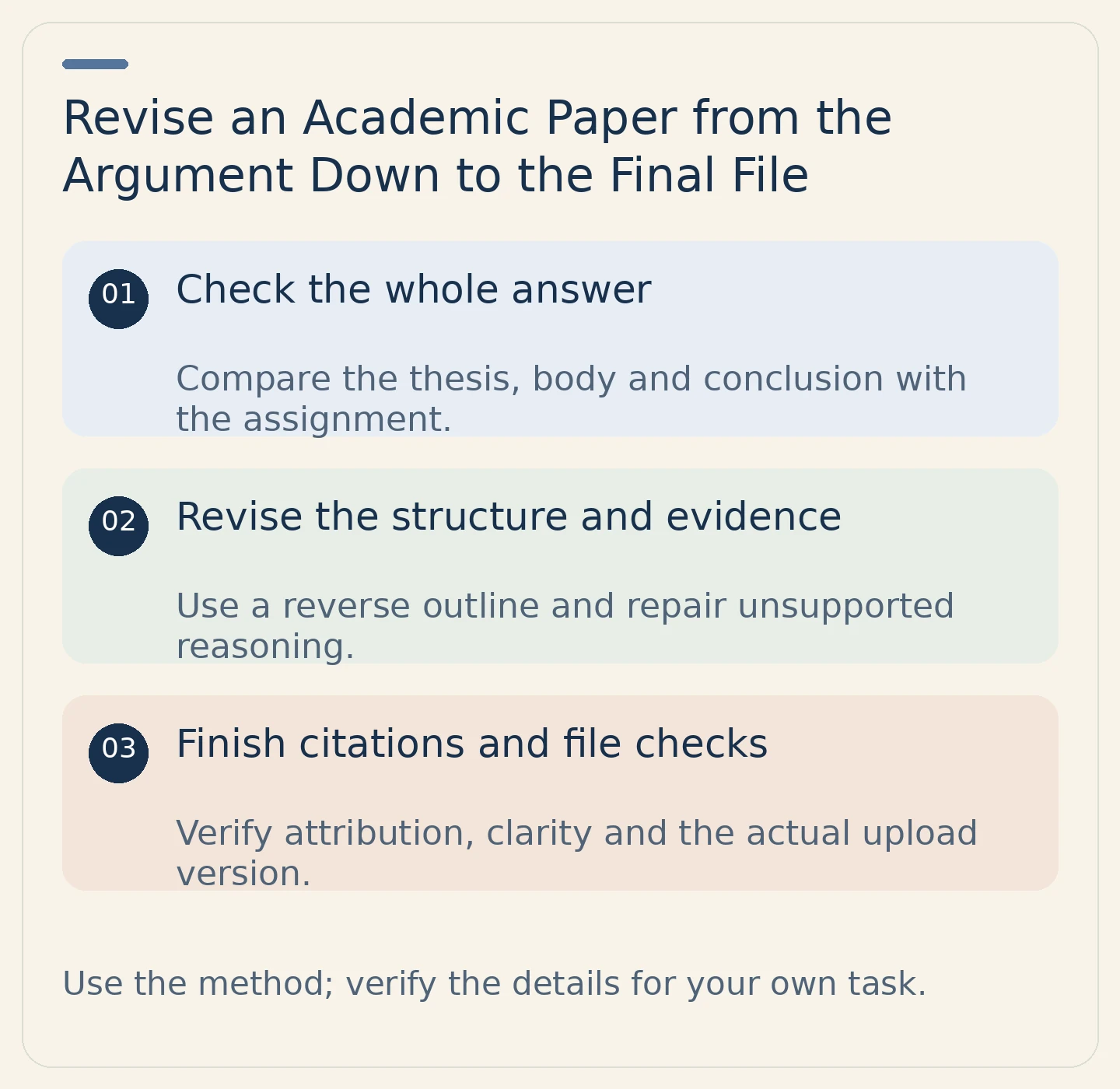
Save the version you are about to revise so you can understand major changes. Reread the prompt, rubric, required sources, citation style, permitted assistance and submission instructions. State the paper’s actual answer in a sentence. Compare it with the assigned question: have you analyzed, evaluated or compared as required, or mainly described a related topic?
Check the introduction and conclusion together. If they promise different answers, determine which answer the body can support. Do not fix this only by changing a title; revise the argument or narrow its scope as needed.
Make a reverse outline of the draft you have
A planning outline records what you intended to write. A reverse outline records what the paragraphs actually do. Give each paragraph a short purpose label and identify the claim it supports. Use the results to decide what stays, moves, combines, expands or goes.
| Reverse-outline question | Likely issue | Revision decision |
|---|---|---|
| Does this paragraph advance the answer? | A detour or disproportionate background | Cut, shorten or connect its purpose |
| Does another paragraph do the same job? | Repetition | Combine useful material and remove duplication |
| Is a required reasoning step missing? | A jump from evidence to conclusion | Add explanation or revise the claim |
| Does the evidence appear before it is understood? | Missing definition or context | Move or supply necessary preparation |
| Does the conclusion exceed the discussion? | An unsupported final claim | Narrow the conclusion or provide real support |
Do not use the table as a requirement that every paragraph look identical. The functions differ by genre; the important point is that the sequence is intelligible and purposeful.
Reassess evidence and reasoning before style
Read the sources underlying important claims. Check whether their definitions, population, time period and limitations match your wording. A real publication can still be the wrong evidence for a particular sentence. Remove unsupported material or find suitable support rather than adding a plausible citation.
After each piece of evidence, ask what it establishes and why it matters. Your explanation may involve comparison, interpretation or application, but it must not be attributed to the source if it is your own inference. Distinguish an alternative explanation you can answer from a limitation you need to acknowledge.
Repair attribution after structural changes
Moving sentences can leave citations behind or make one source appear to support another’s claim. Recheck ownership across the revised paragraph. Compare quotations with the original, confirm real locators and apply the assigned citation system. University of Toronto guidance explains why borrowed ideas still require acknowledgment when paraphrased.
If a passage follows a source too closely, return to understanding and rewrite it for your argument, then verify meaning and cite it. If exact wording is needed, quote it. Do not treat a citation as permission to present copied language as a paraphrase.
Bring permitted report feedback into the review
If your institution allows draft checks and report access, inspect meaningful Turnitin matches in their paragraph context. Its student guide explains that similarity is not a plagiarism judgment and that there is no universal acceptable score. Correct missing attribution, close paraphrasing or unnecessary dependence on source wording; retain legitimate quotations and accurate technical terms when they are needed.
An AI-writing indicator, if available, is a separate output and not proof of misconduct. Follow the applicable policy and respond with genuine information about use and process, not a cosmetic rewrite aimed at a number.
Edit language only after the argument is stable
Read for unclear references, overloaded sentences, unnecessary repetition and missing connections. Keep specialist terms consistent and preserve uncertainty and qualifications. Review every suggested edit from permitted support. A fluent sentence that turns an association into causation is a worse sentence, not an improvement.
Illustrative priority decision: if a conclusion claims more than the evidence establishes and the same paragraph also has a comma error, fix the claim first. The example describes revision order, not a universal time allocation.
Inspect the final version as a new document
Recheck citations and conclusions after the last substantive edit. Apply required disclosures and formatting, export the specified file type and inspect footnotes, symbols, figures and references. Any further source-file change requires a new export and check. Submit through the authorized route and keep the final file, genuine records and confirmation. Turnin is supplementary support, not official institutional acceptance.
Related practical guides
For a separate evidence check, use the citation readiness guide; for the final handoff, use the pre-submission checklist. These are supplementary resources, not your institution’s submission system or policy.
Sources and scope
Further reading: University of Toronto: How Not to Plagiarize; University of Toronto: Using Quotations; Turnitin: Understanding the similarity score for students; Turnitin: Using the AI Writing Report. Institutional examples apply to their own settings; follow the requirements governing your work.