
“Finish the essay” hides several different jobs. You may have a complete draft but unverified sources, a reviewed manuscript but an outdated export, or a successful upload without confirmation that the intended version arrived. Plan the work backward from the deadline and make its dependencies visible. The purpose is to protect meaningful revision, not to squeeze in repeated checks of a similarity number.
Record the real deadline and local rules
Read the assignment and rubric. Confirm the required question, genre, sources, citation style, length, file format and submission route. Record the deadline’s date, time and time zone as shown by the course. Check whether draft uploads, report access and resubmissions are allowed. Do not assume report timing or replacement permissions from another assignment.
Check collaboration, proofreading, translation and AI-use rules before relying on outside assistance. If you need clarification, put the question on the schedule early. An unanswered policy issue is a dependency, not a small task to hide in final proofreading.
Plan outputs rather than vague work sessions
Break the process into deliverables. Research should produce relevant, traceable notes. Planning should produce a working answer and outline. Drafting should produce a complete argument. Revision should produce a coherent paper with verified evidence, followed by language, format and file checks.
| Milestone | What should exist | What it depends on |
|---|---|---|
| Evidence plan | Required claims and likely sources | Understanding the task |
| Traceable notes | Quotations, summaries, analysis and source locations | Actual reading |
| Complete draft | An answer developed across the whole paper | A workable outline and usable evidence |
| Content revision | Corrected reasoning, scope and structure | Seeing the full draft |
| Citation and language review | Accurate borrowing and clear expression | Substantive changes sufficiently settled |
| Final upload file | Checked export and required attachments | Completed changes in the source document |
Some work can overlap. You can verify bibliographic details while reading or ask a focused question while drafting another section. Other work must wait: polishing a paragraph before deciding whether it belongs is often wasted effort.
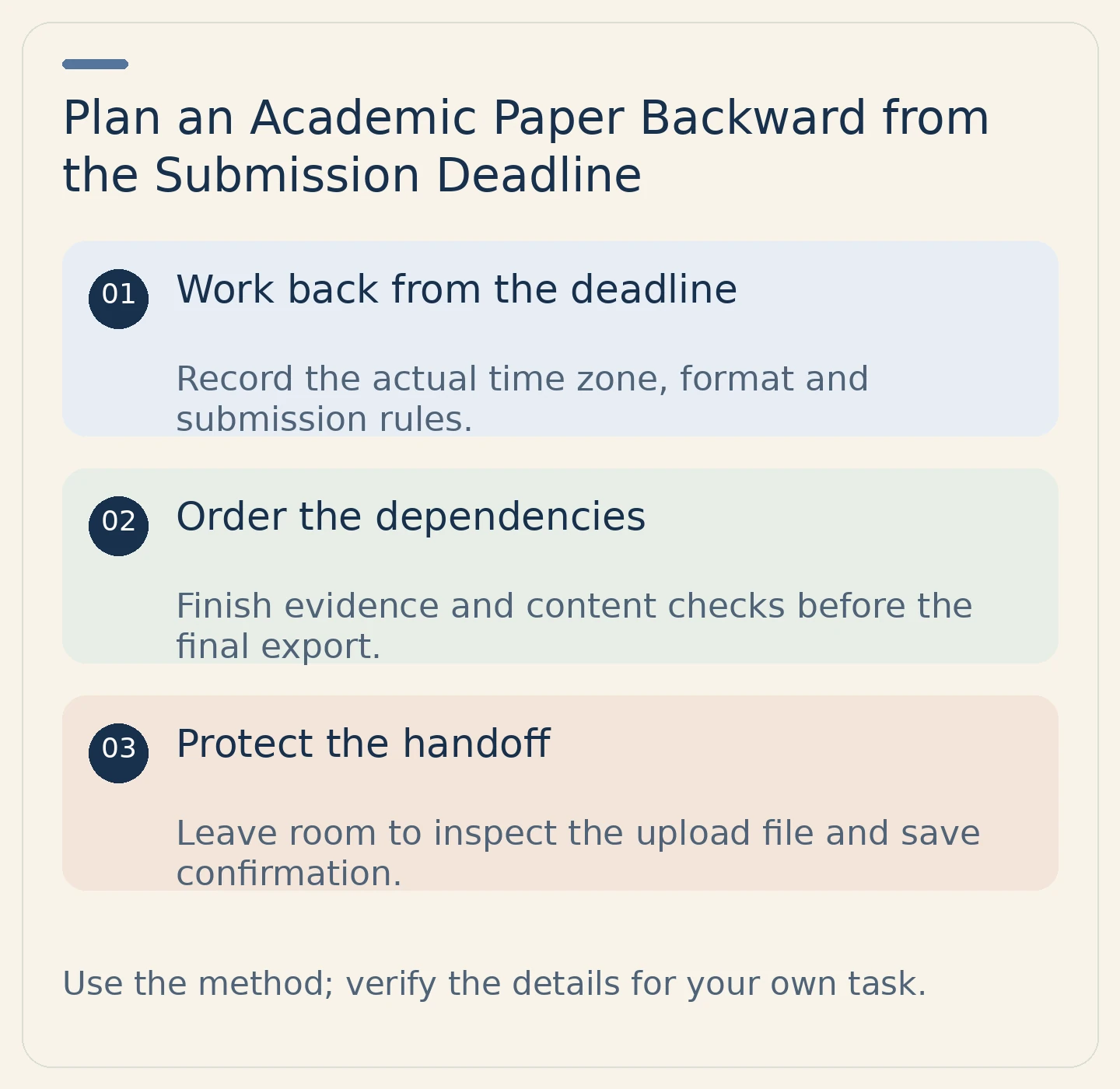
Use an adjustable backward schedule
An illustrative plan might reserve an early stage for interpreting the question and gathering sources, a middle stage for the full draft and structural revision, and a later stage for evidence, language and file checks. These are planning blocks, not prescribed numbers of days. Scale them to the assignment, your other commitments and any known external dependencies.
If a permitted similarity report forms part of the process, leave space to interpret it and revise afterward. An upload made at the deadline is not a reliable plan for obtaining feedback before submission. Check the actual course configuration and current instructions rather than promising that a report will arrive within a fixed period.
Keep the academic work inside the schedule
Start with a provisional thesis and evidence needs. Read relevant sources, save publication details and real locations, and separate copied words from your own summaries and analysis. Draft around claims, not a chain of quotations. Paraphrase from understanding, verify accuracy and cite borrowed ideas. University of Toronto guidance on avoiding plagiarism explains why recording sources during reading supports clear acknowledgment later.
During content revision, test whether the evidence actually answers the question. Then audit quotations, citation scope and reference correspondence under the required style. Read for clear terms and useful transitions, keeping language changes faithful to the sources.
Replan when time becomes tight
Prioritize a major task mismatch, an unsupported central claim or an unresolved source before decorative formatting. Correct missing attribution and copied wording rather than doing cosmetic synonym swaps. Remove an unnecessary claim you cannot verify instead of attaching a guessed reference.
If report access is allowed, inspect meaningful Turnitin matches in context. The official student guide explains that similarity is not a plagiarism judgment and has no universal acceptable score. A lower percentage is not evidence that your schedule produced a better paper.
When a genuine blocker threatens submission, use the course’s specified contact or support procedure. Do not assume an extension, a late window or a right to resubmit.
Close the final handoff
- Freeze the intended source version after content and citation review.
- Export in the required format and inspect references, symbols, tables and attachments.
- If you change the source again, regenerate and recheck the upload file.
- Submit through the authorized channel and confirm the received version where possible.
- Retain the receipt, final file and genuine working records.
A useful schedule ends with verified submission, not merely with a document named “final.”
Related practical guides
For a separate evidence check, use the citation readiness guide; for the final handoff, use the pre-submission checklist. These are supplementary resources, not your institution’s submission system or policy.
Sources and scope
Further reading: University of Toronto: How Not to Plagiarize; Turnitin: Understanding the similarity score for students. Institutional examples apply to their own settings; follow the requirements governing your work.