
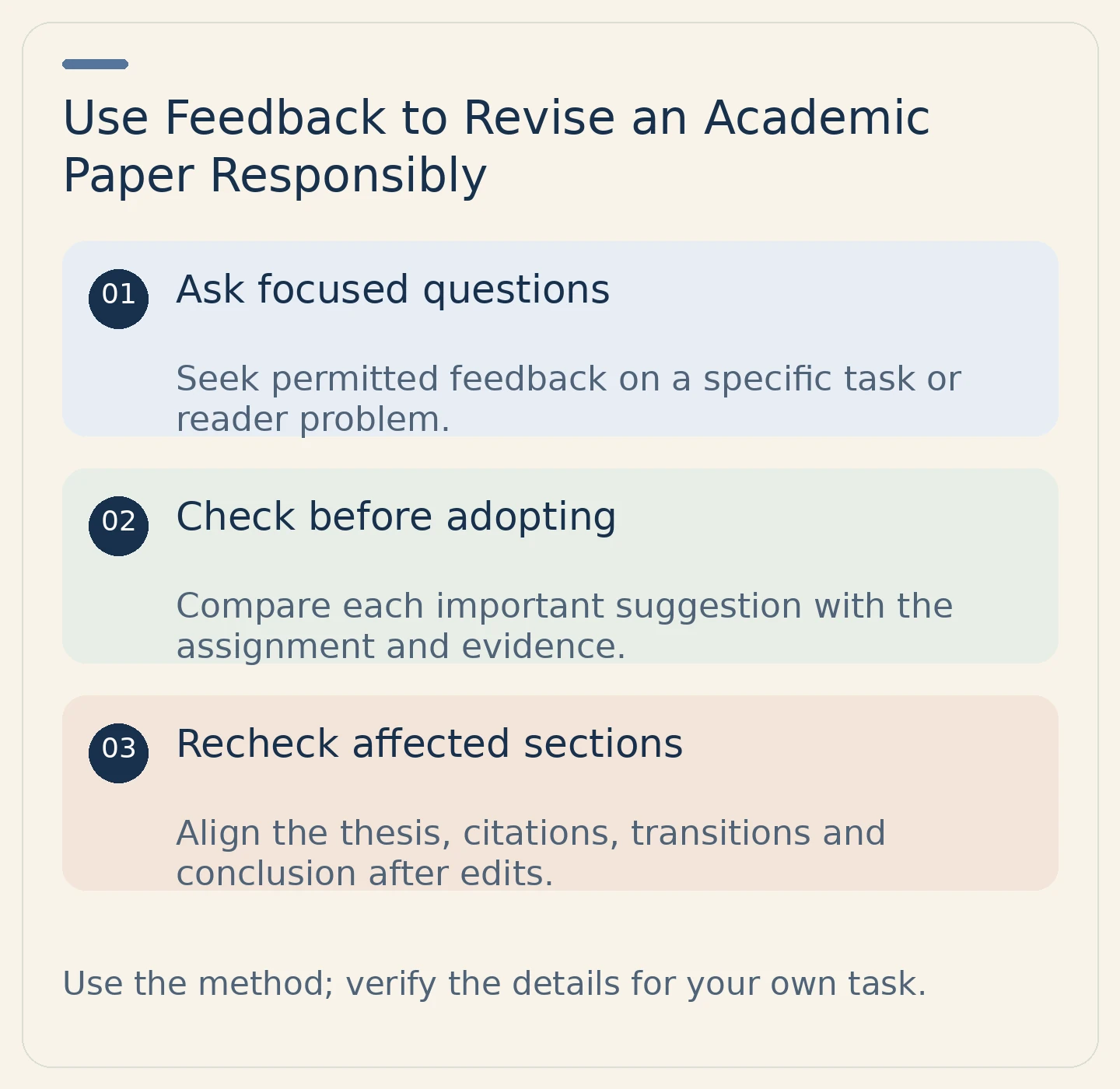
Feedback becomes useful when you decide what problem it identifies and whether its proposed change is justified. Accepting every comment can make a paper less accurate or less clearly yours. Work from an independent draft, ask focused questions within the course’s rules and check suggestions against the task and evidence. Then reread the sections affected by each change.
Establish the task and permitted support
Read the assignment, rubric, source requirements, citation style and submission rules. Check whether peer discussion, tutoring, proofreading, translation or AI feedback is allowed and whether acknowledgment is required. The word “feedback” does not authorize someone or a tool to supply assessed analysis or rewrite beyond the permitted scope.
Write a working answer and outline, then research using traceable notes. Save the publication identity and relevant real locations, distinguish quotations from summaries, and keep your own reasoning separate. Draft enough of the argument to show what you are trying to do before requesting help. A reviewer can respond more usefully to a specific purpose than to a request to “make this better.”
Ask questions a reviewer can actually answer
Choose a question matched to the stage of work. Early feedback may concern task alignment or the sequence of reasons; later feedback may concern an ambiguous sentence. Avoid asking for sentence polishing when the argument still needs substantial restructuring.
| Focus | A useful question | What remains your responsibility |
|---|---|---|
| Task fit | Can you identify how this section answers the question? | Deciding the paper’s answer and scope |
| Reasoning | Where does the connection between evidence and claim become unclear? | Verifying the evidence and explaining the inference |
| Structure | Which paragraph feels repetitive or out of order? | Choosing and carrying out structural changes |
| Language | Which sentence is difficult to follow, and why? | Preserving meaning, terminology and attribution |
| Sources | Can you see which author supports each point? | Checking source identity, support and required citation style |
Give a reviewer the relevant instructions when permitted, but do not share confidential material or another person’s work without authorization. Respect institutional rules for the tools or services used.
Separate the comment from the proposed solution
A comment can identify a genuine problem while offering a poor repair. “This conclusion is hard to follow” might call for clearer explanation, not a stronger claim. Treat the underlying issue and the suggested wording as two decisions.
For important comments, make a brief note: problem identified, evidence checked, decision and affected sections. You may accept, adapt, defer for clarification or reject a suggestion. The purpose is not to build an elaborate compliance log; it is to make consequential changes deliberate.
Check suggestions against the sources
Illustrative example, not a real feedback record: a reviewer suggests changing “the evidence suggests a relationship” to “the evidence proves the cause.” Before accepting it, reread the source. If it does not establish causation, reject that wording and clarify the actual relationship. The reviewer’s confidence does not create evidence.
Likewise, do not add an unfamiliar reference merely because someone recommends it. Locate and read the relevant material, verify what it supports and cite it appropriately. If the claim cannot be supported, narrow or remove it. University of Toronto guidance on acknowledgment explains why your use of an idea needs a clear connection to its source, not just a bibliography entry.
Revise the whole argument affected by a change
If feedback leads you to narrow the thesis, update the introduction, relevant topic sentences and conclusion. If a paragraph moves, check that source boundaries remain clear and the transition still makes sense. If language becomes more concise, verify that qualifications and source ownership did not disappear.
Paraphrase from understanding rather than accepting a replacement sentence you cannot explain. Compare revised accounts with the source and quote exact wording where necessary. Permitted assistance supports your decisions; it does not transfer responsibility for the paper.
Use any available report as another input
If your course permits Turnitin draft-report access, inspect meaningful matches in context. The official student guide explains that similarity is not a plagiarism judgment or a universal pass threshold. Investigate attribution and expression; do not accept a suggestion to remove citations or manipulate wording solely to change the percentage.
Confusing matches or unresolved policy questions should go to the instructor, writing center or appropriate support service. Help can improve your understanding, but it does not guarantee a grade or institutional outcome.
Complete a final independent review
Read the paper without the comments visible. Does it answer the question, develop a coherent argument and represent sources accurately? Verify citations, required disclosures and readable language. Inspect the actual file, submit the intended version and retain genuine drafts, relevant feedback and confirmation. The final paper should reflect decisions you understand and can defend, not merely a collection of accepted suggestions.
Related practical guides
For a separate evidence check, use the citation readiness guide; for the final handoff, use the pre-submission checklist. These are supplementary resources, not your institution’s submission system or policy.
Sources and scope
Further reading: University of Toronto: How Not to Plagiarize; University of Toronto: Using Quotations; Turnitin: Understanding the similarity score for students. Institutional examples apply to their own settings; follow the requirements governing your work.