
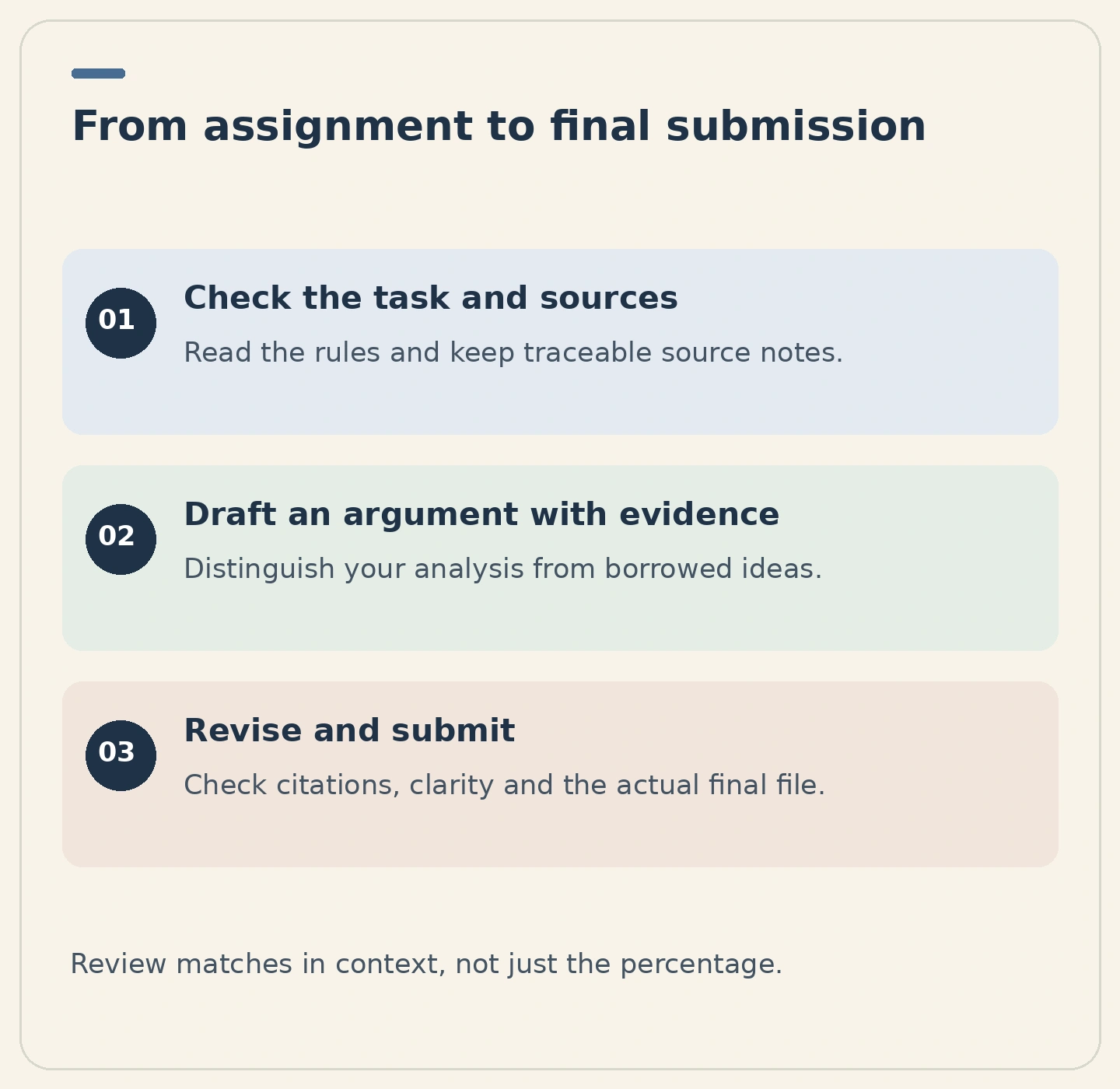
Turnitin and Academic Writing: What Success Really Means
If you are preparing an assignment, you may wonder what Turnitin checks, what a similarity score means, and how to submit work confidently. The goal is not to achieve a particular percentage. It is to produce clear, well-supported writing that represents your own understanding and acknowledges other people's contributions.
Turnitin can help instructors and students identify text that matches material in its comparison sources. A similarity report is not, by itself, a verdict on plagiarism or academic integrity. Matches need to be interpreted in context: a correctly quoted passage, a reference entry, and an unattributed copied paragraph are very different cases.
This checklist is especially useful for international students navigating unfamiliar citation conventions or writing in an additional language. Start with your assignment requirements and institutional policies, then use the workflow below to strengthen your draft.
Step 1: Check the Assignment and Academic Integrity Rules
Before researching, read the assignment brief, marking rubric, and relevant course policies. Identify the question you must answer, the expected structure, the word limit, the required citation style, and the submission deadline.
- Confirm whether the assignment requires an argument, a literature review, an analysis, or another format.
- Check rules for collaboration, proofreading, translation tools, and AI assistance. Permission can differ between assignments.
- Find out whether you can view a Turnitin report before final submission and whether resubmissions are permitted.
- Ask your instructor about unclear requirements rather than relying on general internet advice.
Do not assume there is a universal acceptable similarity score. If your course gives a numerical guideline, follow it while still checking the meaning and attribution of individual matches.
Step 2: Research Carefully and Keep Traceable Notes
Use sources appropriate to the task, such as peer-reviewed articles, scholarly books, primary documents, or authoritative reports. Evaluate each source for relevance, credibility, publication date, and the strength of its evidence.
Record source details as you read: author, title, publication year, DOI or URL, and page numbers where applicable. Separate direct quotations from summaries and your own observations. This prevents accidental copying when notes become part of a draft.
- Put quotation marks around copied wording immediately, even in private notes.
- Label summaries and paraphrases with their source.
- Record your response to the source separately: what does it support, challenge, or leave unanswered?
- Check references imported by citation software against the original publication.
For example, keep separate note fields for “source claim,” “exact quotation,” and “my analysis.” This simple distinction makes attribution easier during drafting.
Step 3: Build an Argument Before Polishing the Language
Create an outline that directly answers the assignment question. Give each main section a purpose, and decide which evidence will support it. Your contribution may be an interpretation, a comparison, a critique, or a synthesis; originality does not require every fact to be new.
Draft paragraphs around a clear point, relevant evidence, and your explanation of why that evidence matters. Avoid assembling a paper from source summaries without showing how they connect to your argument.
If you write in an additional language, prioritize meaning before sentence-level elegance. Use terminology consistently and explain complex ideas in language you understand. Ask a writing tutor or an authorized reviewer for feedback on unclear passages, within your course's assistance rules.
Step 4: Quote, Paraphrase, and Cite Accurately
Use a direct quotation when the original wording matters. Mark it with quotation marks or block formatting as required by your citation style, and provide the appropriate citation and locator.
To paraphrase, read the passage until you understand it, set it aside, and explain the relevant idea in your own sentence structure. Then compare your version with the source for accuracy and overly close wording. A paraphrase still needs a citation because the idea comes from someone else.
- Do not replace a few words with synonyms while retaining the source's structure.
- Cite borrowed arguments, findings, data, and distinctive ideas, not just quotations.
- Distinguish your analysis from the source's claims.
- Verify that every in-text citation has a corresponding reference entry where your style requires one.
- Check rules before reusing text from your own previous assignments.
Translation does not remove the need for attribution. If you translate a passage from another language, cite the original source and follow your required style's guidance for indicating a translation.
Step 5: Review Turnitin Feedback in Context
If your institution provides access to a similarity report, inspect the matched passages rather than focusing only on the overall percentage. The report's contents and display can depend on the assignment settings and available features.
- Locate each meaningful match. Identify the passage in your draft and the source shown in the report.
- Check the source itself. A displayed match may not be the original publication you consulted. Verify your evidence and attribution.
- Assess the use of the material. Is it a correctly marked quotation, a properly cited paraphrase, standard wording, or text that needs revision?
- Fix the underlying issue. Add missing attribution, mark quotations, rewrite an overly close paraphrase from understanding, or remove material that does not support your argument.
- Ask about uncertainty. Discuss confusing matches or submission settings with your instructor or academic support team.
A low similarity score does not prove that every source is cited correctly, and a high score does not automatically establish misconduct. Your review should focus on accurate attribution, appropriate source use, and the quality of your reasoning.
Final Quality Checklist Before Submission
Set aside time for a final review after substantive revisions. Read the draft aloud or use an approved read-aloud tool to spot unclear sentences, missing transitions, and wording that does not sound natural.
- Task fit: Does the paper answer the actual question and follow the required format?
- Argument: Is the central claim clear, and does each section help develop it?
- Evidence: Are sources credible, relevant, accurately represented, and sufficient for the claims made?
- Citations: Are borrowed words and ideas acknowledged, with complete and consistent references?
- Originality: Does the writing demonstrate your own understanding rather than reproduce source language or structure?
- Clarity: Are sentences readable, terms consistent, and paragraphs logically connected?
- Policy compliance: Have you followed rules on collaboration, tools, disclosures, and reuse of previous work?
- Submission readiness: Is the correct file complete, readable, and ready to upload before the deadline?
Save the final version and any required submission confirmation. Retain notes, drafts, and source records in line with your institution's expectations.
Common Pitfalls and Ethical Reminders
Chasing a percentage: Removing legitimate quotations or changing wording solely to lower a score can weaken your paper. Make revisions because they improve attribution, reasoning, or readability.
Assuming a citation fixes everything: A citation does not make unmarked copied wording an acceptable paraphrase. Exact language still needs quotation formatting.
Using sources you have not checked: Verify that cited publications exist and support the specific claims you make. Do not submit invented references or rely on an unverified reference list.
Uploading work to unapproved services: Before sharing a draft, check the service's privacy, retention, and reuse terms, as well as your university's policies. Protect confidential research and other people's personal information.
Leaving revisions until the deadline: Allow time to review sources, resolve questions, and submit successfully. Do not assume reports or resubmissions will be available immediately.
Before submitting, review your draft for clarity, citations, originality, and human readability. Use feedback to strengthen your own work—not to disguise borrowed material—and seek academic support whenever the rules or expectations are unclear.
Related practical guide
Read a Turnitin Similarity Report Step by Step
Official sources and scope
These sources explain reports and their limitations. Follow your institution’s submission requirements; this independent guide is not official Turnitin guidance.