
Writing in an additional language adds decisions at every stage: understanding the question, reading specialist sources, choosing terms and explaining your reasoning. The goal is accurate communication, not a performance of elaborate vocabulary. Use a complete writing workflow that protects meaning and attribution while giving you room to develop a clear voice.
Understand the task before translating sentences
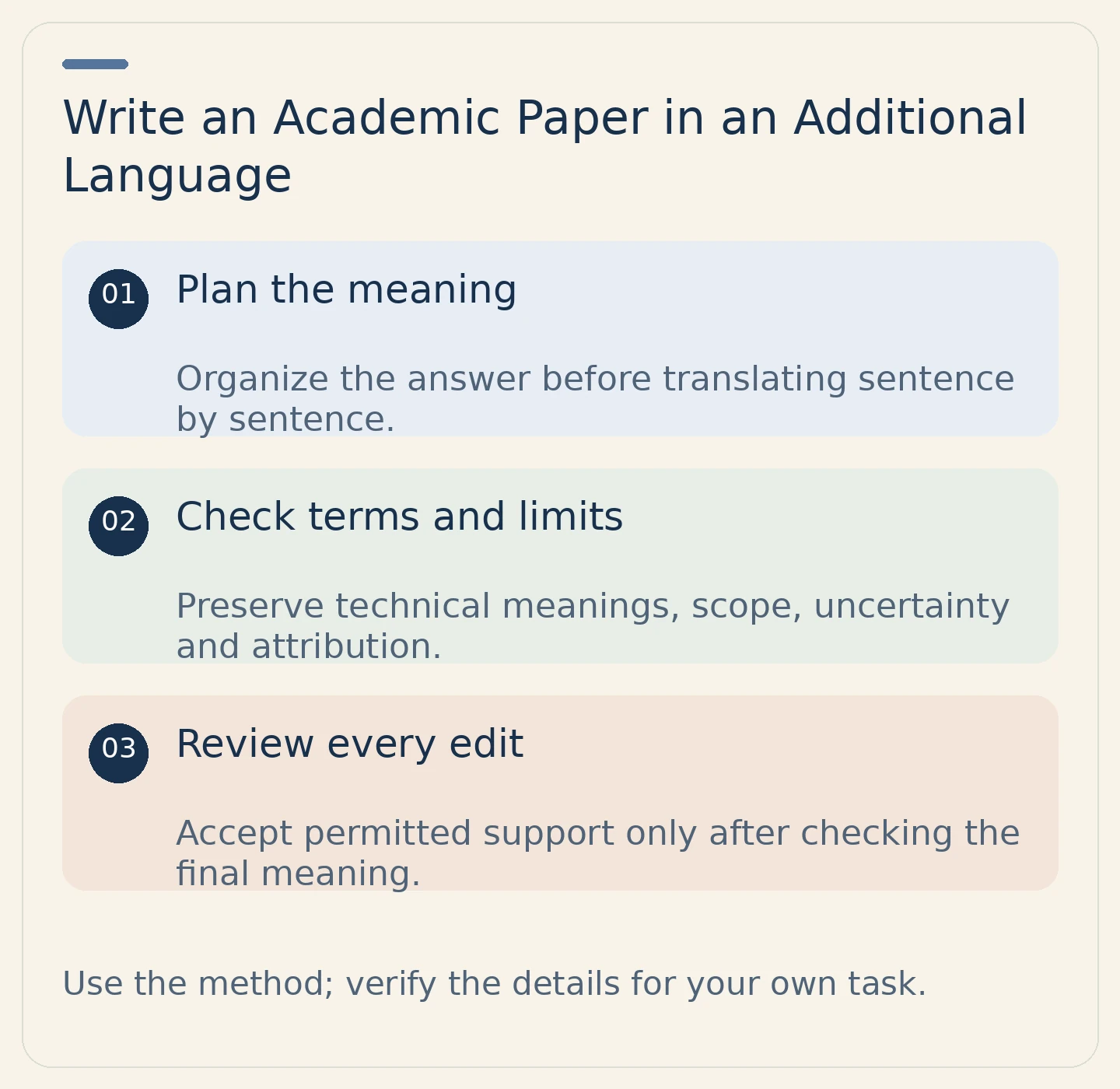
Read the prompt, rubric, citation style and submission rules. Clarify unfamiliar command words with the instructor or approved academic support. “Evaluate,” for example, requires more than reproducing a description, but the expected criteria depend on the course. Check whether translation, proofreading, collaboration or AI tools are permitted and what disclosure is required.
Write the purpose of the paper in language you understand well. You may find it useful to explore ideas in a familiar language before drafting in the submission language. Treat those notes as planning, not as a paragraph-by-paragraph script that must be translated mechanically.
Read and keep a bilingual meaning trail
For sources you actually consult, save bibliographic details and real locations. Label quotations, summaries and your own responses separately. If a note translates a source’s idea, keep the original passage or a retrieval route nearby so you can check meaning later. Changing language does not turn borrowed material into your own contribution.
Create a short working glossary for repeated concepts. Include the source term, your chosen equivalent, a brief definition and a note about phrases that restrict the claim. A glossary is especially useful when everyday words have technical meanings in the discipline.
| Check after translation or editing | What could change | How to verify |
|---|---|---|
| Object | Who or what the statement concerns | Compare the subject and population with the source |
| Scope | Some cases becoming all cases | Restore the original boundary |
| Qualification | A possibility becoming a certainty | Check words expressing uncertainty |
| Negation | A limitation becoming an affirmative claim | Read the sentence against the original context |
| Relationship | An association becoming a cause | Preserve the type of relationship actually established |
Draft for the reader’s line of reasoning
Outline your answer and the reasons supporting it. Build paragraphs around the point you need to make, using evidence and your explanation. Do not translate the source’s sentence structure and then replace a few words. Explain the relevant idea from understanding, compare it with the original and add a citation.
Illustrative example, not a research claim: a teaching passage says a practice “may help some participants under specified conditions.” An edit to “the practice improves participation” removes uncertainty, the limited population and the conditions. A fluent sentence can therefore be less accurate. Keep the limits even if a simpler sentence requires a little more explanation.
Use established terminology consistently instead of substituting a different near-synonym each time. The University of Toronto’s quotation guidance emphasizes precision when introducing sources. Quote exact wording when it is important to the analysis, with the required formatting and actual locators. For translated quotations, consult the style and course rules rather than assuming one convention fits every assignment.
Ask for focused, permitted support
Bring a question to an authorized writing adviser: “Can you follow the contrast between these two positions?” or “Does this sentence express uncertainty clearly?” These requests preserve your responsibility for the argument. Asking someone or a tool to replace your reading, analysis or entire draft is a different kind of assistance and may exceed the task’s rules.
Review every suggestion. Reject changes that distort technical terms, source meaning or your conclusion. If permitted support must be disclosed, describe what actually happened; do not use a vague statement claiming that ideas were untouched if they were substantially reshaped.
Audit the paper beyond language
Check that the paper answers the question, the conclusion follows from the evidence and source changes are visible. Verify citations and references under the required system. University of Toronto guidance explains why paraphrased ideas still need acknowledgment; translation is not an exception.
If your course permits Turnitin report access, inspect matches in context. A score is not a measure of your language ability or a plagiarism verdict. Do not change accurate terms to make the number smaller. No writing style adjustment can guarantee a detection outcome.
Final submission routine
Read the paper for logical connections, then check grammar, punctuation and consistent terminology. Recheck qualifications and citations after language edits. Open the actual required file and inspect quotations, figures, references and special characters before uploading. Keep the confirmation and genuine working records. Clear academic writing is writing whose meaning and evidence remain understandable across the entire process.
Related practical guides
For a separate evidence check, use the citation readiness guide; for the final handoff, use the pre-submission checklist. These are supplementary resources, not your institution’s submission system or policy.
Sources and scope
Further reading: University of Toronto: How Not to Plagiarize; University of Toronto: Using Quotations; Turnitin: Understanding the similarity score for students. Institutional examples apply to their own settings; follow the requirements governing your work.