
An academic argument becomes stronger when it can survive a fair account of its limitations. That does not mean adding a token paragraph beginning “some people disagree.” It means finding the strongest relevant challenge, understanding its evidence and deciding whether to respond, concede a point or revise your position. This work belongs within the full process of reading, drafting and checking the paper.
Establish the assignment’s expectations
Identify the question, genre, assessment criteria, length, source requirements, citation style and deadline. Check rules for assistance and draft reporting. A discussion essay may need explicit engagement with competing positions; an experimental report may address alternative explanations and methodological limitations in a different way. Follow the task rather than forcing a debate format onto every assignment.
Write a working thesis and the reasons supporting it. Include a research question about what might weaken the thesis. This helps you search beyond material that simply confirms your initial view.
Read the challenge with the same care as your preferred sources
Save the source’s identity, real locations and relevant context. Separate exact wording, your summary and your response. Read enough to understand whether the author is rejecting the whole position, questioning a premise, or limiting its application. Do not turn a qualified disagreement into an absolute claim because it is easier to rebut.
Summarize the challenge in terms its author could recognize. Cite it when you use it. The University of Toronto’s source guidance explains why changing the wording does not remove the need for acknowledgment. Quoting a short phrase may help when the disagreement depends on precise language, but the surrounding explanation remains your responsibility.
Choose the right kind of response
| What the challenge reveals | Appropriate response | What not to do |
|---|---|---|
| A factual error in your account | Correct the claim using verified evidence | Dismiss the source because it is inconvenient |
| A different interpretation of shared evidence | Compare the reasoning and explain your judgment | Pretend the alternative has no support |
| A limitation in your evidence | Acknowledge it and narrow the conclusion | Announce a universal result anyway |
| A genuinely different context | Explain the boundary between contexts | Treat incomparable evidence as a decisive refutation |
Responding and conceding are not opposites. You may defend the main position while accepting an important limit. Sometimes the honest result is a substantially revised thesis. That is progress in reasoning, not failure to maintain a fixed opinion.
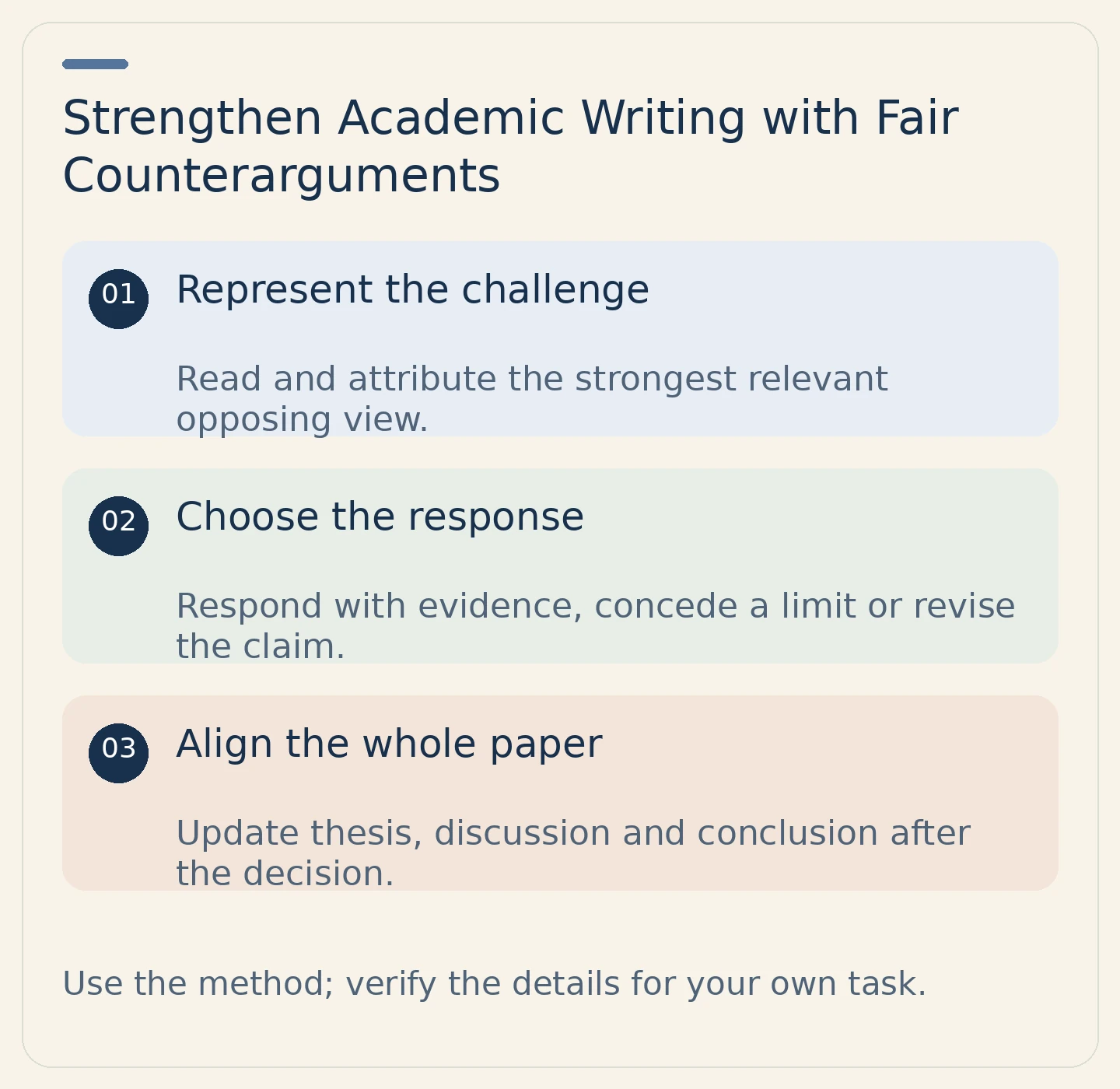
Keep the example smaller than the argument
Illustrative example, not a real study: an essay argues that a university should offer recorded lectures as an additional access route. A relevant objection concerns whether recordings alone provide the interaction some learners need. A weak reply claims that opponents dislike technology. A fairer reply recognizes the concern and narrows the proposal: recordings supplement rather than replace interactive teaching, while the essay still needs evidence for the particular educational claims it makes.
The example shows a decision pattern, not proof that a policy works. In real writing, identify the evidence supporting both positions and explain why the objection changes—or does not change—the conclusion.
Integrate the response into the draft
Place the challenge where readers need it. It might belong after a supporting reason, within a comparison of sources or in a discussion of limits. Make the change of speaker clear so your summary of an objection is not mistaken for your own final position.
After revising, check the entire argument. If a concession narrows the thesis, update the introduction, topic sentences and conclusion. Avoid a cautious discussion followed by an unsupported sweeping final sentence. Use transitions that show the actual relationship between ideas, not a repetitive sequence of “however” and “therefore.”
Review attribution and any permitted report
Check that quotations are accurate, paraphrases independent and claims supported by the cited passages. Use the assigned citation system and verify required locators and references. If report access is permitted, investigate meaningful Turnitin matches rather than reacting to the total score. The official student guide makes clear that similarity is not itself a plagiarism judgment; it cannot decide whether your counterargument is fair.
Final checklist
- Does the paper answer the assigned question with a clear, appropriately limited position?
- Is the strongest relevant challenge represented accurately and attributed?
- Have you explained your response with evidence rather than dismissive wording?
- Do source changes and your own judgments remain clear after revision?
- Are language, disclosures, formatting and the final upload file checked?
Retain genuine notes, drafts and the submission confirmation. A defensible paper is one you can explain, including what its evidence does not establish.
Related practical guides
For a separate evidence check, use the citation readiness guide; for the final handoff, use the pre-submission checklist. These are supplementary resources, not your institution’s submission system or policy.
Sources and scope
Further reading: University of Toronto: How Not to Plagiarize; University of Toronto: Using Quotations; Turnitin: Understanding the similarity score for students. Institutional examples apply to their own settings; follow the requirements governing your work.