
An outline listing “introduction, three sources, conclusion” is a container, not an argument. To write a persuasive academic paper, decide what you are claiming, why a reader should accept it and how the evidence supports each reason. This structure should guide research, drafting, source acknowledgment and revision—not appear only when you write the conclusion.
Confirm the task and sketch a working answer
Read the assignment, rubric, source requirements, citation style and submission instructions. Check the permitted scope of feedback, collaboration, translation and AI assistance. Identify the genre: an argumentative essay, empirical report and reflective assignment need not share the same structure.
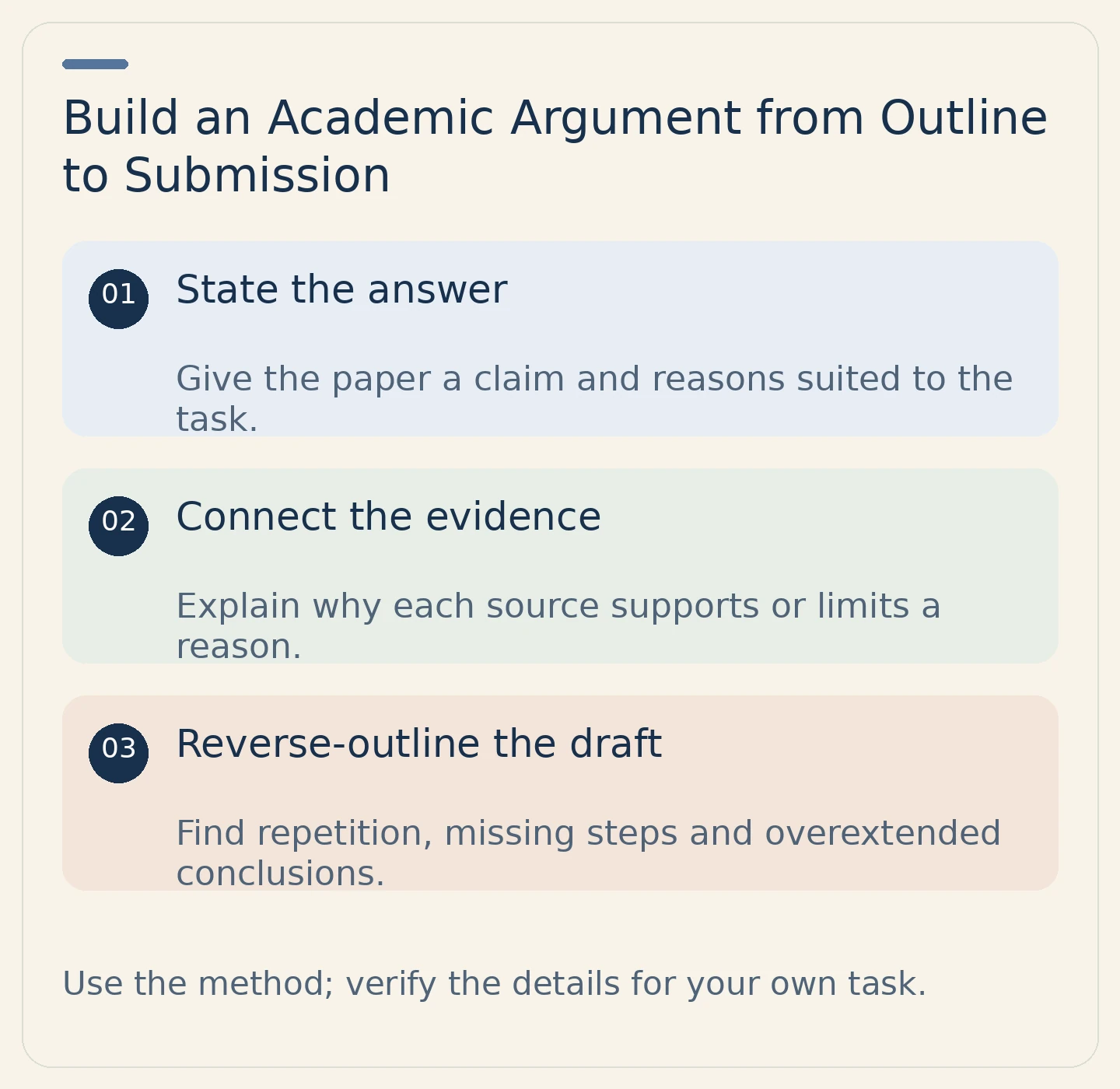
Write a provisional answer in a sentence. Under it, list the reasons that would make the answer convincing. Ask what a skeptical reader would need explained. This identifies research needs and helps you avoid collecting quotations simply because they sound relevant.
Research with the structure in view
Read suitable sources and keep traceable notes: publication identity, actual locations, accurate summaries and limitations. Mark exact wording immediately and keep your interpretation separate. Record whether a source supports, challenges or provides context for a particular reason. If evidence undermines your working answer, revise the answer rather than hiding the difficulty.
A useful planning hierarchy is: central claim, supporting reasons, evidence for each reason, explanation connecting evidence to reason, and limits on the conclusion. These are thinking functions, not compulsory headings in every paper.
| Layer | Question it answers | Warning sign |
|---|---|---|
| Central claim | What is the paper’s answer? | A broad topic rather than a position |
| Supporting reason | Why should the reader accept that answer? | Repetition of the thesis in different words |
| Evidence | What material supports the reason? | A citation that does not address the claim |
| Reasoning | How does the evidence support it? | An unexplained leap after a quotation |
| Limit | How far can the conclusion extend? | A universal conclusion from narrow material |
Replace a materials list with an argument outline
Illustrative example, not a reported investigation: suppose a course essay asks how a museum should present a contested historical object. A materials list might contain a catalogue, a scholarly interpretation and an institutional statement. An argument outline instead identifies the criteria for interpretation, uses the materials to explain different perspectives, and argues for a presentation approach within those limits.
The difference is the role assigned to each source. The catalogue may establish the documented description; it cannot automatically resolve the ethical interpretation. The essay must explain how its judgment follows from evidence and criteria, not imply that the source made the judgment for it.
Draft paragraphs that carry the reasoning
A paragraph often benefits from a controlling idea, evidence and explanation of significance, but do not force every paragraph into an identical formula. A paragraph establishing a definition may function differently from one answering an objection. What matters is that each advances the paper’s purpose and connects to its neighbors.
After evidence, ask “Why does this support my point?” and “What else could it mean?” Answering these questions makes your contribution visible. Paraphrase from understanding and verify the meaning against the source; quote exact language when necessary. University of Toronto guidance on quotations emphasizes integrating source language into your discussion rather than leaving it to do the analytical work.
Use a reverse outline to repair the draft
Once a draft exists, summarize what each paragraph actually does. Mark repeated reasons, missing steps and claims that appear before their foundations. Decide whether each paragraph should stay, move, combine, expand or go. Rewrite transitions to explain the relationship—contrast, qualification or consequence—rather than merely adding connective words.
Then check the introduction and conclusion. Both should reflect the argument you developed, including changes prompted by research. Do not end with a stronger claim than the evidence supports.
Audit and submit the complete paper
Check citations, quotations, source details and required locators, including after paragraphs move. If permitted, read Turnitin matches in context; its student guide explains that similarity is not a plagiarism judgment. Resolve actual attribution problems rather than seeking a particular percentage.
Finish with clarity, consistent terminology, applicable assistance disclosures and the required formatting. Open the final export, check references and figures, upload the intended version and retain the confirmation. A coherent argument remains coherent in the submitted file, not only in the planning notes.
Related practical guides
For a separate evidence check, use the citation readiness guide; for the final handoff, use the pre-submission checklist. These are supplementary resources, not your institution’s submission system or policy.
Sources and scope
Further reading: University of Toronto: Using Quotations; University of Toronto: How Not to Plagiarize; Turnitin: Understanding the similarity score for students. Institutional examples apply to their own settings; follow the requirements governing your work.