
A paragraph can contain accurate references yet leave readers unsure who said what. The problem is often the scope of a citation: does it support one sentence, several claims, or only the last phrase? Clear attribution starts with research planning and continues through drafting and revision. It is part of producing a complete argument, not a formatting task to leave until the reference list is finished.
Establish the paper’s purpose and evidence needs
Read the task, rubric, source requirements, citation style and submission rules. Confirm what assistance is permitted and whether draft reports are available. Write a working answer to the question, then outline the reasons and evidence needed to support it. Do not assume that a familiar essay structure will suit every report or disciplinary assignment.
During reading, save the identity of each source and the location of the relevant passage. Separate exact quotations, source summaries and your own observations. When a note contains several authors’ positions, identify each one rather than putting the entire note under a single reference label.
Draft around claims, then map their ownership
Write a paragraph that advances your argument. Use evidence to support, challenge or qualify the point, and explain the connection yourself. Paraphrase from understanding and compare with the source for accuracy; quote distinctive wording where necessary. Both borrowing ideas and borrowing exact words require appropriate acknowledgment.
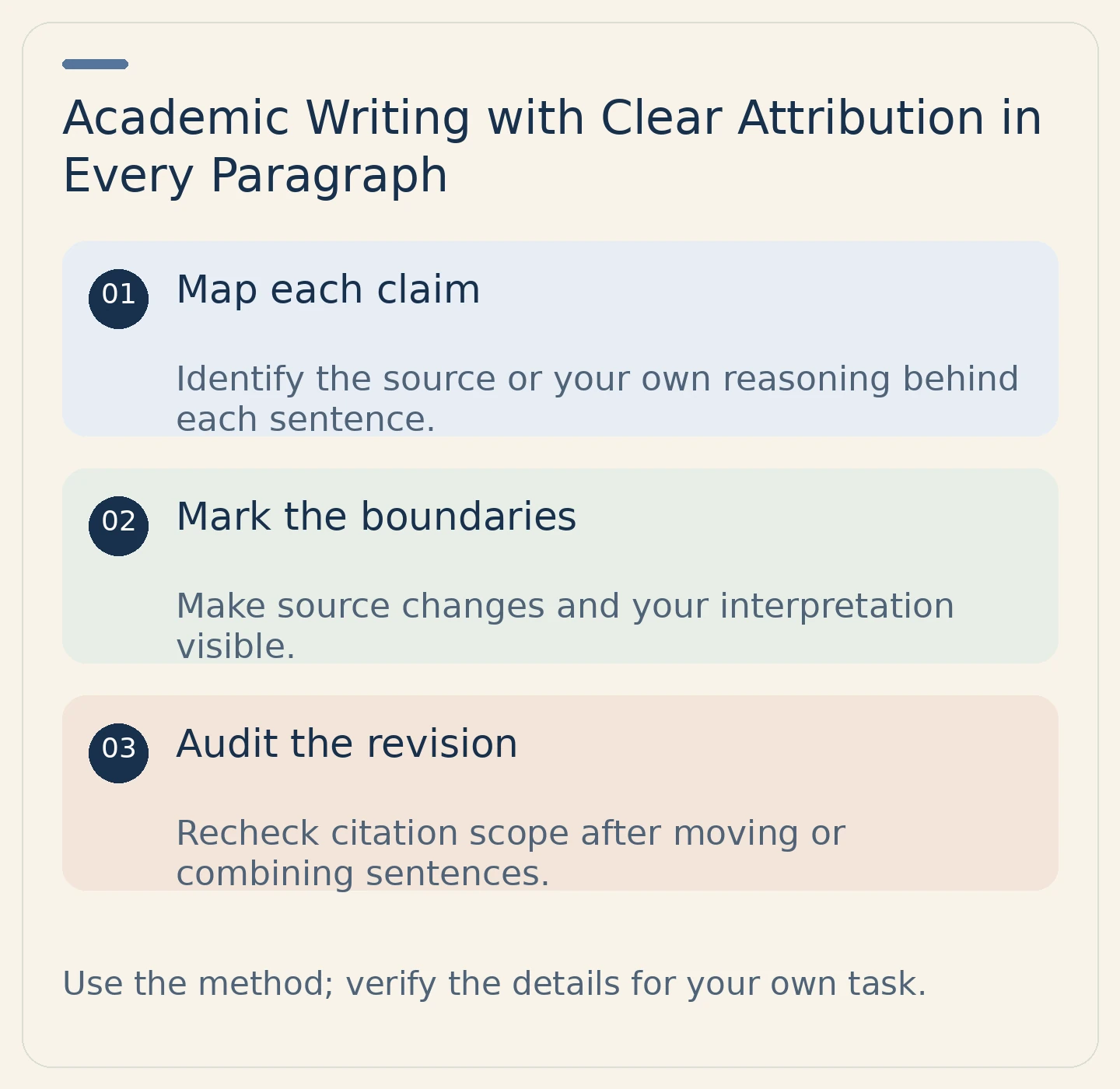
Next, make a temporary source map. This can stay in your private revision notes; its purpose is to expose ambiguity before you submit.
| Sentence function | Question to ask | Revision if unclear |
|---|---|---|
| Source-based claim | Which actual passage supports this statement? | Add a precise citation or narrow the claim |
| Second source’s view | Can the reader see the change of speaker? | Introduce the author or place a new citation |
| Comparison | Is this relationship in the sources or my interpretation? | Attribute the evidence and identify your comparison |
| Conclusion | Does the evidence justify the strength of this claim? | Qualify, replace or remove the conclusion |
The University of Toronto’s plagiarism guidance distinguishes acknowledging an idea where it is used from merely listing the source in a bibliography. Author names and reporting phrases can help readers follow that boundary; follow your assigned style for the formal citation details.
Repair an ambiguous paragraph without inventing evidence
Illustrative example: teaching note A says a library extended its opening hours. Teaching note B says a student could not reserve a particular room. Neither is a real study. A draft that places only “B” after both claims obscures the source of the hours information. It also cannot support the conclusion that access problems were solved.
A clearer version would say: “Teaching note A describes extended opening hours, while teaching note B describes an unsuccessful room reservation. These examples distinguish opening hours from booking availability; they do not establish that access problems were resolved.” The first sentence identifies each source. The second makes a limited comparison by the writer. In real coursework, replace teaching labels with sources actually read and the locators required by your style.
Recheck boundaries after revision
Moving, combining or shortening sentences can change what a citation appears to cover. Revisit the paragraph whenever you add another source, remove an author’s name or merge evidence with your own analysis. A final citation may be appropriate when its scope is clear; there is no need to force a mechanical citation after every sentence. The test is whether the reader can trace each borrowed contribution without guessing.
If you cannot locate support for a claim, pause. Recover the source, rewrite the claim to match verifiable evidence, or delete it. Do not add a plausible-looking reference to fill the gap. If you only read a secondary account, represent that route honestly under the applicable citation rules.
Use report feedback without losing the argument
If permitted, open meaningful Turnitin matches and compare the paragraph with the actual material used. A match is not automatically misconduct, and an unhighlighted claim is not automatically correctly attributed. Turnitin’s student guide cautions against treating a similarity score as a plagiarism judgment. Correct copied wording, missing citations and misleading attribution rather than chasing a percentage.
Finish with a whole-paper review: does the evidence develop the working answer, and does the conclusion respect its limits? Read for clarity and transitions, check references according to the assigned style, and disclose permitted assistance where required. Finally inspect the exported file, upload the correct version and keep the confirmation. Citation scope must remain clear in the submitted document, not just in your notes.
Related practical guides
For a separate evidence check, use the citation readiness guide; for the final handoff, use the pre-submission checklist. These are supplementary resources, not your institution’s submission system or policy.
Sources and scope
Further reading: University of Toronto: How Not to Plagiarize; University of Toronto: Using Quotations; Turnitin: Understanding the similarity score for students. Institutional examples apply to their own settings; follow the requirements governing your work.