A polished paper can still miss the assignment. It may describe a topic when the task asks for an evaluation, compare things using different criteria, or introduce evidence that never answers the question. Prevent that mismatch by making a small task map before researching and returning to it during revision. Similarity checking cannot perform this intellectual work for you.
Decode what you are being asked to do
Read the prompt alongside the rubric and any required structure. Record the audience, length, citation style, source expectations, deadline and permitted assistance. If instructions conflict or an important term is unclear, ask the instructor rather than treating a general writing guide as the final authority.
Task words suggest different work, although their precise meaning depends on the course. Use this planning aid as a starting point, not as a universal marking formula:
| Task word | Work the paper needs to do | Evidence-planning question |
|---|---|---|
| Compare | Examine similarities and differences on shared dimensions | Are the cases being compared on a fair basis? |
| Evaluate | Reach a supported judgment using clear criteria | What makes this option effective or limited? |
| Analyze | Explain relationships, parts or mechanisms | What evidence supports the proposed connection? |
| To what extent | Assess the strength and boundaries of a claim | Where does the claim hold, and where does it not? |
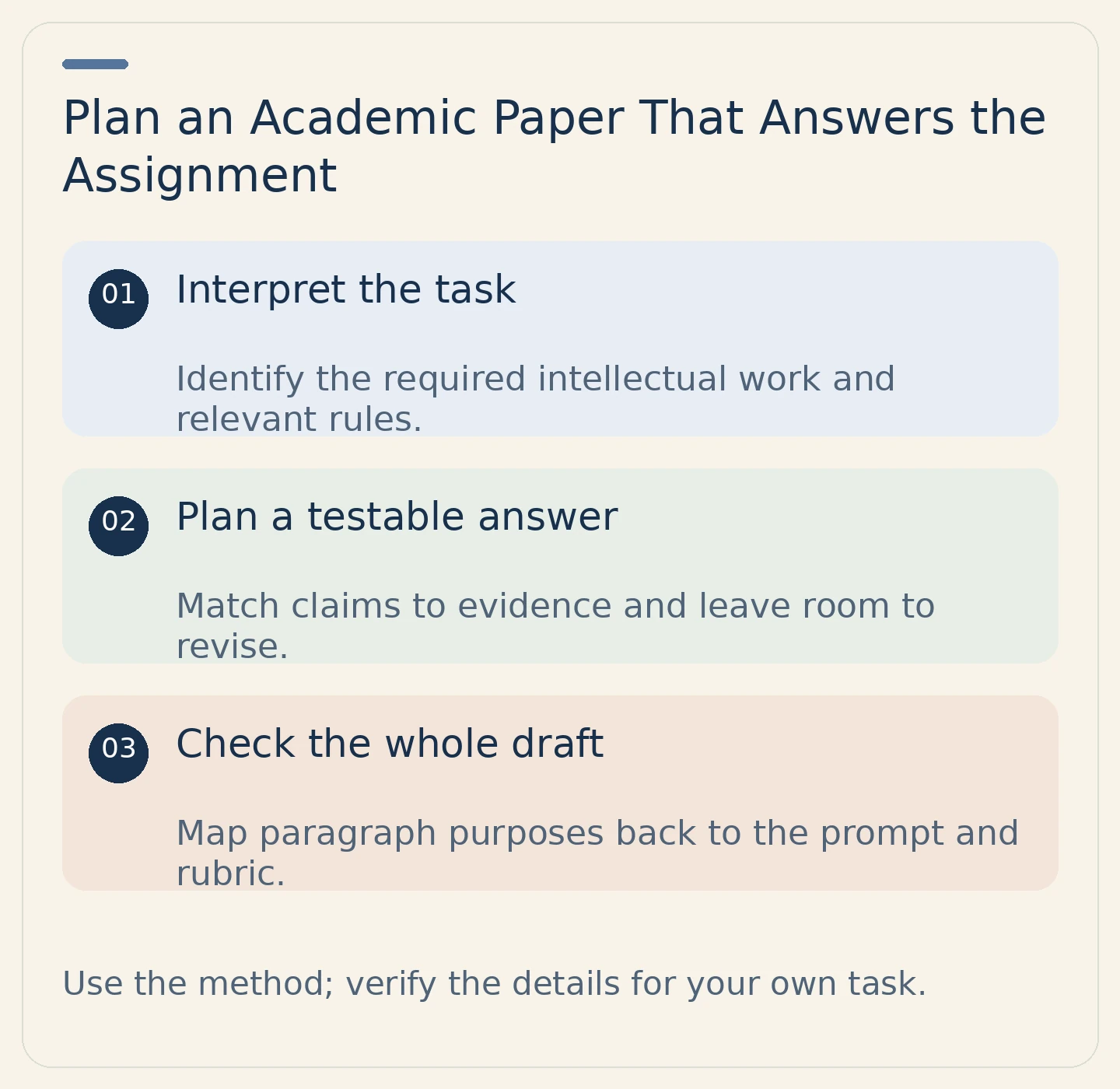
Write a plain-language sentence beginning “This paper must…” and check that it includes all parts of the task. Keep this sentence beside your draft.
Narrow a topic into an answerable question
A topic is an area; a question specifies what you will investigate. Narrow by the relevant setting, concept, material or comparison, guided by the assignment rather than arbitrary restrictions. Avoid a question so broad that you can only list facts, but do not narrow it until evidence becomes impossible to find.
Illustrative planning example, not a reported study: “digital learning” is a topic. “How should this course evaluate the accessibility of two digital learning formats?” is a more focused question. It requires defining accessibility, choosing comparison criteria and finding suitable evidence. It does not license a sweeping conclusion about all students or all digital education.
Research to test a working answer
Draft a provisional thesis, then list what evidence would support and challenge it. Read the actual sources and record bibliographic details, relevant locations and limits. Separate quotations from your summaries and your own analysis. If the available evidence does not support your early position, revise the position rather than stretching the sources.
Turn the outline into section purposes: establish the criteria, compare the relevant evidence, consider limits and reach a judgment. Sources should contribute to these purposes, not dictate a source-by-source sequence. Explain why each piece of evidence matters to the task.
Check paragraphs against the promise
After drafting, make a reverse outline: summarize the job of each paragraph in a short phrase. Then connect it to the prompt or rubric. A paragraph that provides necessary context may belong, but ask whether that context is proportionate. A beautifully written detour still needs cutting if it does not help the reader follow the answer.
Look for missing operations as well as missing topics. An essay may mention both options without actually comparing them. It may present criteria without applying them. Fill those reasoning gaps before polishing sentences. The rubric helps locate the expected work; it does not guarantee a grade when boxes are ticked.
Verify attribution and interpret any available report
Paraphrase from understanding, preserve qualifications and cite borrowed ideas. Use quotation formatting for retained exact wording and real locators where required. The University of Toronto’s guidance explains why attribution belongs with the material used, not merely in a bibliography. Check source support separately from reference formatting.
If your course permits draft reporting, inspect Turnitin matches in context. The official student guide explains that a similarity score is not a plagiarism judgment and has no universal acceptable target. Correct genuine source-use issues without damaging accurate terminology or the argument.
Complete the final review in passes
- Content: check that the thesis and conclusion answer the same assigned question.
- Evidence: verify the sources, quotations, qualifications and citation-reference correspondence required by the style.
- Readability: clarify transitions, define key terms and remove unnecessary repetition.
- Submission: check required disclosures, formatting, word limit and the actual upload file; retain the confirmation.
A successful task map keeps your research and writing accountable to a purpose. Its value is not mechanical compliance, but a clearer answer that a reader can assess.
Related practical guides
For a separate evidence check, use the citation readiness guide; for the final handoff, use the pre-submission checklist. These are supplementary resources, not your institution’s submission system or policy.
Sources and scope
Further reading: University of Toronto: How Not to Plagiarize; Turnitin: Understanding the similarity score for students. Institutional examples apply to their own settings; follow the requirements governing your work.