
The answer arrives after the opening
In an imagined classroom discussion, a student has an objection before they have a sentence. By the time the wording is ready, the conversation has moved. The silence could be mistaken for a lack of ideas. What happened is more particular: forming a contribution in an additional language took longer than the opening in which it might have been spoken.
That distinction matters without becoming a general story about all multilingual learners. Some speak readily in every setting; some prefer time to formulate regardless of language. Knowledge, familiarity with the topic, confidence in the room, and the kind of question all matter. A slower response tells an observer very little by itself about the thought behind it.
Retrieval and reasoning are different tasks
A person can see a relationship clearly while searching for the verb that expresses it. They can also speak smoothly without having examined the relationship very far. Fluency makes ideas easier to share, but it is not an exact measure of their depth. Confusing the two can lead both speakers and listeners to underrate a contribution before its content has become available.
For the speaker, this confusion can change the argument itself. A nuanced objection gets replaced by a simpler statement because that statement is easier to retrieve quickly. Sometimes compression is necessary in conversation. But if compression regularly removes the condition that makes a thought accurate, the speaker is not merely speaking more briefly; they are being represented by an idea they did not intend.
A note that holds the shape
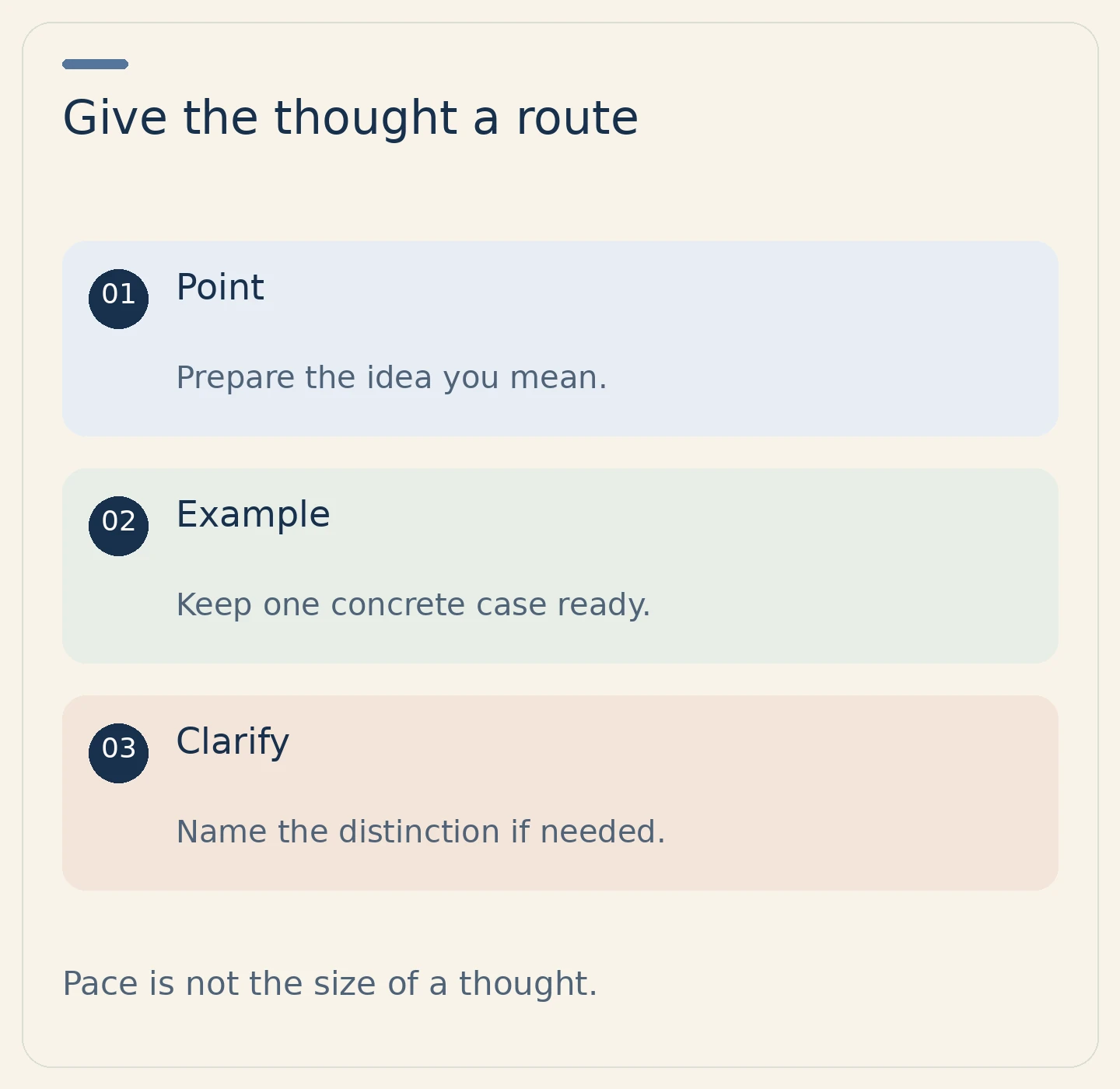
A small experiment is to prepare a note with a point, one example, and a sentence that clarifies the main distinction. In the imagined discussion, the point might be that equal access to a resource does not mean equal ability to use it. The example and clarification give the speaker more than one route into that thought if the first wording becomes difficult.
The note is not a script to memorize perfectly. It holds the shape of the contribution while leaving room for the actual conversation. A clarification can be especially useful when a familiar word is interpreted too broadly. Being able to say which meaning is intended can preserve more of the argument than trying to deliver a long, uninterrupted explanation without pause or repair.
The room also carries responsibility
It would be misleading to place all adaptation on the slower speaker. A discussion that rewards only immediate entry can miss contributions from many people. Allowing a pause, returning to an unfinished point, or making space for a written question are possible ways a room can work differently. They are possibilities, not promises about what any particular course permits or provides.
The speaker may be able to ask about a suitable way to contribute. They may also encounter a setting that is inflexible. A preparation technique does not erase that limitation, and difficulty within it is not proof that the technique was used badly. Communication is an arrangement between people, not a private test that one participant can pass through sufficient effort alone.
Clarity without a smaller claim
There is still a practical reason to choose manageable language. Shorter sentences can make a distinction easier to deliver and easier to hear. The aim, however, is not to remove everything complex from the thought. It is to decide which complexity belongs in the content and which burden comes from a form that is unnecessarily difficult to produce in the moment.
A prepared example can carry a subtle point more effectively than a sentence crowded with unfamiliar abstractions. It also invites a listener to check understanding against something concrete. That exchange is different from asking the speaker to sound effortless. It treats clarification as part of the intellectual work rather than an interruption that should have been prevented by better language skills.
What the pause can contain
In the imagined classroom, the note may not secure the perfect moment to speak. It can still help the student recognize that the idea has a coherent form independent of how quickly it enters discussion. That recognition is modest but important. The pause is no longer empty evidence of inadequacy. It may be the interval in which a substantial thought is finding a shareable shape.