
What deserves a place in the next term
The end of a semester can invite an extravagant redesign. A new notebook will hold every task, every reading, every deadline, and every reflection. The system looks capable of carrying the next term before that term has acquired its actual shape. Yet the most useful thing to carry forward may be much smaller: one practice that answered a recurring difficulty and could still fit a less predictable week.
Small does not automatically mean effective. An action can be brief and useless, just as a large system can be thoughtful and necessary. The distinction is not between modest virtue and ambitious failure. It is between a practice connected to a real need and a practice maintained because the idea of being organized has become more compelling than the work the organization is supposed to support.
An imagined choice between systems
Imagine a learner deciding what to retain from a demanding term. One option is a comprehensive set of reading templates that was used enthusiastically and then abandoned. Another is a brief question written after a reading when something remained unresolved. That question occasionally gave the next session a clear starting point. The second practice has less visual presence, but its purpose is easier to identify.
The learner should not conclude that every reading now needs a question. Some readings serve a quick factual purpose; some are understood well enough for the immediate task. The practice is worth keeping only if it captures an uncertainty that would otherwise disappear or become vague. Its value comes from the relationship between the question left today and the work made possible tomorrow, not from a full sequence of completed boxes.
Attach the action to a real moment
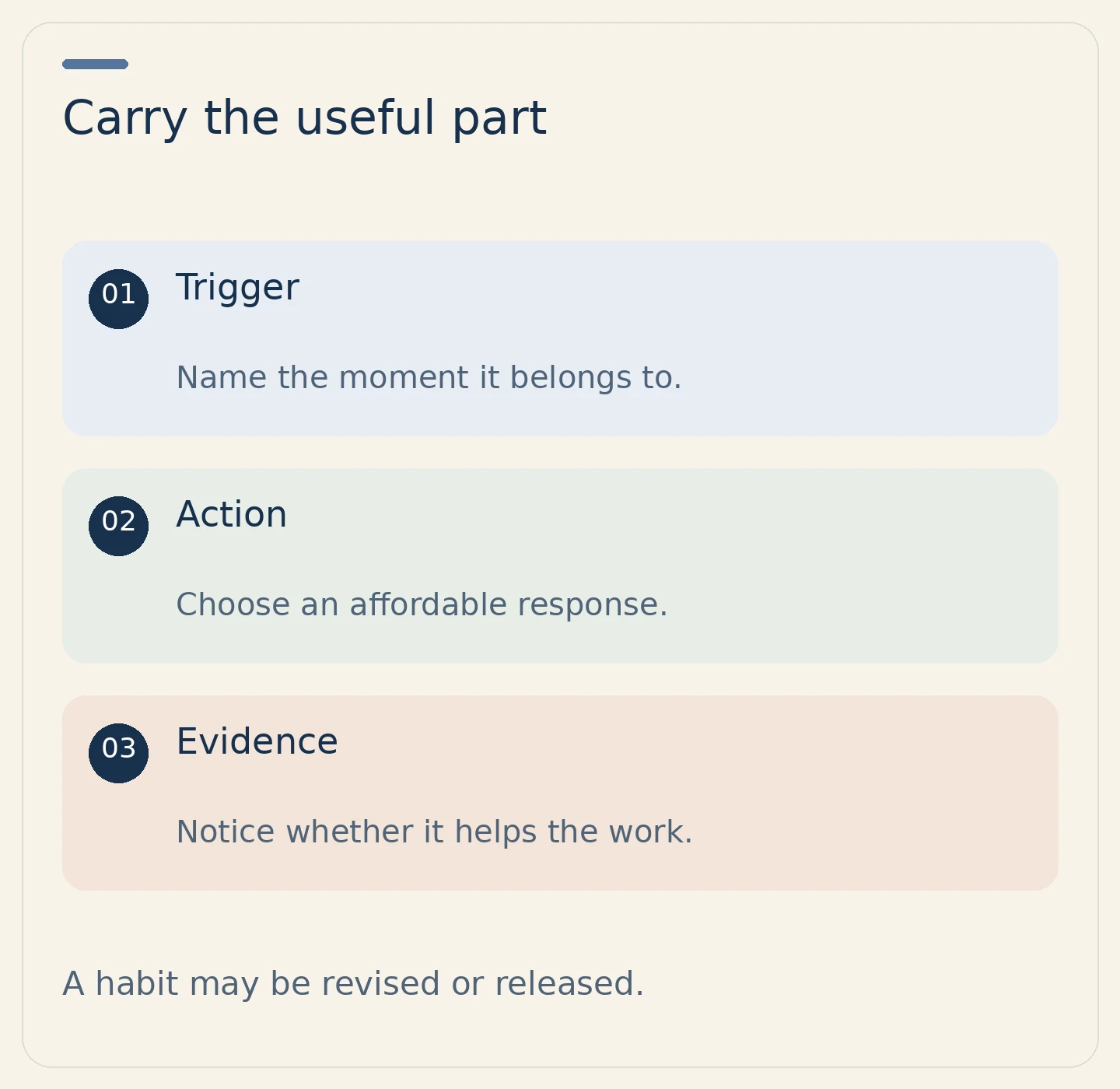
A small experiment is to state a trigger and an affordable action together. After closing a reading that matters to the current project, the learner writes the one question most likely to affect the next step. This is more concrete than resolving to become reflective. It places the practice at a recognizable moment and gives it a limit. One question is a chosen unit, not the beginning of an indefinite new obligation.
The trigger may need changing. If readings are usually interrupted rather than neatly finished, the practice might fit better when putting the material away. If the question is already clear in another form, copying it again may add nothing. A useful habit should adapt to the conditions in which it is meant to operate. Its design is provisional, not a test of whether the learner can obey an ideal routine.
Look for use, not a perfect streak
After trying the practice, the learner needs evidence of its effect. Did a saved question help restart work? Did it reveal that the next reading should address a specific gap? Or did the notes accumulate without influencing any later decision? These are ordinary observations about the work, not invented measures of transformation. They give a reason to keep, modify, or stop the practice.
A missed occasion is less informative than the pattern of use. Maintaining a perfect streak can become another task whose success is disconnected from learning. At the same time, flexibility should not mean declaring a habit valuable without ever testing it. The middle position is practical: give the action enough real encounters to judge its fit, while remaining willing to reduce it or let it go when its purpose is not being served.
What continuity can look like
In the imagined next term, the learner may keep the question habit but abandon the comprehensive templates. Later, a different kind of project may require more structure. That change need not mean the smaller practice failed. It may have done a limited job well and then yielded to a different need. Continuity lies in carrying forward responsive judgment, not in preserving every tool unchanged.
A semester leaves more than finished assignments. It can leave a clearer sense of what makes returning to difficult work possible. The habit worth keeping is not necessarily the one that looked most complete at the start. It may be the one small action whose usefulness can still be explained when the original timetable, course, and notebook have all been left behind.