
The page count stays still
Imagine leaving a library after a long session with the same number of draft pages as when you arrived. The easy verdict is that nothing happened. Yet during that time, one confusing term became clearer and an apparently relevant reading turned out to address a different question. The document did not grow, but the field of possible next moves became smaller and more accurate.
That possibility deserves recognition without becoming an automatic consolation. A long interval is not evidence of learning simply because it felt difficult. Nor does a lack of visible output prove that the interval was wasted. The question is what changed in a form that can be identified later. Progress needs some trace beyond both the clock and the wish to feel better about the clock.
Elimination can be a positive result
Finding that a route does not serve a question can save later confusion. The imagined reader may have followed a familiar keyword into a discussion whose central concern is different from the essay's. Closing that route is useful if the reason is understood: the source examines personal preference, while the draft concerns practical opportunity. The distinction tells the writer not only to stop reading there but why stopping is justified.
Without that explanation, abandoning a source is hard to distinguish from losing patience with it. This is where a small record matters. A sentence that names the mismatch makes the result inspectable. The reader can reconsider it if the essay's question changes. The closed route is no longer merely an absence from the bibliography; it is part of a reasoned understanding of the task.
Three sentences at the door
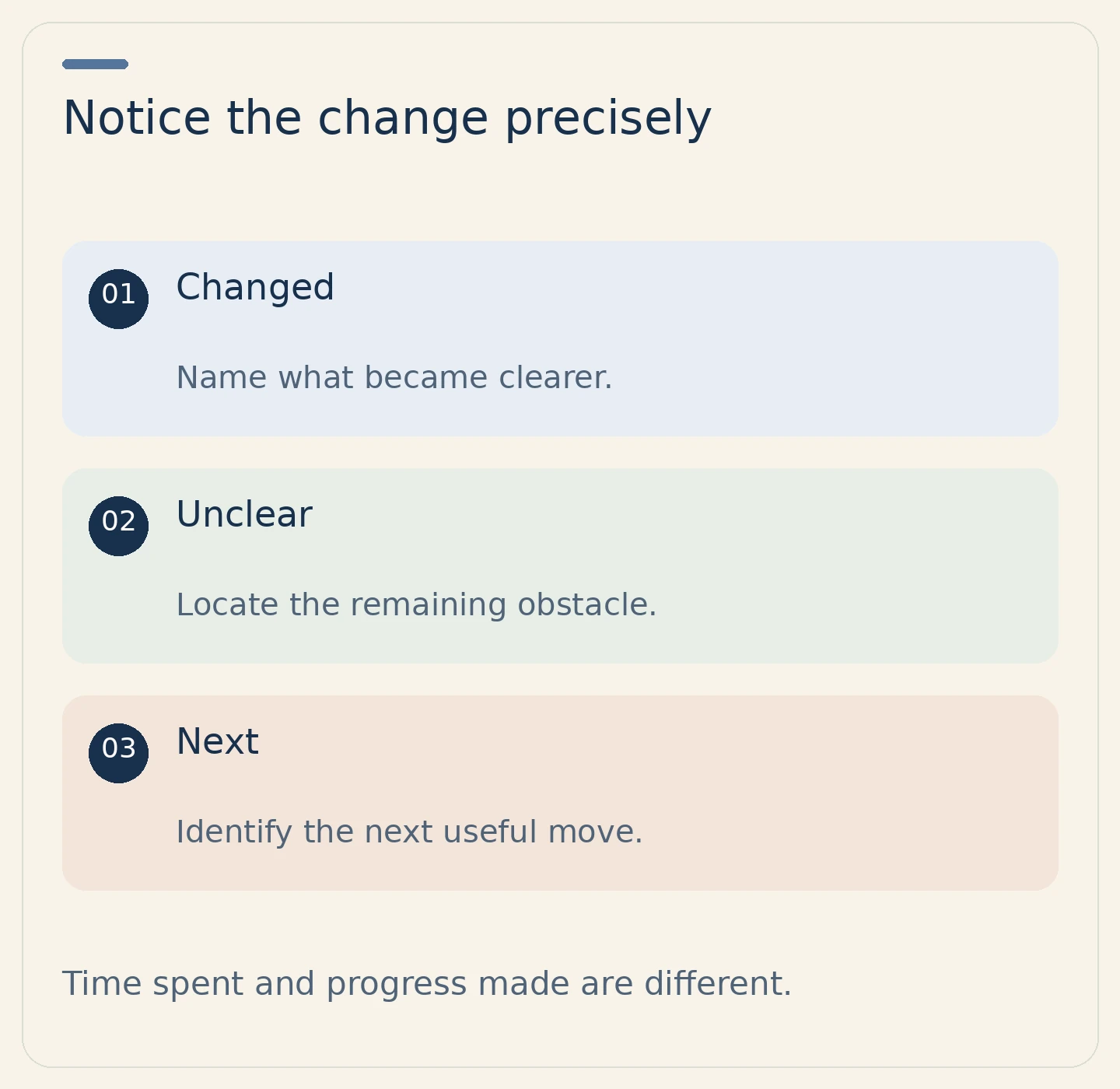
A modest experiment is to end one session with three sentences: what changed, what remains unclear, and what the next useful move would be. These sentences should refer to the material. The first might identify the meaning of a term that was previously being used too broadly. The second might name the connection still missing. The third might point to a specific comparison rather than simply promise more reading.
This is not a requirement to find a positive result every time. Some sessions may leave the writer unable to name a meaningful change. That is information too. Perhaps the activity had no clear purpose, or the question was too broad to guide selection. An honest record can expose those patterns. Inventing a small success to complete the note would defeat the very distinction the practice is meant to preserve.
A trace should not become another performance
The record needs to stay small enough to serve the work. If every session requires an elegant reflection, the writer has acquired a second assignment. A rough sentence with a precise difference is more useful than a paragraph full of general statements about gaining insight. The measure is whether the note helps the next encounter begin somewhere more accurate, not whether it makes the previous encounter look admirable.
Likewise, one session cannot carry a complete judgment about a person's ability or commitment. The account concerns a bounded interval and a particular task. It does not need to explain the whole life around the library visit. Keeping that scale matters: the purpose is to distinguish forms of intellectual movement, not to turn every quiet hour into a moral assessment of how seriously someone studies.
The next visit begins differently
When the imagined writer returns, the note can prevent the same uncertain search from starting again. The clarified term is available, the unsuitable route has a reason attached, and the remaining question is narrower. If none of these changes affects the next session, the writer can reconsider whether the record captured something useful. A trace earns its value through the difference it makes to subsequent work.
A page count is easy to see because it gives progress a familiar shape. Understanding sometimes changes shape before it changes length. The library session may have removed an assumption or made a question more exact. Those results deserve neither inflated celebration nor dismissal. They belong to a quieter category: work that makes the next piece of writing more possible by changing what the writer can responsibly attempt.