
The outline is ready before the question is settled
Imagine a learner using a tool that the task permits. They are puzzled by a tension in a reading: a proposal appears to widen access while making participation harder for some users. The tool returns a fluent outline about the benefits and challenges of inclusion. The headings are balanced, the prose reassuring, and the original tension has almost disappeared.
Nothing needs to be obviously nonsensical for this response to be unhelpful. It may contain reasonable general observations. The failure is one of substitution. A question about how two features coexist has become a broader invitation to discuss a topic. Because the output looks finished, the learner may begin improving it rather than noticing that the inquiry has moved away from the problem that made the reading interesting.
Keep a copy of the problem
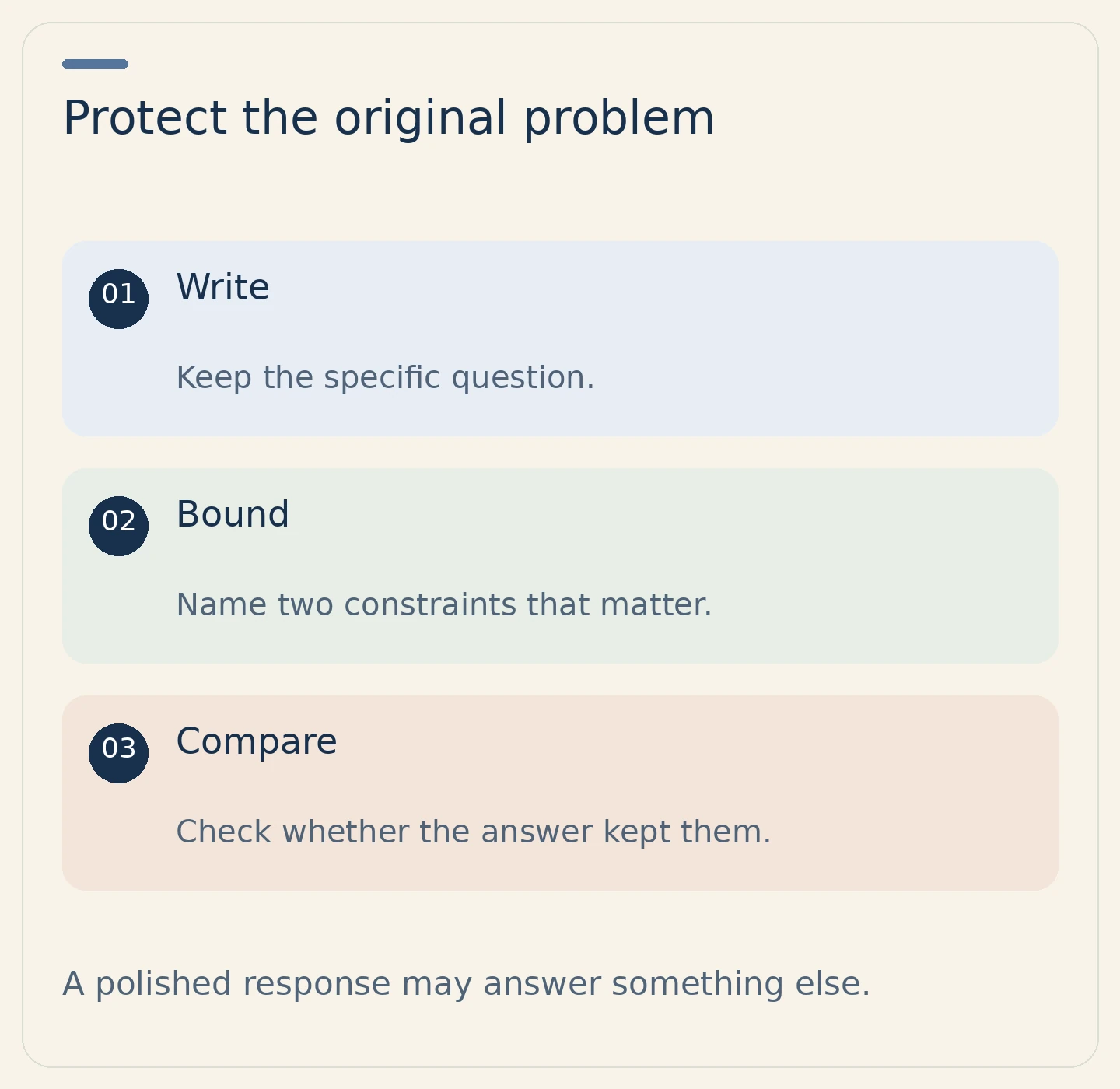
Before requesting assistance, a small experiment is to write the actual question and two constraints that an adequate response must preserve. In the imagined case, one constraint might be that access and participation cannot be treated as interchangeable. The other might be that the explanation must concern the arrangement described in the reading, not an invented program with more convenient features.
These notes are not a technical trick for obtaining perfect output. They create a reference point outside the output. Without that point, a smooth answer can redefine success by its own shape. With it, the learner can ask whether the response still addresses the original difficulty. The check concerns fidelity to the inquiry before it concerns elegance, breadth, or the ease with which the outline could become an essay.
A useful answer can be incomplete
The tool might preserve one distinction and lose the other. It could help articulate why practical entry differs from meaningful participation while inventing a feature the reading never mentions. The learner can retain the useful formulation only after checking it against the material. A partially useful response should remain partial in the writer's account; fluency does not authorize missing support.
Sometimes the best result is a clearer question rather than an answer. The output may reveal that the learner has combined two different meanings of participation. That discovery can guide a return to the reading. The tool has then served the inquiry without settling it. Expecting every interaction to produce a complete solution can encourage acceptance of general prose where a more exact difficulty still needs attention.
A particularly useful comparison concerns what the output left out. If the answer never returns to the tension between entry and participation, the omission is not merely a missing section. It may show that the response has organized itself around an easier problem than the one the learner brought.
Permission and verification are separate
The imagined scene begins with permission because access to a tool does not establish that a task allows its use. The learner needs to know the relevant boundary before involving it, including any restrictions on what can be shared. No particular software or institutional rule can be assumed here. Choosing not to use a tool may be the appropriate response when those conditions are unclear or unsuitable.
Even permitted use does not remove the need to verify claims. A response may introduce a source, factual assertion, or interpretation that the learner cannot establish. Such material should not acquire authority because it fits the outline. The original reading remains the place to check what the reading says. The writer remains responsible for distinguishing a helpful suggestion from an explanation that the available material actually supports.
The question belongs outside the answer
In the imagined case, the learner might set aside the general outline and return with one sharper distinction: the proposal broadens eligibility but leaves the practical conditions of participation unchanged. Whether that interpretation holds still depends on the reading. What matters is that the inquiry has retained a shape that can be examined, rather than dissolving into a familiar essay about inclusion in general.
Tools can make a finished-looking object arrive unusually early. That changes the temptation, not the responsibility. The writer must still decide what problem is being addressed and what would count as a defensible response. Keeping the question outside the answer gives that decision a place to stand. The output becomes material to consider, rather than a new destination chosen simply because a fluent route has appeared.