
There is a narrow picture of seeking assistance: the writer has tried everything, understands nothing, and finally arrives with an empty page. That picture can make early help feel undeserved. Yet a partially understood problem may be the best material for a useful conversation. There is enough work to inspect and enough uncertainty for another perspective to matter.
The boundary is not simply between working alone and receiving help. It lies partly in what is being handed over. A writer can share a difficulty without transferring the responsibility to decide what the work says. A conversation can sharpen the author's judgment, or it can quietly replace that judgment. The difference becomes clearer when the request concerns a specific choice rather than a general demand to make the essay good.
Bring the fork in the road
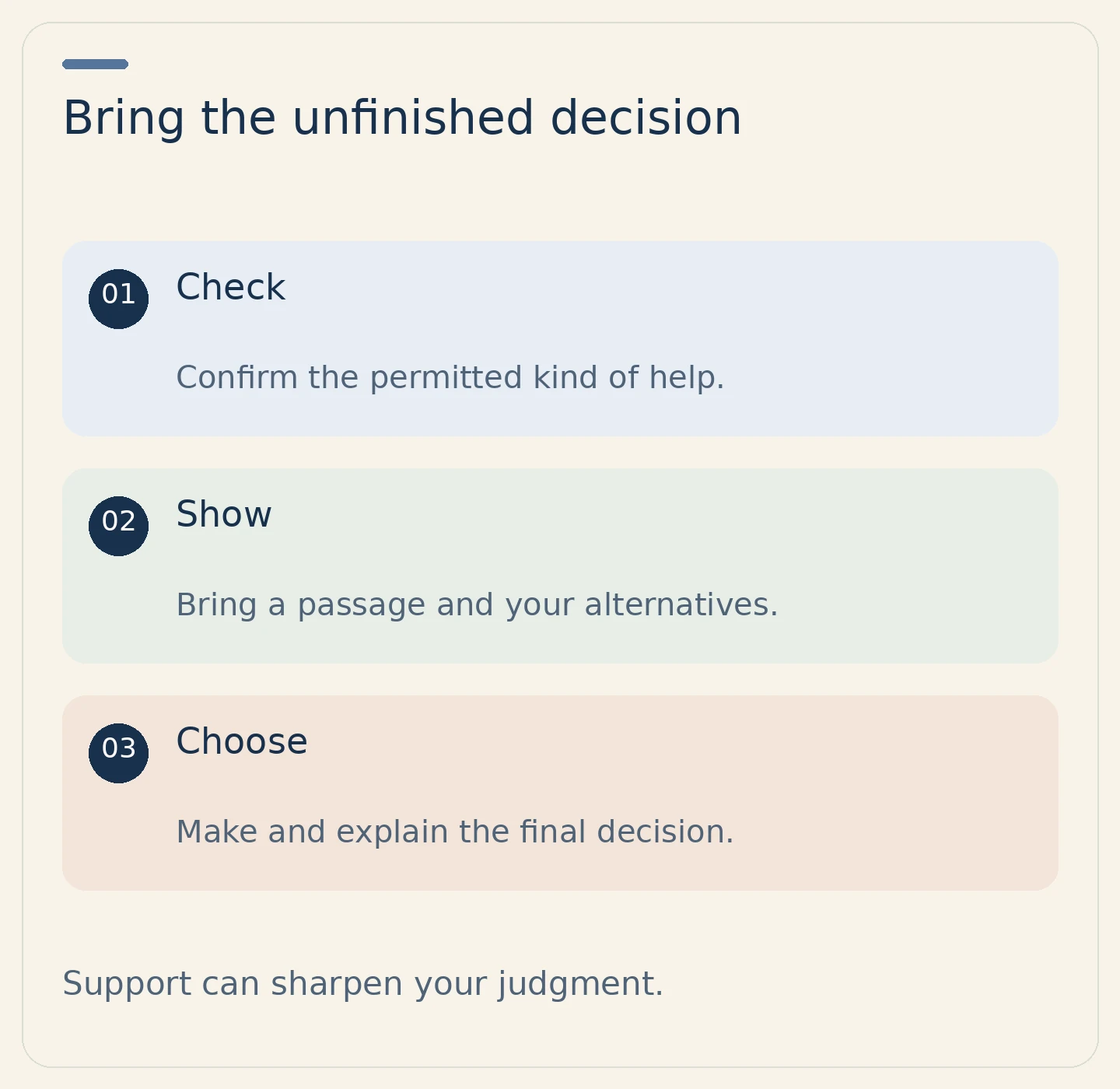
Imagine a permitted writing consultation. The writer brings one paragraph and two possible interpretations of an example. In the first, the example shows a failure of access; in the second, it shows a failure of communication. The writer has reasons for each but is unsure which the available material supports. This is not a blank request for someone else to produce an argument.
The helper can ask what changes under each interpretation, point to an unsupported assumption, or explain where the paragraph stops making sense. These responses give the writer a better view of the decision. The useful object in the room is not only the paragraph. It is the fork in the road, made visible enough that another person can help examine it without choosing the destination on the writer's behalf.
Establish the boundary first
Before that conversation, the writer needs to confirm what kind of assistance the course or task allows. Permission cannot be assumed simply because a service exists or because a friend offers help. A particular task may permit discussion of ideas but restrict rewriting, or may define collaboration differently. Without knowing that boundary, even well-intended support can move beyond the work the author is expected to do independently.
This need not turn the whole encounter into a procedural checklist. It is a practical condition for asking the right question. If only discussion is permitted, the writer can ask about the reasoning rather than request replacement prose. If the allowed scope is unclear, clarification comes before the disputed assistance. The form of help should be chosen deliberately, not discovered after the helper has already supplied the central work.
The author returns to the decision
A small experiment is to leave a consultation with a short note describing what was questioned, which choice the writer made, and why. This note is not a performance of independence. It checks whether the conversation produced a judgment the writer can explain. If the only account is that the helper said to use the second interpretation, the main responsibility may still be sitting with the wrong person.
The writer can reasonably reject advice. A helper may be unfamiliar with the subject or may prefer a direction that does not fit the task. Equally, rejecting advice simply to prove ownership misses the point. Authorship is not measured by how little another person influences the draft. It is sustained through accountable decisions about what to accept, what to question, and what the resulting language actually claims.
A more generous form of independence
In the imagined consultation, the writer may discover that neither interpretation works without a narrower distinction. The eventual paragraph can be different from both original options and still belong to the writer who reasons through the change. Assistance has made the decision more demanding rather than removed it. That is a useful sign of support: the work becomes more understandable to its author, not merely more polished to an observer.
Independence need not mean withholding a difficulty until it becomes overwhelming. It can mean knowing what kind of help to seek and returning from that help with the responsibility still intact. The writer does not have to bring a finished answer. Bringing a genuine attempt and a real decision can be enough to keep the conversation both generous and properly their own.