
Before the reply becomes fluent
It can be easier to answer a weak version of an argument than to understand a strong one. The reply arrives quickly, complete with a satisfying objection. But fluency can conceal a substitution: the claim being rejected is not quite the claim that was made. A page reserved for disagreement introduces a useful delay between recognizing opposition and announcing that it has been defeated.
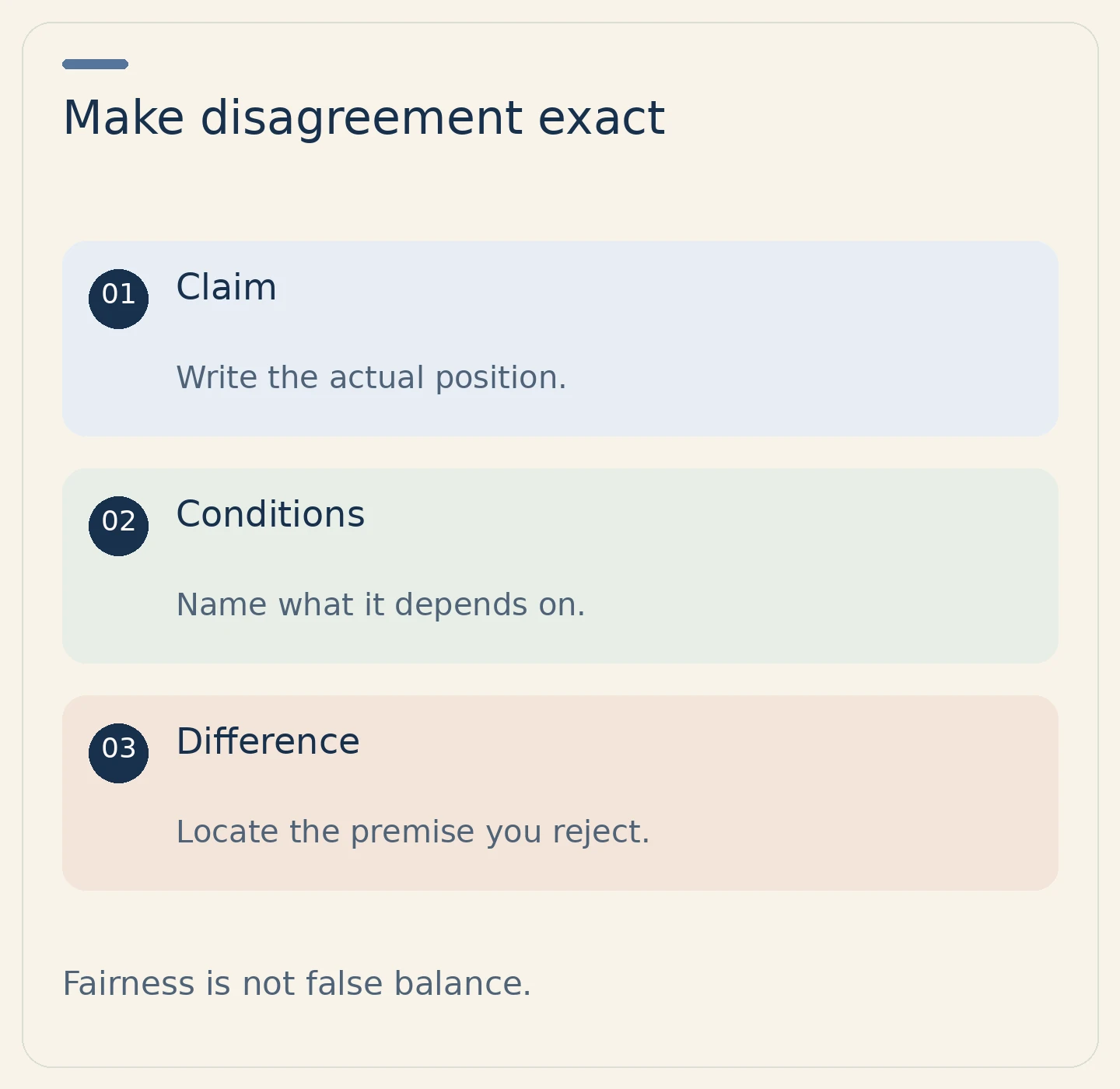
This page need not become an exercise in compulsory sympathy. Some claims are unsupported, harmful, or simply irrelevant to the question. They do not acquire equal standing because someone objects to them. The aim is narrower: when an argument deserves engagement, represent it well enough that the disagreement concerns its real commitments rather than the version most convenient to dismiss.
An imagined argument about shared space
Suppose a hypothetical essay argues that a common room should have quiet hours because several different activities must share limited space. A reader objects that quiet hours would make the room unwelcoming. Both positions might matter, but the objection may miss the essay's actual premise: the room cannot support every activity at the same time. The dispute is not necessarily between hospitality and hostility to conversation.
A more accurate reconstruction would identify the claim, its scope, and its reasons. Perhaps the proposal concerns only one part of the evening, not all use of the room. Perhaps it assumes that conversational activities have another suitable location. If that assumption is wrong, the objection becomes more precise. The reader can challenge the availability of alternatives rather than attributing a general dislike of sociability to the imagined author.
Three spaces on one page
The small experiment is to divide a page into the actual claim, the conditions under which it could be reasonable, and the point of disagreement. These spaces are not votes for and against. They do different jobs. The first prevents replacement of the argument; the second reveals dependencies; the third gives the writer somewhere to stand without pretending that every part of the opposing view must be mistaken.
For the common room example, the relevant condition might be genuinely usable alternative space. The disagreement might be that no such space exists for the people most affected. This is stronger than saying the proposal is bad because it restricts activity. It shows why a particular restriction would impose a burden the argument has not adequately considered. Precision does not soften the objection; it gives it a firmer basis.
The limits of reconstruction
A reader cannot always determine what someone intended. The text may be ambiguous, inconsistent, or incomplete. Fairness does not require repairing it into an argument its author never supplied. In that situation, the notebook can distinguish the stated claim from a possible charitable interpretation. Keeping those separate avoids quietly lending the argument reasons that belong to the reader and then treating the result as an accurate account.
Nor should every unsupported assertion receive a lengthy three-column analysis. Attention is limited, and relevance matters. If an assertion supplies no reasons, it may be enough to identify that absence and move on. A notebook is useful when it clarifies a live intellectual disagreement. It becomes a distraction when its neat format pressures the writer to invent respectable conditions for claims that have offered no credible basis at all.
A disagreement worth keeping
The imagined common room dispute may remain unresolved. One person may give greater weight to uninterrupted use; another may prioritize a wider range of activities. A better account of those values does not guarantee agreement, and agreement is not the only worthwhile outcome. The reader may leave with a narrower objection that survives closer contact with the other position instead of depending on its distortion.
Keeping that page creates a record of something more demanding than opposition. It records the effort to locate a genuine difference. Later, if the conditions change, the writer can see whether the old objection still applies. A disagreement that can name what would matter is not weaker than a categorical rejection. It has acquired a structure through which new information can reach it.