
The first sentence is doing too much
Imagine a writer replacing the opening line of an essay for the sixth time. Each version sounds more assured than the last. Meanwhile, the middle contains an unresolved comparison that could change the whole argument. The first sentence has become an attractive place to work because its boundaries are visible. The uncertain section is harder to face because the writer does not yet know what a successful version would say.
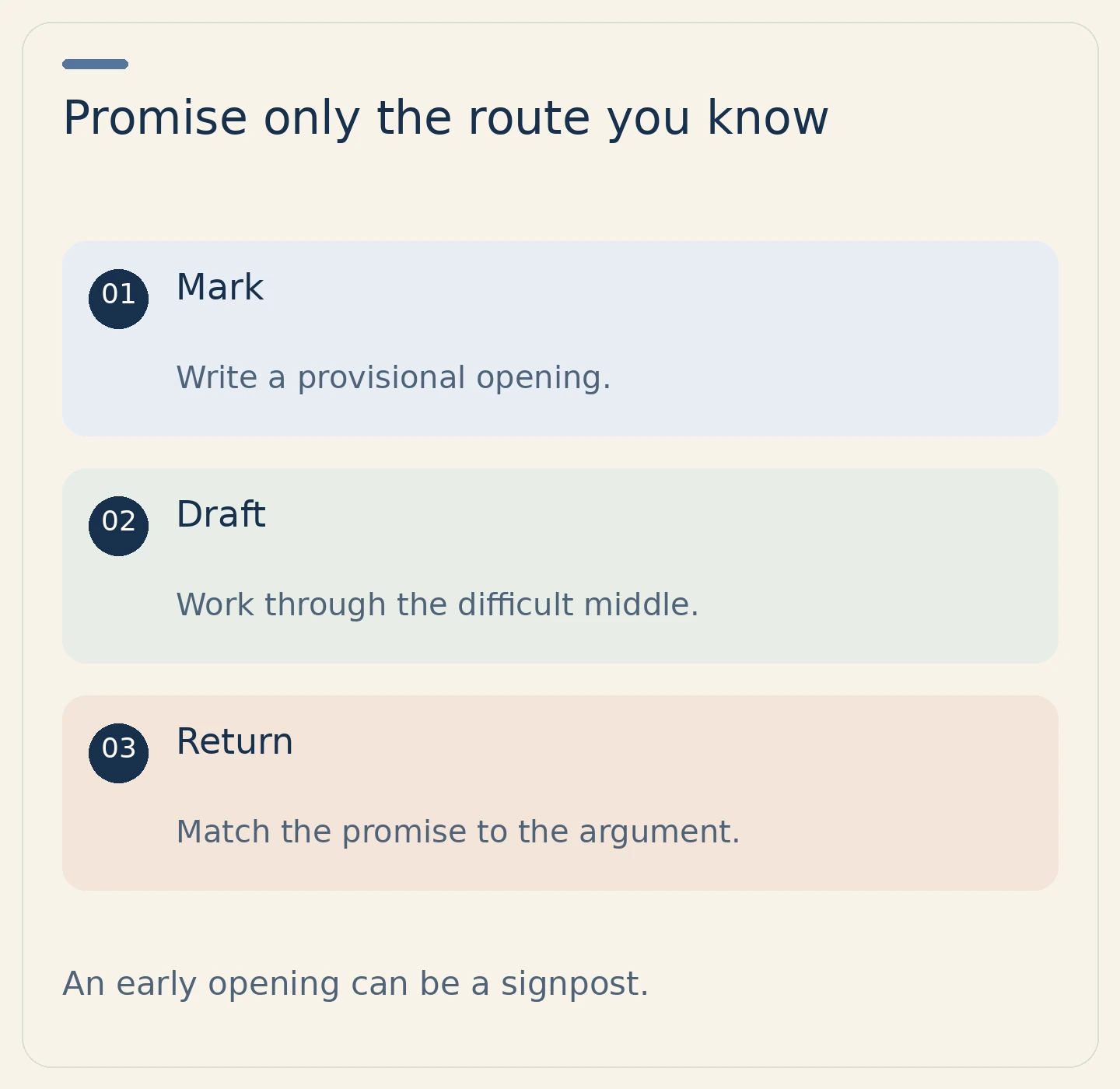
An introduction has a real task: it offers a question, a direction, and a reason to continue. But that task can become difficult when the route is still being discovered. Polishing the promise too early may encourage the writer to defend an initial plan after the essay has found a better question. The opening begins to govern the inquiry instead of introducing what the inquiry actually became.
A provisional promise
One small experiment is to replace the demand for a finished introduction with three temporary sentences. The first names the subject, the second identifies the unresolved problem, and the third describes the route the writer currently expects to take. These sentences are working signs, not a formula for the final opening. Their value is that they are clear enough to guide drafting and light enough to change.
In the imagined essay, the subject could be access to a shared garden. The initial problem might seem to be opening hours. Drafting the comparison, however, could reveal that the stronger issue is who can participate in decisions about those hours. A temporary introduction can absorb that discovery. A polished opening built around a vivid image of a locked gate may be harder to release, even if the essay no longer centers on physical entry.
Let the middle earn the opening
The middle of an essay does more than fill the space between an introduction and a conclusion. It tests whether the proposed relationships can be explained. A distinction that sounds persuasive in a first paragraph may become unstable when applied to a specific example. An apparently secondary point may turn out to be the condition on which the argument depends. These discoveries deserve influence over the opening.
After drafting the difficult section, the writer can return with a narrower question: does the introduction prepare a reader for what the essay now does? That is different from asking whether it sounds impressive. A modest beginning that accurately names a problem can be more inviting than an elegant opening whose promise the rest of the piece has quietly abandoned. Accuracy of invitation is part of style, not an alternative to it.
Not a rule to write backward
Some writers need an opening to discover their rhythm or understand the scope of the task. Others are writing under time constraints that do not allow a long return to the beginning. In those circumstances, an early introduction can be necessary and useful. The distinction is not between a correct order and an incorrect one. It is between an opening treated as revisable and an opening treated as a contract the evidence must obey.
A timed response may need a compact initial direction and a brief final check rather than a fully postponed introduction. A long exploratory essay may benefit from more substantial reworking. Neither situation makes early writing wasted. Even an opening that disappears can help define what the final version should not promise. Its provisional status protects the inquiry from the expectation that the first clear sentence must remain the governing one.
A beginning that has listened
The imagined garden essay might eventually open with a small decision about who gets to set a timetable, rather than with the locked gate. The new beginning is not necessarily more dramatic. It is closer to the question the essay can now sustain. The reader meets the work at the right entrance, while the discarded opening remains part of the path by which the writer found it.
An introduction written or revised late has an unusual advantage: it can speak with knowledge of what follows. But the deeper lesson is not chronological. A beginning needs to listen to the work it introduces. When it does, its confidence comes less from sounding certain at the outset and more from making a promise the rest of the essay has genuinely learned how to keep.