
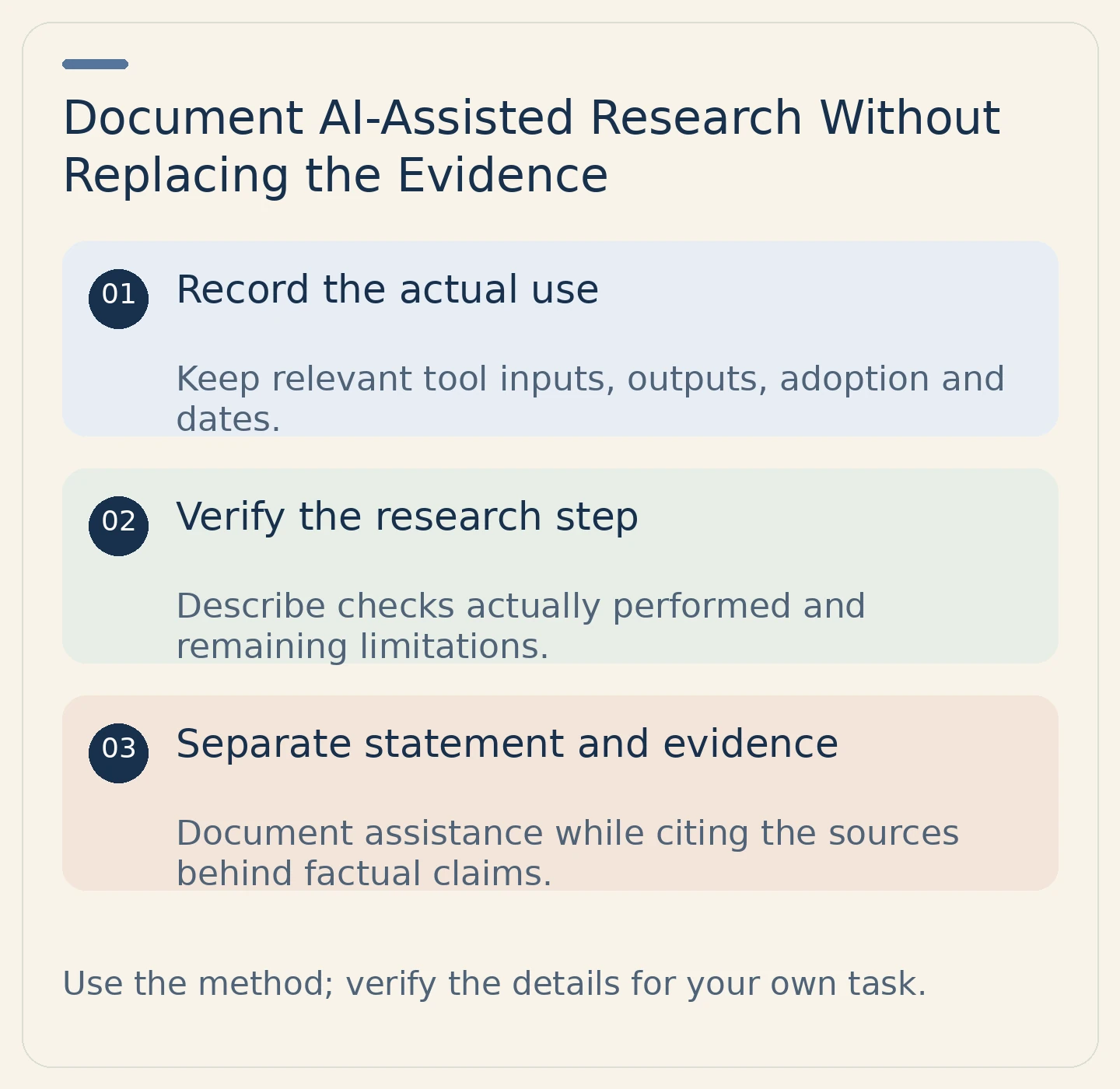
AI assistance in research can affect more than the wording of a paper. It may suggest search terms, explain a concept, produce code or help classify material. To document it accurately, separate what the tool did from what you verified and what the evidence establishes. A tool-use statement is not a substitute for a research method, and neither replaces references to the actual sources supporting your claims.
Identify the rules governing this project
Check the course, institution, supervisor, research protocol and intended journal requirements that actually apply. Record permitted activities, restrictions on data sharing and required disclosure locations. Do not assume that rules for coursework, a thesis and a journal manuscript are interchangeable.
The ICMJE’s guidance on AI use by authors provides a specific example for medical publishing: it calls for disclosure and human responsibility and says AI tools should not be authors. Those are requirements in that guidance, not a claim that every discipline has identical submission procedures. Consult your actual destination’s current instructions before applying a concrete rule.
Maintain three distinct records
| Layer | What it explains | What it does not replace |
|---|---|---|
| Tool-use record | Tool, date, task, relevant input/output and adoption | Evidence that the output is correct |
| Method explanation | How the tool affected a research procedure and how you checked it | The procedure’s underlying rationale and limitations |
| Evidence references | The publications, data or materials supporting claims | Disclosure of how AI influenced the work |
Keep the records proportionate to the actual use and required standard. Preserve meaningful prompts, outputs, versions and decisions where appropriate, without uploading restricted material or sharing private information merely to create a fuller-looking appendix. Do not claim to have retained a transcript if only a brief note exists.
Verify literature leads at the source
Treat an AI-suggested title, quotation or DOI as a lead to investigate. Locate the real work, confirm its bibliographic identity and read the relevant material. Check the precise claim, not just whether the reference resolves. Record actual locations and distinguish your summaries from exact language.
The MLA’s guidance on describing AI use advises reading and citing the underlying source rather than treating a generated account as equivalent to that source. If you cannot locate or verify the material, do not put it into the paper as evidence. A convincing citation format does not repair a nonexistent or irrelevant reference.
Explain code or classification assistance concretely
For code, record what was generated or changed and the checks you actually ran. Depending on the project, these might include inspecting the logic, testing known inputs or comparing an output with a trusted calculation. These are possible verification methods, not a claim that any were performed or a universal validation standard. Describe unresolved uncertainty rather than writing “the code was verified” without detail.
For classification, retain the categories, instructions, relevant version information, actual checking procedure and changes made after inspection. If only part of the material was checked, state that scope. Do not invent a validation sample, accuracy figure or agreement statistic to make the method appear complete.
Illustrative documentation structure: “The tool suggested [specific processing step]. I checked it by [actual procedure], found [actual result] and changed [what changed]. The remaining limitation is [what remains].” This is a fillable structure, not a report of completed research.
Distinguish studying an output from trusting it as evidence
There are cases where AI output itself is the object of analysis or where the applicable style requires documenting an output. Follow the relevant instructions and preserve the material needed to identify what was examined. That does not make its factual assertions verified knowledge.
If your project analyzes generated responses, explain how they were collected and what conclusions that material can support. If a tool merely helped you find a scientific claim, cite verified scientific evidence for the claim and document the assistance separately. Do not assume that every use belongs in the same reference-list format.
Write only the disclosure your records support
Describe the tool’s actual contribution, the parts affected and the human checks performed. Use the required location: methods, acknowledgment, appendix, submission declaration or another specified channel. Do not borrow a language-only statement if the tool also influenced analysis. If use exceeded permission or affected an approved protocol, ask the responsible supervisor or authority how to proceed.
Final research and submission audit
Check source support, quotation accuracy, method transparency, limitations and required disclosures. Confirm that claims remain yours to explain and defend. If report access is permitted, remember that similarity and AI indicators are different and cannot establish compliance alone. Inspect the final files and retain genuine records and confirmation. Turnin does not replace the institution’s or publisher’s official process.
Related practical guides
For a separate evidence check, use the citation readiness guide; for the final handoff, use the pre-submission checklist. These are supplementary resources, not your institution’s submission system or policy.
Sources and scope
Further reading: MLA: Beyond Citation: Describing AI Use in Your Work; ICMJE: Use of AI by Authors; University of Toronto: How Not to Plagiarize. Institutional examples apply to their own settings; follow the requirements governing your work.