
An example earns its place when it can surprise the person using it. If it only makes an abstract claim look friendly, it may leave the hardest part of the reasoning untouched. The moment the example stops fitting can be the moment it begins to teach something: a condition was missing, a category was too broad, or the argument was asking one scene to prove too much.
A queue that will not stay simple
Consider an explicitly imagined discussion of fairness. Someone offers a queue as an example: people should be served in the order they arrive. The arrangement is easy to picture, and the principle sounds clear. Then a person with a prior appointment enters. Does fairness require placing them at the back, or does the appointment create a different legitimate order?
Now introduce an urgent need. Serving that person first may be fair even though it breaks arrival order. The queue has not become useless. It has exposed the limits of a claim that initially looked self-evident. First come, first served can be a fair procedure under some conditions without being a complete account of fairness in every setting where people wait.
Change one thing, not everything
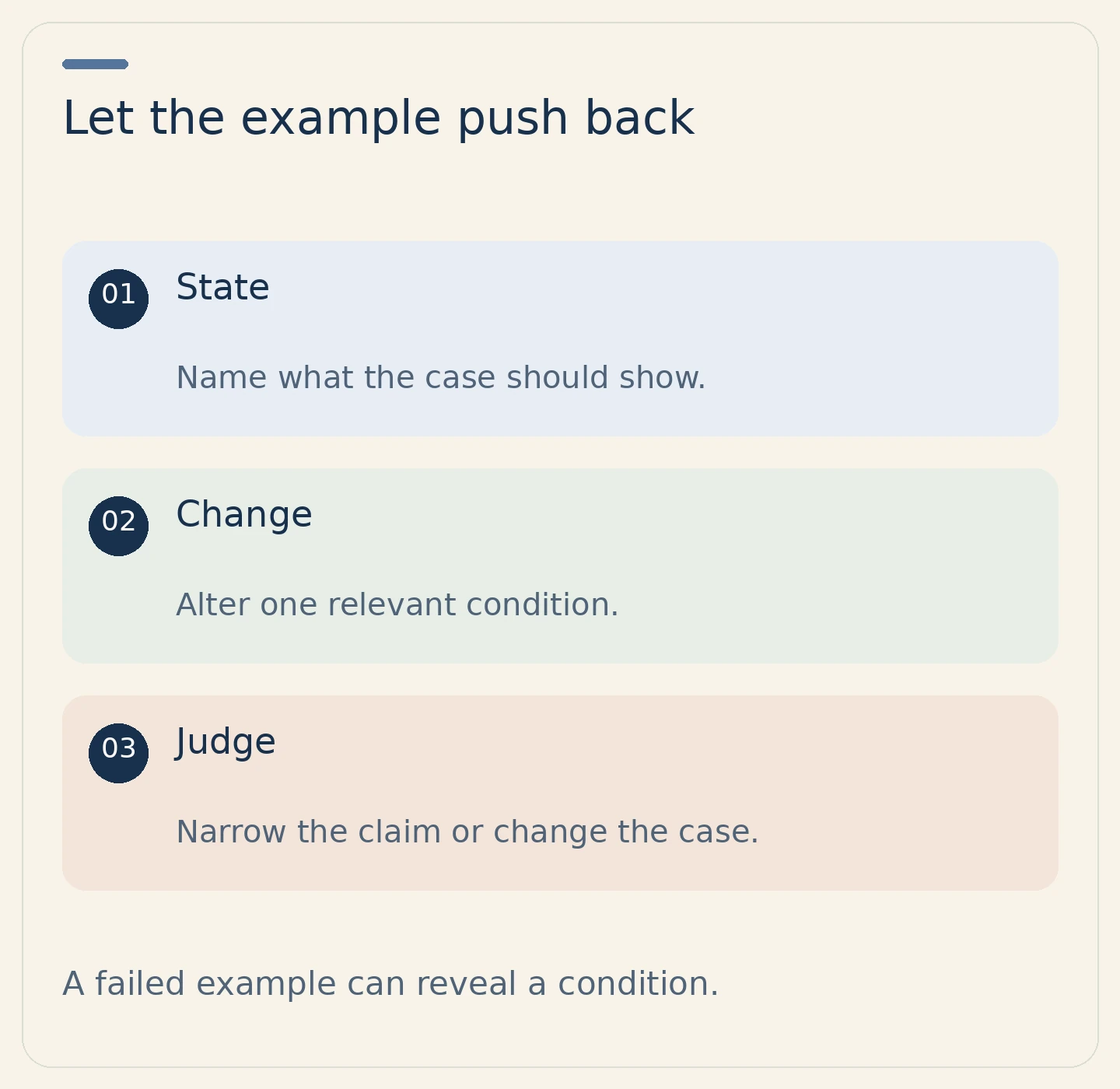
A useful experiment begins by stating what the example is meant to show. Perhaps the intended point is that a public rule can reduce arbitrary preference among otherwise comparable claims. Then change one relevant condition while keeping the rest of the scene stable. A prior appointment tests one assumption; an urgent need tests another. Changing both at once makes it harder to see why the judgment moves.
This discipline keeps examples from turning into a contest of dramatic exceptions. The point is not to invent an increasingly extreme scenario until every principle collapses. It is to locate the ordinary boundary the original example quietly depended on. If the arrival-order rule assumes comparable needs and no prior entitlement, those assumptions should become visible in the explanation rather than remain hidden in the simplicity of the scene.
The revised claim may now be less sweeping and more useful. Arrival order is one defensible way to allocate service among people whose claims are relevantly similar. The phrase relevantly similar introduces further work, but it is work the original statement already owed. The failed example has not created unnecessary complexity. It has uncovered complexity that a familiar image made easy to overlook.
Writing down the changed condition helps preserve this discovery. Without it, the writer may remember only that the example became confusing and abandon it too soon. The useful result is more exact: this rule worked until a particular feature altered the basis on which claims should be compared.
Narrow the claim or replace the example
There are at least two responsible responses when a case resists an argument. One is to narrow the claim so that it accurately describes what the example supports. Another is to recognize that the example concerns a different issue and choose a better one. Keeping the original claim while repeatedly explaining away the case can protect the wording at the expense of the thought.
Not every objection deserves a full retreat. A case may depend on an unusual feature outside the argument's intended scope. Then the writer can state that scope and explain why the feature does not bear on the question. The important thing is that the limit be reasoned rather than convenient. Scope should identify where the claim applies, not move whenever an inconvenient example appears.
An illustration with a second job
In the imagined discussion, the queue can remain, but its role changes. It no longer serves as a cheerful picture of fairness already settled. It becomes a compact way to distinguish consistent procedure from justified priority. A reader can follow the initial rule, see why it is attractive, and then understand why appointments or urgent needs might require something more than consistency.
This is why an awkward example may deserve more attention than a perfect one. A perfect fit can make the author feel that the concept has been mastered while leaving its boundaries unexamined. A resistant case asks the writer to decide what really matters. Once that decision is visible, the abstract idea is not merely easier to picture. It is more accurately understood, including the places where it should stop.