
The passage with the best view
Imagine an essay about whether a neighborhood walking route needs clearer signs. Its opening describes a distant train journey: mist against the window, a missed connection, the relief of recognizing a station name. The paragraph is carefully made. It also takes the reader somewhere the essay never returns. By the time the actual route appears, the small, interesting question about signs has begun to seem like an interruption.
The writer hesitates to remove the opening because it contains the most satisfying sentences in the draft. That hesitation is understandable. Those sentences may have been where the writing first became possible. Yet a passage can help its writer begin without helping its reader proceed. Its importance in the history of the work is different from its function in the work now.
Two kinds of value
Revision becomes painful when these values collapse into one. If the paragraph cost an afternoon, removing it can feel like declaring the afternoon wasted. But effort is not a claim on the reader's attention. The reader cannot repay the labor by finding a connection that the essay has not established. Asking the paragraph to justify its place is not asking the writer to justify having written it.
There is another value worth protecting: discovery. The train scene might have revealed that the real concern is not signs themselves but the vulnerability of being unfamiliar with a place. That insight could inform the essay even if the scene disappears. Sometimes a draft needs to pass through a larger experience before it can identify a smaller question. The discarded language has already done something useful.
Make removal reversible
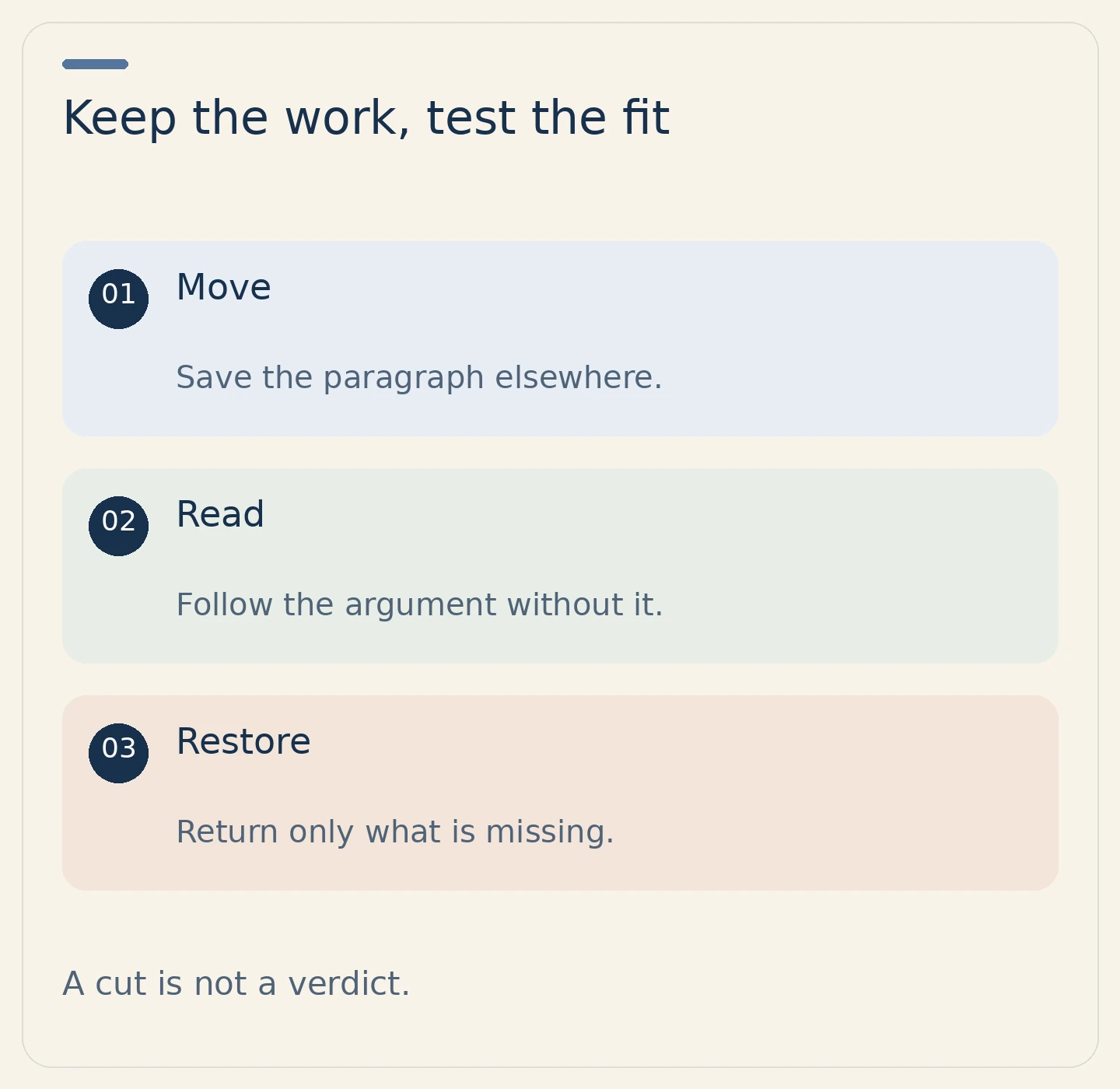
A separate file changes the practical terms of the decision. Instead of deleting the passage forever, the writer moves it into a collection of unused material. This is not a promise that every saved sentence will find a home. It simply separates the present question, whether the paragraph belongs here, from the unnecessarily dramatic question of whether it deserves to exist anywhere.
Then comes a more revealing experiment: read the two paragraphs that now meet. What information has actually vanished? Perhaps the later reference to unfamiliar travelers has lost its explanation. Perhaps nothing has vanished except atmosphere. Naming the loss precisely matters. A missing condition can be restored in one sentence. A general sense of bereavement cannot tell the writer how much space the argument needs.
The saved file also needs permission to remain unused. Otherwise the writer has only moved the burden: every cut becomes a debt owed to some future essay. Preserving a passage can make the present decision gentler without creating an obligation to publish it later.
Beauty is not the problem
It would be easy to turn this into a rule against lyrical openings. That would confuse relevance with plainness. A vivid scene can establish stakes that an abstract introduction leaves lifeless. If the train journey genuinely changes how the neighborhood route is understood, the writer may decide to keep it, shorten it, or build a clearer return to it later. The test is connection, not austerity.
Nor should every moment of pleasure be reduced to a measurable service. An essay has pace, texture, and room for surprise. The question is whether this particular pleasure creates a worthwhile relationship with what follows. Sometimes removing a beautiful paragraph makes a draft thinner rather than stronger. Reversibility lets the writer discover that without defending the original placement out of loyalty or cutting it to prove editorial toughness.
What survives the cut
In the imagined essay, the mist and station platform might stay in the saved file while one thought returns: directions that seem obvious to regular users may be unreadable to a newcomer. The paragraph's useful contribution has not been erased. It has changed scale. The essay can now reach its own question sooner, carrying the insight without carrying the entire journey that produced it.
There is a quieter kind of ownership in that choice. Writing feels like one's own not because every hard-won sentence remains visible, but because the decisions are responsive to the work in front of the reader. A saved passage can still be cherished. It no longer has to occupy the entrance simply because it once opened a door for the writer.