
One word, a whole judgment
A single why in the margin can feel heavier than a page of praise. In an imagined draft, it sits beside the sentence that residents need a different meeting time. The writer has explained that attendance was low and assumed the recommendation followed. The comment feels like a challenge to competence, although its actual content is much smaller: a reader has not accepted the connection.
That difference does not make the sting disappear. Work can be closely tied to the person who made it, especially when the effort behind it is invisible. But the first reaction need not determine the next reading. A margin note is a fragment of another person's encounter with the page. It is not a reliable summary of the writer's abilities, motives, or future.
Follow the reader back
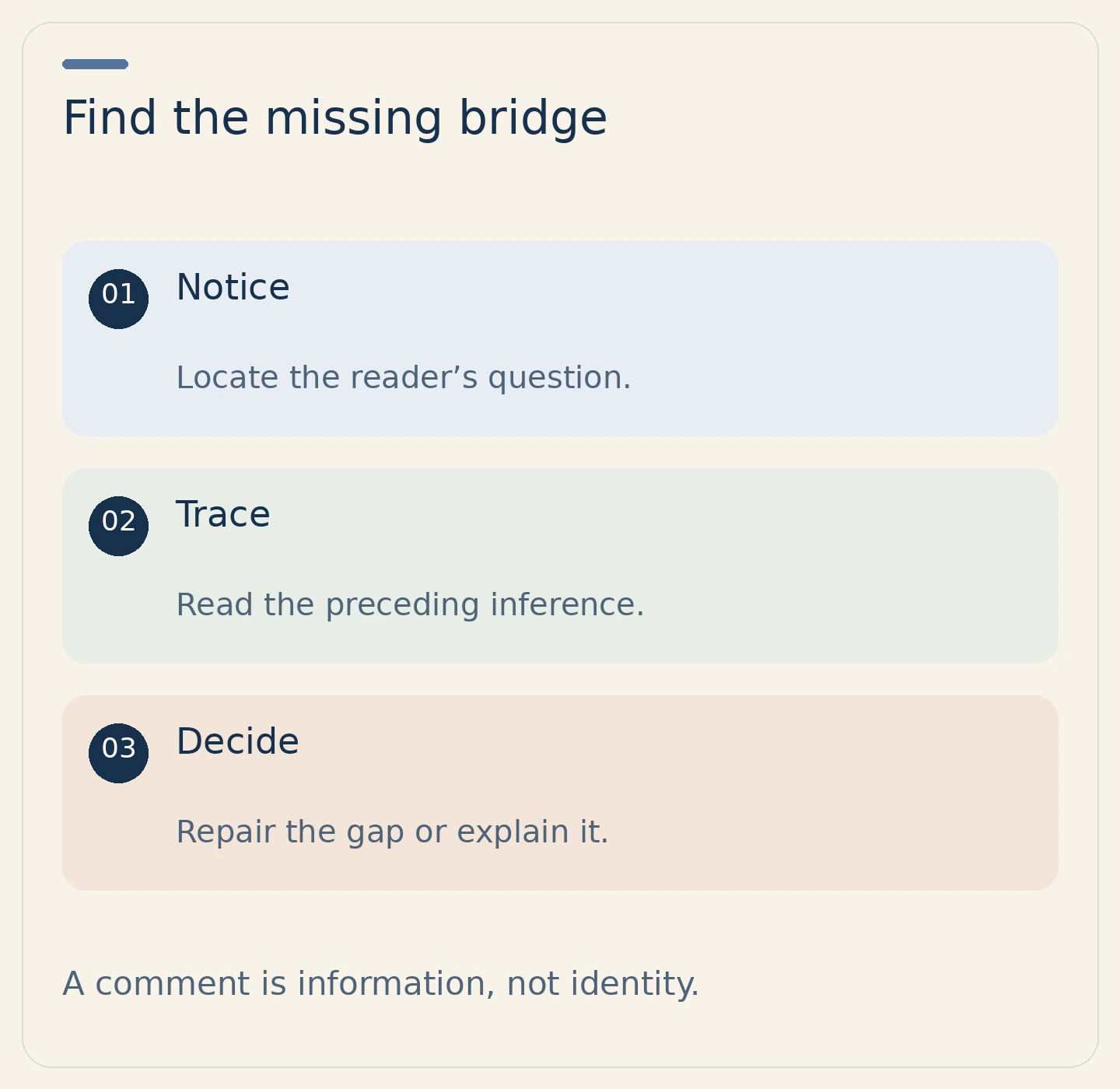
The useful question is where the reader began needing information the draft did not provide. Low attendance could result from timing, but also from an inaccessible venue, an unclear invitation, or a meeting people consider irrelevant. The recommendation may be reasonable; the draft has simply not shown why this explanation should be preferred. The comment reveals an inference that was familiar to the writer and unavailable to the reader.
This is more specific than deciding that the paragraph is bad. It also prevents a defensive response that merely repeats the recommendation more strongly. Adding clearly or obviously would not supply the missing reason. The paragraph needs either support for the timing explanation or a narrower conclusion that acknowledges alternatives. Those are intellectual decisions, not just ways of making the reader stop asking questions.
Try the smallest responsible repair
A modest experiment is to copy the sentence before the comment and the sentence it questions onto a separate page. Between them, write the step that must be true for the conclusion to follow. Then ask whether the draft has established that step. This keeps attention on one connection rather than turning a brief note into a demand to rebuild the whole essay.
In the imagined case, the missing step might be that residents wanted to attend but could not manage the scheduled hour. If there is no basis for that assumption, the responsible revision may be a proposal to investigate timing rather than an assertion that timing is the problem. The comment has not provided the answer. It has identified the place where the writer needs to make a choice.
The reader can be mistaken
Feedback is evidence, not an order. A reader may overlook a qualification, misunderstand the task, or prefer a different argument. Accepting every suggestion can produce a draft whose sentences satisfy individual comments but whose overall purpose has dissolved. The writer remains responsible for deciding which changes preserve or improve the work. Respect does not require surrendering the question the essay is trying to address.
Even a mistaken comment may reveal something worth considering. If the relevant explanation appears much later, perhaps its placement asks too much of a first reading. Yet sometimes the reader genuinely missed a plainly stated connection. In that case, leaving the passage unchanged can be a defensible choice. What matters is being able to explain the decision through the draft, rather than through resentment or a wish to seem agreeable.
A less lonely kind of revision
The margin becomes easier to use when it is treated as a meeting point between two routes. The writer arrives with hours of thinking, discarded alternatives, and an intended destination. The reader arrives with only the sentences provided. A comment records the moment these routes diverge. It may be incomplete or abrupt, but it can still help locate a difference that silent rereading would leave hidden.
This perspective does not require gratitude for every harsh phrase. It makes a narrower promise: the writer can extract useful information without accepting the comment as an account of the self. In the repaired paragraph, the changed conclusion may be more cautious and more persuasive at once. What has improved is not the writer's worth. It is the relationship between what the page asks a reader to believe and what it actually lets them see.